
Marine Invertebrates
Tiger Cowrie Snail
Cypraea tigrisCypraeidaeSnails
Price: $14.10 USD
Add from My tanks →1 photos
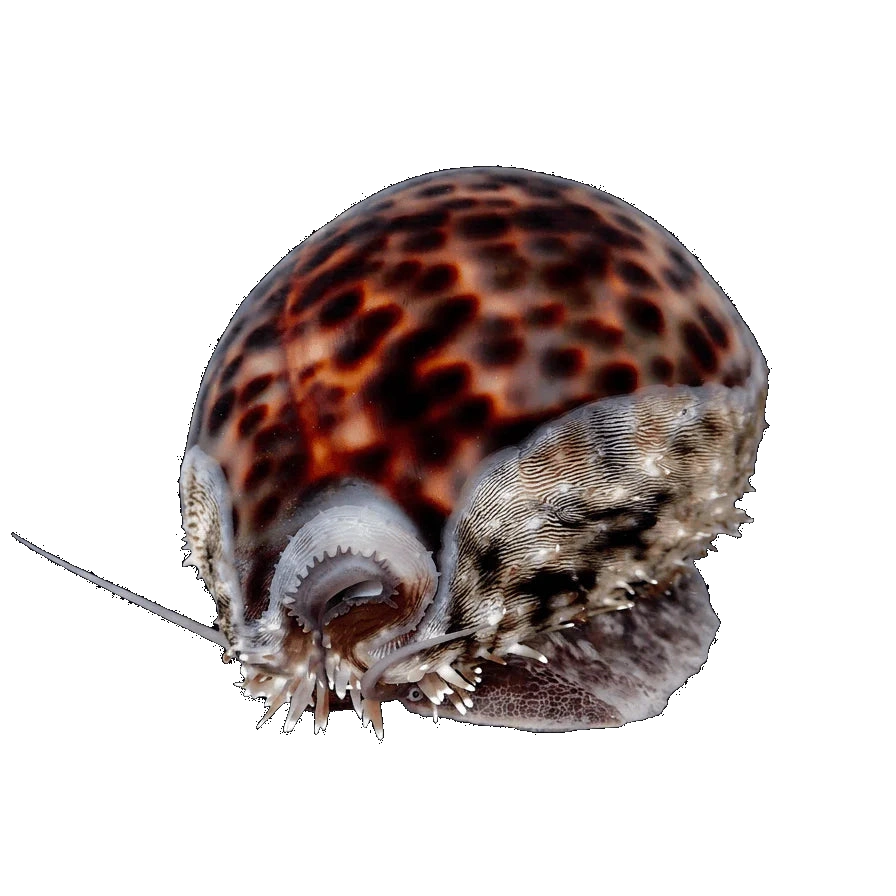
The Tiger Cowrie has an egg-shaped spotted glossy shell, normally completely covered by its fingerprint-like black and gray mantle unless threatened. It hides under rocks or rests on soft corals by day and forages at night; while small it eats algae and scavenges, but as an adult it may eat anemones, sponges, and soft corals, so house with starfish, urchins, and tubeworms, not with Condylactis anemones; needs low nitrates and no copper; supplement large specimens with fish and mussel pieces.
Quick facts
Identity
- Synonyms
- Cypraea tigris tigris
- Environment
- Saltwater
- Native to
- Indo-Pacific, East Africa to Hawaii
- Habitat
- Tropical reef flats and lagoons, under rocks, in crevices, or resting on soft corals and sponges by day
- Sourcing
- Wild-caught
- Conservation
- Not Evaluated
Care
- Care level
- Easy
- Temperament
- Peaceful
- Adult size
- 1.5 – 4 in (3.8 – 10 cm)
- Lifespan
- 5 – 10 yrs
- Min tank
- 90 gal (341 L)
- Growth rate
- Slow
- Placement
- Rock & glass
Water
- Temperature
- 72 – 78 °F (22 – 26 °C)
- pH
- 8.1 – 8.4
- dKH
- 8 – 12 dKH
- Salinity
- 1.023 – 1.025 SG
- Flow
- Low-Moderate
Behavior & compatibility
- Social
- Solitary
- Aggression to own kind
- Low
- Active
- Night
- Reef safe
- With caution
- Invert safe
- With caution
- Shrimp safe
- With caution
- Clean-up role
- Algae, Detritus, Leftover food
- Population boom risk
- Low
Feeding & breeding
- Diet
- Omnivore
- Foods
- Frozen, Algae, Biofilm
- Breeding type
- Broadcast spawner
- Breeding difficulty
- Not bred in captivity
- Sexing
- Not externally distinguishable with confidence; some sources note males tend to be smaller than females
- Target feeding
- Beneficial
Something wrong or missing? Submit a correction
Care guide
Overview
A large marine gastropod prized for its glossy, egg-shaped shell mottled with brown and cream spots, usually cloaked by a black-and-gray mantle that withdraws when disturbed. By day it shelters beneath rock and coral, emerging at night to forage; adults turn increasingly carnivorous and require careful tankmate selection.
Care
This large cowrie needs a mature, well-established reef tank with plenty of live rock offering caves and overhangs to retreat into during the day. It is sensitive to copper-based medications and does not tolerate elevated nitrates, so stable water quality is essential. As it grows and moves around the tank at night, it can topple loose rockwork or unsecured corals, so aquascape should be built on the substrate rather than stacked precariously.
Feeding
Juveniles graze on algae and biofilm, but adults shift toward a mostly carnivorous diet and will scavenge leftover meaty foods as well as prey on sponges, soft corals, and anemones. Large specimens benefit from supplemental feedings of chopped fish, clam, or mussel to keep them from targeting desirable reef inhabitants. Feeding is best done at night or dusk when the snail becomes active and begins foraging.
Tank mates
Best paired with peaceful tankmates such as starfish, sea urchins, and tubeworms rather than soft corals, sponges, or anemones that it may eventually eat. Condylactis anemones in particular should be avoided as known prey items. Because of its size and blundering movement at night, it is unsuitable for tanks with delicate or top-heavy coral placements.
Breeding
In the wild, females deposit egg masses and guard them until they hatch into planktonic larvae that eventually settle and metamorphose. Captive breeding has not been achieved in the aquarium hobby, and essentially all specimens in the trade are wild-collected. There is no established method for inducing spawning or rearing larvae at home.
Health
Tiger cowries are generally hardy when kept in mature systems with good water quality, but they are notably intolerant of copper-based medications and elevated nitrate levels. Sudden exposure to poor water conditions or medicated dips intended for fish can be fatal. A damaged or retracted mantle that fails to re-extend over the shell can be a sign of stress or declining health.
Sources
More Snails
Something wrong or missing? Submit a correction
In the community
Popular tanks using Tiger Cowrie Snail
No public tanks are showcasing Tiger Cowrie Snail yet.