
Marine Invertebrates
Bumble Bee Snail
Pusiostoma mendicariaColumbellidaeSnails
Price: $2.12 USD
Add from My tanks →1 photos
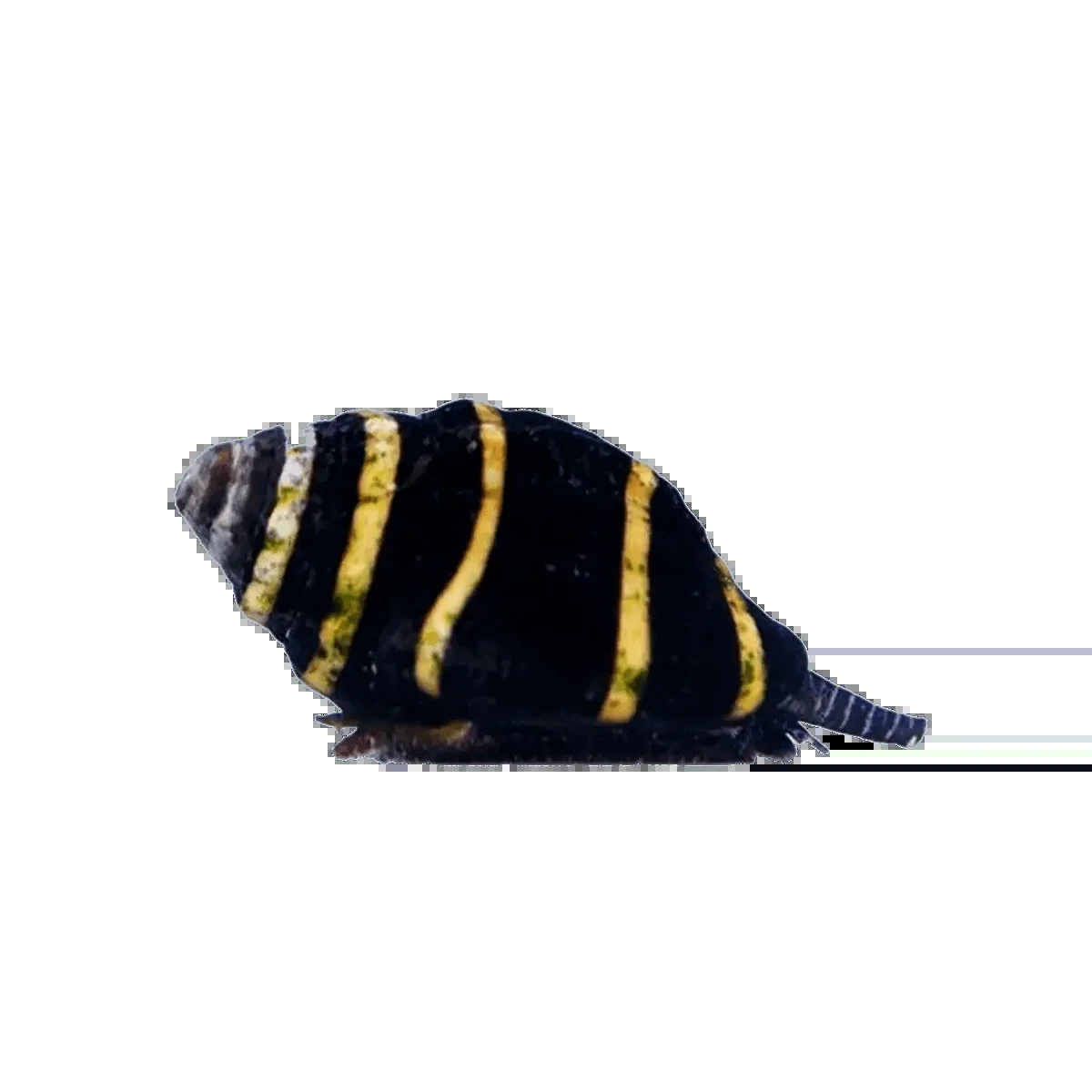
The tiny Bumble Bee Snail (Pusiostoma mendicaria) has a striking black shell striped with elegant white to yellow bands and can get into small crevices and tight rockwork to clean away detritus, uneaten meaty foods, and decomposing organisms, also burrowing into sand beds and consuming sand-dwelling worms while aerating substrate. It is a peaceful carnivore but may feed on other snails or polychaetes if food is insufficient; supplement with chopped brine or mysis shrimp if needed, and it is sensitive to copper, high nitrates, and water parameter fluctuations.
Quick facts
Identity
- Also known as
- Whelk Snail; Engina Snail
- Synonyms
- Engina mendicaria
- Environment
- Saltwater
- Native to
- Indo-Pacific, Marshall Islands, Florida, Kenya
- Habitat
- Shallow rocky intertidal shorelines and reef flats, foraging over rock and sand for detritus and organic matter
- Sourcing
- Wild-caught
- Conservation
- Not Evaluated
Care
- Care level
- Easy
- Temperament
- Semi-Aggressive
- Adult size
- 0.3 – 1 in (0.6 – 2.5 cm)
- Lifespan
- 2 – 5 yrs
- Min tank
- 10 gal (38 L)
- Growth rate
- Slow
- Placement
- Bottom
Water
- Temperature
- 72 – 78 °F (22 – 26 °C)
- pH
- 8.1 – 8.4
- dKH
- 8 – 12 dKH
- Salinity
- 1.023 – 1.026 SG
- Flow
- Low-Moderate
Behavior & compatibility
- Social
- Solitary
- Aggression to own kind
- Low
- Active
- Night
- Reef safe
- With caution
- Invert safe
- With caution
- Shrimp safe
- With caution
- Clean-up role
- Detritus, Carrion, Sand sifting, Pest control
- Population boom risk
- Low
Feeding & breeding
- Diet
- Carnivore
- Foods
- Frozen, Live
- Breeding type
- Broadcast spawner
- Breeding difficulty
- Not bred in captivity
- Sexing
- Sexes not externally distinguishable
- Target feeding
- Beneficial
Something wrong or missing? Submit a correction
Care guide
Overview
Burrows through sand beds by day and forages rockwork crevices after dark, hunting detritus, meaty leftovers, and small worms rather than algae. Its black shell carries alternating cream to yellow bands. Best suited to mature, established reef systems with sand for cover, stable parameters, and no copper exposure.
Care
This small whelk snail is best kept in a mature, fully cycled system with live rock and a sand bed to forage through. It spends daylight hours hidden in rockwork or buried in substrate, emerging mainly at night to search for food, so sightings are infrequent. Stable water parameters are important, as it reacts poorly to sudden shifts in salinity, temperature, or nitrate levels, and copper exposure of any kind is fatal.
Feeding
In the wild and in aquariums this snail feeds primarily on detritus, carrion, and uneaten meaty foods rather than algae or biofilm. If the tank is very clean and lacks sufficient scraps, it will turn to hunting small worms, tiny snails, or bristleworms, and occasionally weakened sessile invertebrates. Supplementing with small pieces of frozen mysis or brine shrimp during target feeding helps prevent it from preying on more desirable tankmates.
Tank mates
Generally compatible with peaceful reef fish and most corals, since it does not graze on coral tissue under normal conditions, though it may nip at zoanthids, small polyps, or feather duster worms if food is scarce. Avoid pairing with aggressive predators such as certain wrasses, hawkfish, triggers, or large hermit crabs that may attack or out-compete it for food. Stocking density is usually limited to about one snail per 10-25 gallons to ensure enough natural detritus is available.
Breeding
Captive breeding has rarely been documented and is considered very difficult to achieve intentionally. Reproduction is thought to depend on ample and consistent food availability, but larvae and rearing requirements are poorly understood in home aquariums. Most specimens in the trade are wild-collected rather than a result of captive spawning.
Health
Most losses stem from poor acclimation, starvation in overly clean systems, or predation by tankmates, rather than disease. A snail that stays inactive for long periods, fails to respond to food, or shows a gaping operculum is likely in distress. Copper-based medications must never be used in a system housing this species, and stable alkalinity and calcium levels help maintain healthy shell growth.
Sources
More Snails
Something wrong or missing? Submit a correction
In the community
Popular tanks using Bumble Bee Snail
No public tanks are showcasing Bumble Bee Snail yet.