
Marine Invertebrates
Mexican Turbo Snail
Turbo fluctuosaTurbinidaeSnails
Price: $3.53 USD
Add from My tanks →1 photos
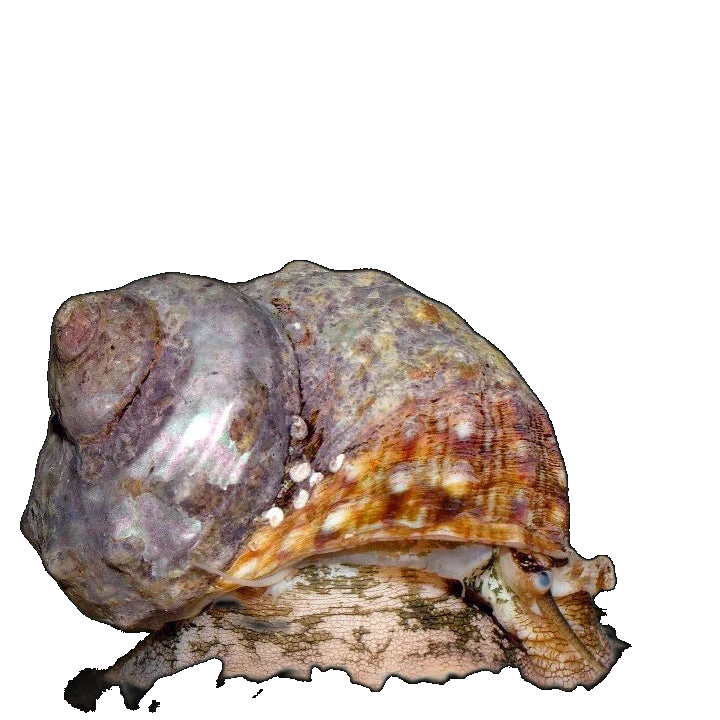
The Mexican Turbo Snail (Turbo fluctuosa), also called the Turban or Top Shell Snail, is native to the Gulf of California off Mexico and is prized for eliminating large amounts of nuisance hair algae. It has a thick turban-shaped shell, needs secured rockwork since it bulldozes loose rocks, adequate calcium for its shell, and drip acclimation due to sensitivity to copper medications and high nitrates.
Quick facts
Identity
- Also known as
- Turban Snail; Top Shell Snail; Trochus Snail; Gulf Turban; Eastern Pacific Turban; Wavy Turban
- Synonyms
- Turbo fluctuosus
- Environment
- Saltwater
- Native to
- Mexico (Gulf of California), Baja California, Peru, Galapagos Islands
- Habitat
- Intertidal to shallow subtidal rocky reef shores, 2-40 ft depth, sheltering under rocks and dead coral among crevices and boulders on mud, sand, or rubble substrate
- Sourcing
- Wild-caught
- Conservation
- Not Evaluated
Care
- Care level
- Easy
- Temperament
- Peaceful
- Adult size
- 0.8 – 2.5 in (1.9 – 6.4 cm)
- Lifespan
- 2 – 5 yrs
- Min tank
- 20 gal (76 L)
- Growth rate
- Slow
- Placement
- Bottom
Water
- Temperature
- 72 – 78 °F (22 – 26 °C)
- pH
- 8.1 – 8.4
- dKH
- 8 – 12 dKH
- Salinity
- 1.023 – 1.025 SG
- Flow
- Moderate
Behavior & compatibility
- Social
- Solitary
- Aggression to own kind
- Low
- Active
- Daytime
- Reef safe
- Yes
- Invert safe
- Yes
- Shrimp safe
- Yes
- Clean-up role
- Algae, Biofilm
- Population boom risk
- Low
Feeding & breeding
- Diet
- Herbivore
- Foods
- Algae, Biofilm, Vegetables
- Breeding type
- Broadcast spawner
- Breeding difficulty
- Not bred in captivity
- Sexing
- Sexes not externally distinguishable
- Target feeding
- Beneficial
Something wrong or missing? Submit a correction
Care guide
Overview
A heavy, whorled turban shell distinguishes this Eastern Pacific grazer, collected wild from the Gulf of California and cooler Baja waters. It forages steadily across live rock for film algae and diatoms, favoring the lower end of reef temperatures, and can topple unsecured rock while foraging. Sensitive to copper and nitrate spikes, it requires drip acclimation and stable calcium levels to protect its shell.
Care
This snail does best in a mature reef or fish-only system with plenty of well-established live rock to graze across. Rockwork should be secured with epoxy or careful stacking, since a hungry specimen can dislodge loose rocks or frags while foraging. It prefers cooler-than-tropical temperatures compared to many reef inhabitants, so it suits systems run on the lower end of the reef range rather than warmer tropical setups.
Feeding
Diet consists mainly of film algae, diatoms, and hair algae grazed directly off rock and glass surfaces. In a newer or very clean tank natural algae supply can run out quickly, so dried seaweed or algae wafers should be offered to prevent starvation. Avoid relying on this species alone to solve a heavy hair algae outbreak, as it works best as one part of a broader cleanup crew.
Tank mates
Tankmates should be peaceful and slow enough not to harass this snail, since it cannot defend itself against aggressive fish or crabs and simply withdraws into its shell when threatened. Avoid wrasses, triggers, puffers, hawkfish, and other known snail predators, and watch hermit crab numbers as they may target the shell if unfed. It generally coexists well with other grazing snails and reef-safe corals, provided coral frags are mounted securely against bulldozing.
Breeding
Breeding has not been achieved in home aquariums, and this species is collected from the wild rather than propagated. Reproduction in nature involves broadcast spawning with planktonic larvae that require open ocean conditions to develop, which is not replicable in a closed system.
Health
The main risks are starvation from insufficient algae, shell erosion from low pH or poor calcium and alkalinity, and stress from abrupt swings in salinity or temperature. Watch for a snail that fails to grip surfaces, falls repeatedly, or shows a gaping operculum, as these are signs of decline. This species is highly sensitive to copper-based medications and elevated nitrate, so it should be moved to a separate system if fish in the display need copper treatment.
Sources
More Snails
Something wrong or missing? Submit a correction
In the community
Popular tanks using Mexican Turbo Snail
No public tanks are showcasing Mexican Turbo Snail yet.