
Aquatic Plant
Crinum Calamistratum
Crinum calamistratumAmaryllidaceaeBulb plants
Price: $15.99 USD
Add from My tanks →1 photos
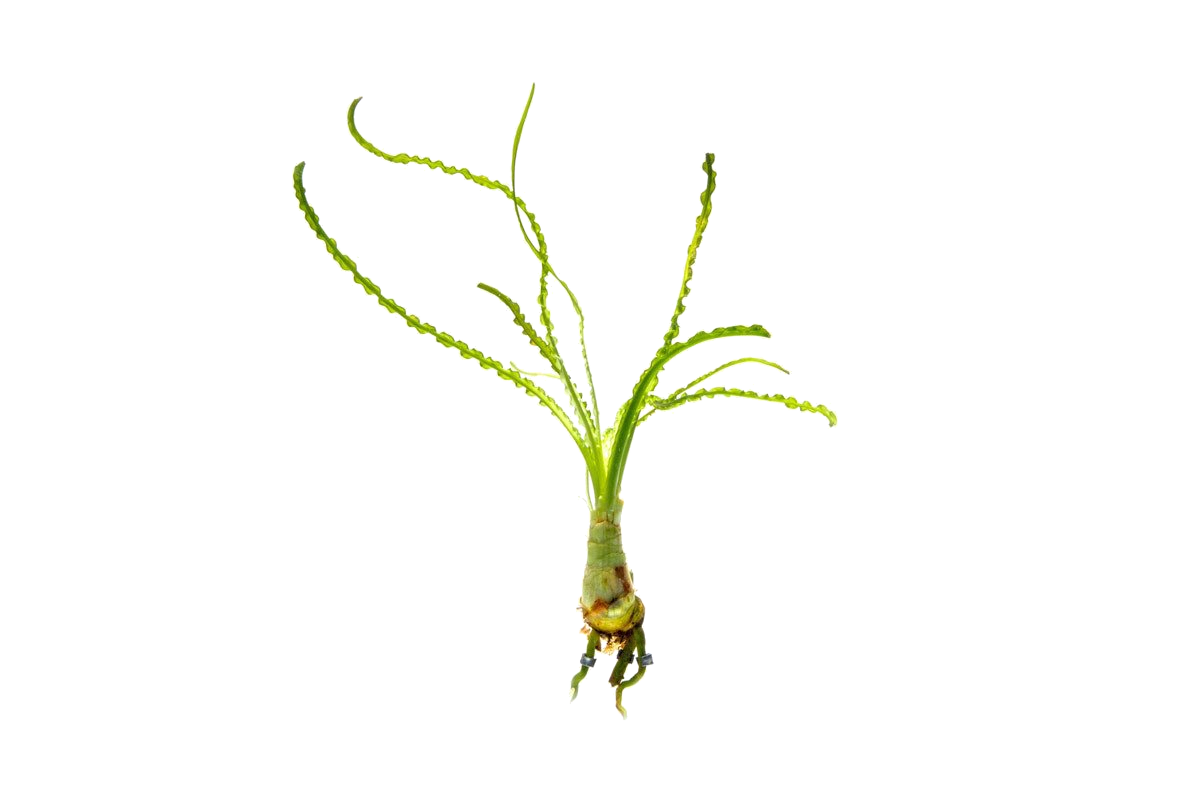
Crinum Calamistratum, from Central Africa, is an interesting bulbous plant with thin, ruffled leaves growing out of an onion-like bulb. One of the smaller Crinum types but still tall enough for a background plant in any tank; slow-growing, CO2 recommended, propagated from daughter bulbs.
Quick facts
Identity
- Also known as
- Ribbon Crinum; Corkscrew Crinum
- Environment
- Freshwater
- Native to
- Cameroon, Central/West Africa
- Habitat
- Slow to moderately flowing freshwater rivers and streams in West-Central Africa, sometimes seasonally exposed or mildly brackish
- Sourcing
- Aquacultured
- Conservation
- Not Evaluated
Care
- Care level
- Moderate
- Growth form
- Bulb
- Max height
- 8 – 40 in (20 – 102 cm)
- Spread
- 16 in (41 cm)
- Growth rate
- Slow
- Placement
- Background, Midground
Water
- Temperature
- 72 – 82 °F (22 – 28 °C)
- pH
- 6.5 – 7.5
- GH
- 5 – 20 dGH
- PAR
- 30 – 80 PAR
- Flow
- Moderate
- Light
- Medium
- CO₂
- Beneficial
Planting
- Substrate
- Nutrient-rich preferred
- Feeds from
- Roots
- Fertilizer needs
- Medium
- Colors
- Green
Feeding & breeding
- Propagation
- Rhizome division
Something wrong or missing? Submit a correction
Care guide
Overview
Suited to larger, patient setups where a single specimen can anchor the background for years without being disturbed. Its narrow, deeply crinkled leaves spiral upward from an onion-like bulb, growing slowly but reaching considerable length under medium-to-bright light. Root feeding and stable placement matter more than water column dosing for steady development.
Care
This slow-growing bulb plant is prized for its long, ribbon-like, deeply crinkled dark green leaves that curl and loop as they extend toward the surface. It is undemanding once established and tolerates a wide range of water hardness, but it dislikes being moved or disturbed after planting, which can cause leaf drop and stalled root growth. Medium to fairly bright light speeds growth and encourages the long leaf form, though the plant survives in shade at a much slower pace. Given its eventual size and wide root spread, it is best reserved for larger aquariums where it can serve as a standalone specimen.
Planting & trimming
Plant the bulb with only its lower half and roots buried in a deep, nutrient-rich substrate, leaving the crown and neck exposed above the substrate line to prevent rot. Choose a permanent spot in the background or midground of a large tank, since the plant resents being uprooted and moved once it has settled in. Trimming is limited to removing old or damaged leaves near the base as needed.
Fertilizing
As an aggressive root feeder, this crinum draws most of its nutrition through a well-developed root system rather than the water column. Root tabs pushed into a nutrient-rich substrate around the bulb support strong, steady growth, and a comprehensive liquid fertilizer helps supply potassium and micronutrients including iron. Pale or thin new leaves usually signal a lack of substrate nutrients rather than a water column deficiency.
Propagation
Mature, well-established plants produce small daughter bulbs around the base of the main bulb over time. Once a daughter bulb has grown two or three leaves of its own along with a small root system, it can be gently separated and replanted as an independent plant. Propagation from seed via flowering is possible but rare in aquarium conditions and much slower than bulb division.
Problems
Leaves are tough and largely ignored by herbivorous fish, so physical damage is uncommon once the plant is settled. The main risk is bulb rot from planting too deep or burying the crown, which cuts off oxygen to the fleshy tissue and can kill the plant outright. Slow growth combined with long-lived leaves means algae can accumulate on older foliage in high-light tanks without adequate CO2 or flow.
Sources
More Bulb plants
Something wrong or missing? Submit a correction
In the community
Popular tanks using Crinum Calamistratum
No public tanks are showcasing Crinum Calamistratum yet.