
Aquatic Plant
Barclaya Longifolia
Barclaya longifoliaNymphaeaceaeBulb plants
Price: $18.99 USD
Add from My tanks →1 photos
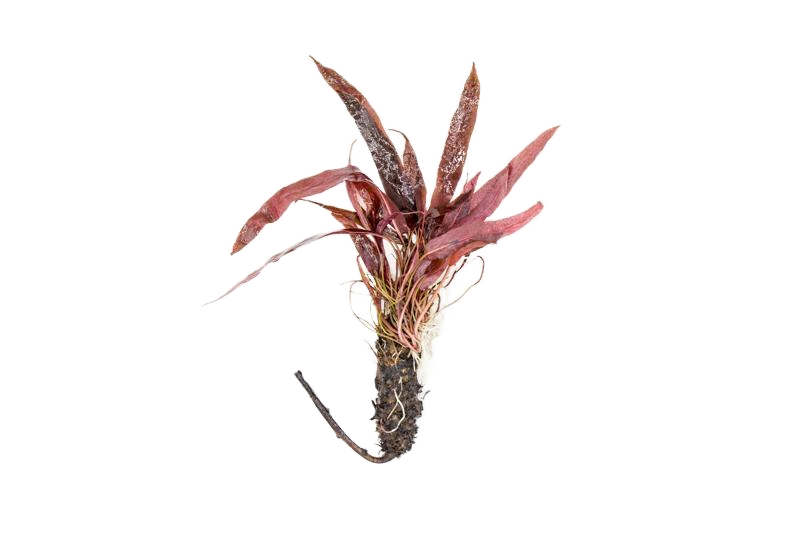
Barclaya longifolia is a rare Asian bulb plant whose long leaves turn deep maroon red under high light with CO2 and fertilizers, growing up to 12 inches. It needs moderate to high light, grows at a medium rate, and is planted with the bulb partially buried in the substrate.
Quick facts
Identity
- Also known as
- Orchid Lily; Red Aponogeton; Burma Conehead; Long-leaf Barclaya
- Synonyms
- Barclaya rubra; Stratiotes longifolius
- Environment
- Freshwater
- Native to
- Thailand, Myanmar, Malaysia, Sumatra, India, Laos, Vietnam
- Habitat
- Clear, warm forest streams, rivers, and shaded creeks with slow to moderate current, over sandy or muddy substrates rich in iron and organic matter
- Sourcing
- Both
- Conservation
- Not Evaluated
Care
- Care level
- Moderate
- Growth form
- Rosette
- Max height
- 4 – 16 in (10 – 41 cm)
- Spread
- 16 in (41 cm)
- Growth rate
- Moderate
- Placement
- Midground, Background
Water
- Temperature
- 75 – 84 °F (24 – 29 °C)
- pH
- 5.5 – 7.5
- GH
- 2 – 10 dGH
- dKH
- 2 – 8 dKH
- Flow
- Low-Moderate
- Light
- Medium
- CO₂
- Beneficial
Planting
- Substrate
- Nutrient-rich required
- Feeds from
- Roots
- Fertilizer needs
- High
- Colors
- Green, Red, Brown
Feeding & breeding
- Propagation
- Seeds, Rhizome division
Something wrong or missing? Submit a correction
Care guide
Overview
Long, undulating leaves take on a deep maroon-red cast under strong light and CO2, fading toward green in dimmer setups, and can reach roughly 12 inches from a partially buried rhizome. It is a root-feeding rosette plant for midground or background placement, tolerant of periodic dormancy but sensitive to repeated uprooting.
Care
Barclaya longifolia grows from a tuberous rhizome that should rest on top of the substrate or be only half buried, since fully covering it invites rot. It prefers warm, soft, slightly acidic water and settles best once planted and left undisturbed, as repeated uprooting causes leaf loss. Periodic dormancy, where the rosette dies back for several weeks before resprouting, is a normal part of its life cycle rather than a sign of poor health.
Planting & trimming
Set the bulb on top of the substrate or bury only the lower half, leaving the crown exposed so it can sprout without rotting; roots will anchor it once growth starts. Give it generous open space since mature leaves spread wide, and avoid transplanting once established as this triggers leaf drop. Confining the roots in a pot keeps the plant more compact for aquascapes with limited room.
Fertilizing
This is a heavy root feeder that benefits from root tabs pushed into the substrate near the rhizome on a regular basis. A weekly dose of liquid fertilizer containing iron supports leaf color and growth, and yellowing or holed leaves usually point to a nutrient shortfall rather than disease. Fertile, iron-rich substrate such as aquasoil or mineral-enriched gravel makes ongoing dosing more effective.
Propagation
Barclaya longifolia is most often propagated from seed, since self-pollinated flowers that reach or stay just below the surface produce seed pods that can be collected and sown in sand. Mature plants may also throw side bulbs or runner offsets that can be separated and replanted once they have developed their own roots.
Problems
The thin, wavy leaves are a favorite snail food and even a small population can leave visible holes, so snail control helps keep the foliage intact. Algae on older leaves usually signals too much light relative to nutrients or weak flow rather than a plant problem, and is best corrected by reducing light duration or intensity and boosting circulation. A short spell of leaf loss after planting or after a dormancy phase is normal and resolves once the plant settles back into stable conditions.
Sources
More Bulb plants
Something wrong or missing? Submit a correction
In the community
Popular tanks using Barclaya Longifolia
No public tanks are showcasing Barclaya Longifolia yet.