Snail
Assassin Snails
Clea helenaNassariidaeAssassin snails
Price: $16.99 USD
Add from My tanks →1 photos
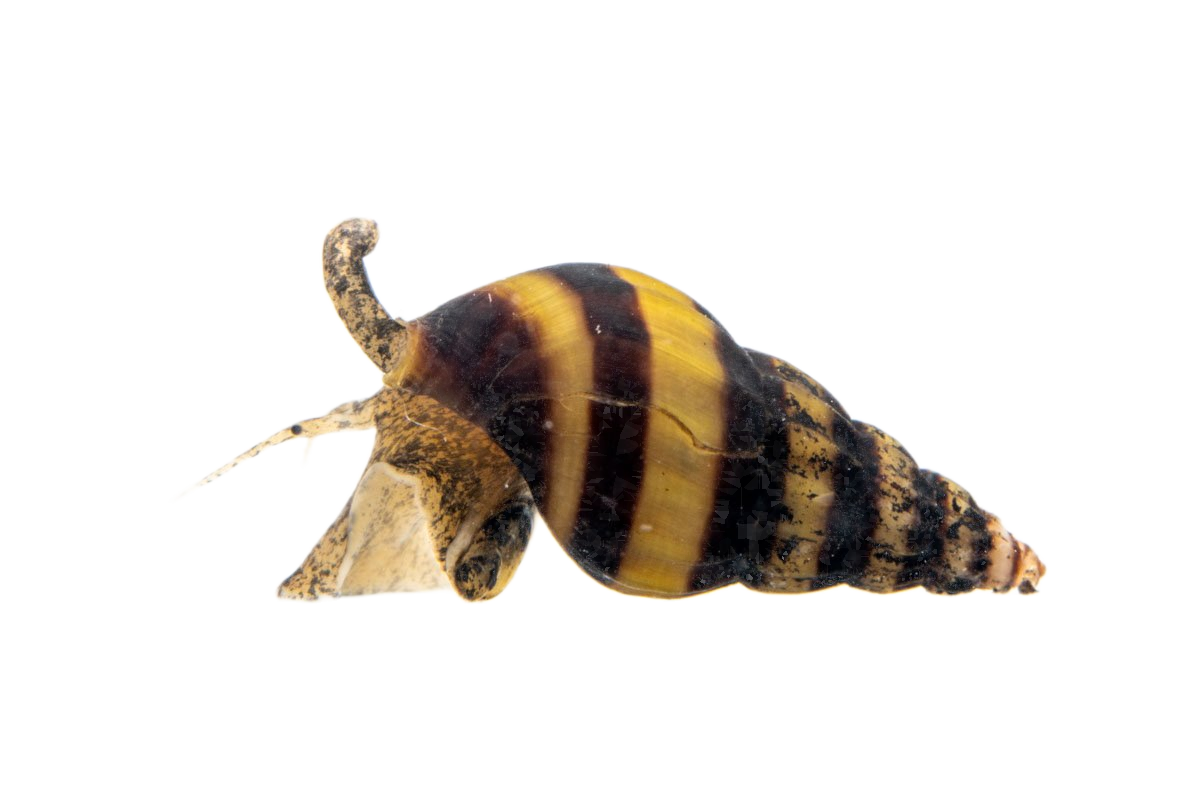
Assassin Snails (Clea helena) are popular carnivorous freshwater snails from Southeast Asia kept for natural pest-snail control, preying on pond, ramshorn, bladder, and Malaysian trumpet snails. They burrow into sand substrate, prefer 75-80F water with a pH of 6.5-8.0, and do best alongside peaceful tank mates.
Quick facts
Identity
- Also known as
- Snail-eating snail
- Synonyms
- Anentome helena
- Environment
- Freshwater
- Native to
- Malaysia, Thailand, Indonesia (Sumatra)
- Habitat
- Rivers, ponds, lakes, and ditches with soft sandy substrate throughout Southeast Asia; tolerant of stagnant water
- Sourcing
- Captive-bred
- Conservation
- Not Evaluated
Care
- Care level
- Easy
- Temperament
- Semi-Aggressive
- Adult size
- 0.3 – 1 in (0.6 – 2.5 cm)
- Lifespan
- 1 – 3 yrs
- Min tank
- 5 gal (19 L)
- Growth rate
- Slow
- Placement
- Bottom
Water
- Temperature
- 75 – 80 °F (24 – 27 °C)
- pH
- 7.0 – 8.0
- GH
- 8 – 12 dGH
- TDS
- 175 – 250 ppm
- dKH
- 4 – 6 dKH
- Flow
- Low-Moderate
Behavior & compatibility
- Social
- Solitary
- Aggression to own kind
- Low
- Active
- Night
- Invert safe
- With caution
- Plant safe
- Yes
- Shrimp safe
- With caution
- Clean-up role
- Pest control, Carrion
- Population boom risk
- Low
Feeding & breeding
- Diet
- Carnivore
- Foods
- Live, Frozen, Pellets, Freeze-dried
- Breeding type
- Direct development
- Breeding difficulty
- Moderate
- Sexing
- Dioecious (separate sexes) but sexes are not visually distinguishable; keep a group to ensure both are present for breeding
- Target feeding
- Beneficial
Something wrong or missing? Submit a correction
Care guide
Overview
Clea helena is a small predatory snail identified by its yellow-and-brown banded shell, which tapers to a pointed spire. It stays buried in sandy substrate by day, emerging mainly to hunt pest snails or take meaty foods. Best kept in groups in mature, moderately hard water for shell health.
Care
Assassin snails do best in a mature, fully cycled tank with a soft sandy substrate they can burrow into during the day. They are undemanding about décor and will also tolerate fine gravel, though sand lets them display their natural ambush-hunting behavior. Water hardness matters more than most parameters since their shells are calcium-based and will erode in very soft, acidic water, so keep the pH on the higher side and the water moderately hard.
Feeding
In the wild these snails hunt other snail species, and in captivity they will readily clear out pest populations of ramshorn, bladder, pond, and Malaysian trumpet snails. Once pest snails are depleted, offer sinking protein-rich foods such as frozen bloodworm, shrimp pellets, or other meaty foods to keep them fed. They hide in the substrate and emerge mainly when they sense food nearby, often surfacing more actively around feeding time.
Tank mates
Peaceful community fish, shrimp, and plants are generally safe, since assassin snails do not target healthy fish or graze on foliage. Avoid combining them with any snail species you want to keep, including trumpet snails and ramshorns, as these are their preferred prey. Very small or slow shrimp may occasionally be at risk, though established adult shrimp are usually left alone.
Breeding
Breeding occurs sporadically in home aquariums rather than on a predictable schedule, and a group of several individuals improves the odds of having both sexes present. Females lay small individual egg capsules on hard surfaces such as glass, driftwood, or plant leaves, and development is direct with no free-swimming larval stage. Hatching takes roughly seven to eight weeks, and population growth is naturally limited once the supply of prey snails runs low.
Health
These snails are generally hardy in a stable, mature tank and have few specific ailments reported in the hobby. Shell erosion or pitting can develop in soft, acidic, or mineral-poor water, so maintaining adequate hardness helps prevent this. Sudden parameter swings or copper-based medications used to treat fish should be avoided, as invertebrates are sensitive to copper.
Sources
Something wrong or missing? Submit a correction
In the community