
Marine Invertebrates
Halloween Hermit Crab
Ciliopagurus strigatusDiogenidaeHermit crabs
Price: $7.05 USD
Add from My tanks →1 photos
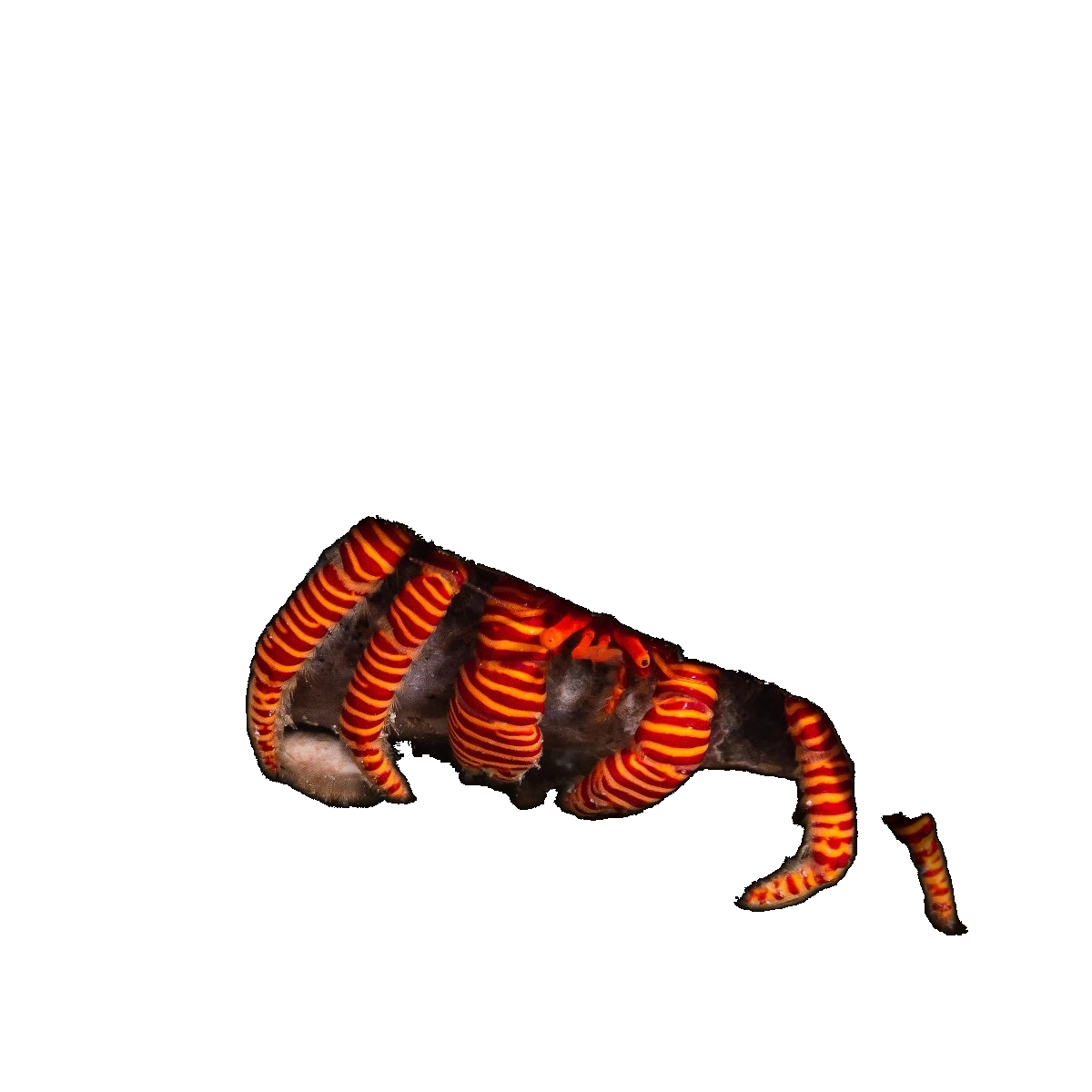
The Halloween Hermit Crab, originating from the Hawaiian Islands, has vibrant orange and red banding and is a useful cleanup-crew member that eats leftover food, green hair algae, and cyanobacteria while aerating the substrate. Large individuals may disrupt rockwork or attack snails for shells, so provide empty shells of assorted shapes and sizes; supplement with dried seaweed and mysis shrimp if algae is insufficient.
Quick facts
Identity
- Also known as
- Striped Hermit Crab; Orange-legged Hermit Crab; Orange-banded Hermit Crab
- Synonyms
- Trizopagurus strigatus
- Environment
- Saltwater
- Native to
- Indo-Pacific, Red Sea, Hawaii, Philippines, French Polynesia
- Habitat
- Shallow coral reefs, sandy lagoons, reef flats, and coral rubble zones from the intertidal down to about 90 ft, often among cone snail shells.
- Sourcing
- Wild-caught
- Conservation
- Not Evaluated
Care
- Care level
- Easy
- Temperament
- Semi-Aggressive
- Adult size
- 0.8 – 2 in (2 – 5.1 cm)
- Lifespan
- 2 – 4 yrs
- Min tank
- 20 gal (76 L)
- Growth rate
- Slow
- Placement
- Bottom, Rock & glass
Water
- Temperature
- 75 – 81 °F (24 – 27 °C)
- pH
- 8.1 – 8.4
- dKH
- 8 – 12 dKH
- Salinity
- 1.023 – 1.026 SG
- Flow
- Moderate
Behavior & compatibility
- Social
- Solitary
- Aggression to own kind
- Moderate
- Active
- Night
- Reef safe
- With caution
- Invert safe
- With caution
- Shrimp safe
- With caution
- Clean-up role
- Algae, Detritus, Leftover food
- Population boom risk
- Low
Feeding & breeding
- Diet
- Omnivore
- Foods
- Algae, Frozen, Pellets, Flakes, Freeze-dried, Vegetables
- Breeding type
- Broadcast spawner
- Breeding difficulty
- Not bred in captivity
- Sexing
- Sexes cannot be reliably distinguished externally without removing the crab from its shell; not practical for hobbyists.
- Target feeding
- Beneficial
Something wrong or missing? Submit a correction
Care guide
Overview
The Halloween Hermit Crab is a nocturnal scavenger marked by orange-red banded legs and a cream body, often carrying a cone-shaped shell salvaged from reef rubble. It forages after dark across rock and sand for algae and detritus, and a stock of spare shells keeps it from raiding neighboring snails. Stable salinity and calcium levels are essential through each molt.
Care
This hermit crab does well in a mature reef tank with plenty of live rock to graze over and a sandy or mixed sand-rubble substrate to dig through. It tolerates a fairly wide range of typical reef parameters but does poorly with sudden salinity swings and will not tolerate copper-based medications. A steady supply of iodine and stable calcium and alkalinity levels support healthy molting, and rockwork should be arranged securely since a larger specimen carrying a bulky shell can dislodge loose frags or rubble while foraging.
Feeding
In the wild it grazes hair algae, cyanobacteria, and biofilm off rock and sand, and in the aquarium it will supplement this with leftover fish food and detritus. When algae growth slows down, offer sinking pellets, flake, dried seaweed, or small pieces of mysis and krill a few times a week so it does not turn to harassing snails for food. Target feeding occasionally helps ensure it gets enough nutrition in a tank with limited natural grazing.
Tank mates
Generally peaceful toward fish and corals but opportunistic toward smaller invertebrates, especially snails, if it needs a bigger shell or is underfed. Always keep a stock of empty shells of assorted shapes and sizes, favoring cone-shaped ones, on hand so it can upgrade without attacking cohabiting snails. Avoid pairing with shell-crushing predators such as triggerfish, puffers, and large wrasses, and use caution when housing with small delicate snails or bottom-dwelling fish like mandarins.
Breeding
Breeding has not been achieved in home aquariums, as larvae go through a planktonic marine stage that requires specialized rearing conditions. Wild populations reproduce by broadcasting larvae into open water where they eventually settle and find their first shells. Aquarium specimens are essentially all wild-collected rather than captive-propagated.
Health
Molting is the most vulnerable period; the crab may hide for several days and should not be disturbed, and it may emerge in a new, larger shell if one was available. Watch for lethargy, repeated shell abandonment, or missing limbs, which usually point back to unstable salinity, poor acclimation, or nutritional deficiency. Exposure to copper treatments, even residual amounts, can be lethal, so quarantine and treat any tankmates in a separate system.
Sources
More Hermit crabs
Something wrong or missing? Submit a correction
In the community
Popular tanks using Halloween Hermit Crab
No public tanks are showcasing Halloween Hermit Crab yet.