
Marine Invertebrates
Garmard's Hermit Crab
Calcinus gaimardiiDiogenidaeHermit crabs
Price: $4.23 USD
Add from My tanks →1 photos
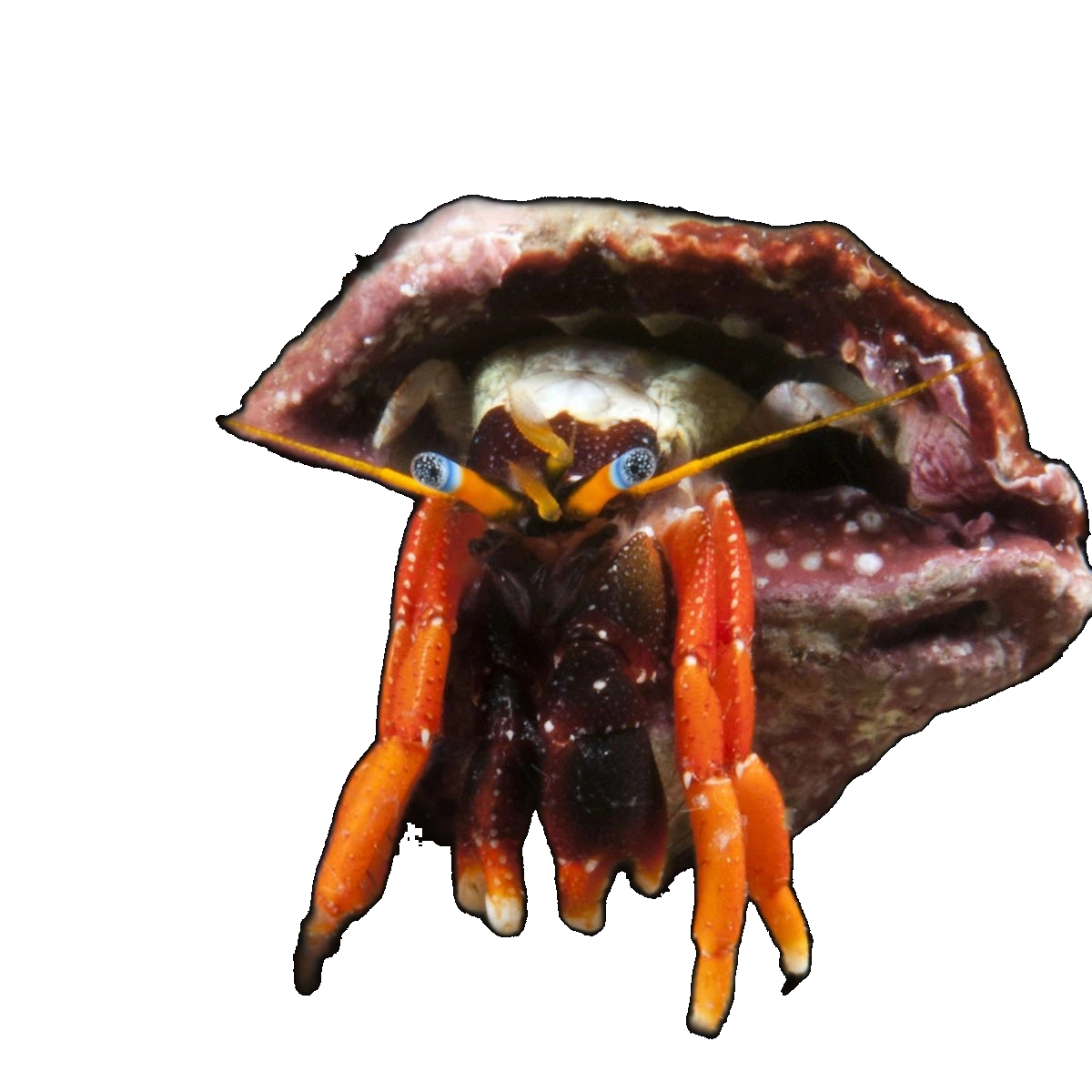
Garmard's Hermit Crab (Calcinus gaimardii) is a dwarf hermit crab that grows to only about 2–3 cm and is very suitable for nano aquariums. Like other hermits, it is a good cleaner with no protection of its own, living in a snail shell and continuously seeking a larger home as it grows, so keep a supply of larger shells available.
Quick facts
Identity
- Also known as
- Gaimard's Hermit Crab; Blue-Eyed Hermit Crab
- Synonyms
- Calcinus terrae-reginae; Pagurus gaimardii
- Environment
- Saltwater
- Native to
- Indo-Pacific, Indian Ocean, Red Sea, Australia, Fiji, Japan, Taiwan, Philippines, Indonesia, Hawaii
- Habitat
- Intertidal and subtidal rocky and coral reef areas, tide pools, and shallow reef flats from the intertidal zone down to about 40 m depth.
- Sourcing
- Wild-caught
- Conservation
- Not Evaluated
Care
- Care level
- Easy
- Temperament
- Peaceful
- Adult size
- 0.5 – 1.2 in (1.3 – 3 cm)
- Lifespan
- 1 – 3 yrs
- Min tank
- 5 gal (19 L)
- Growth rate
- Slow
- Placement
- Bottom, Rock & glass
Water
- Temperature
- 74 – 82 °F (23 – 28 °C)
- pH
- 8.0 – 8.4
- dKH
- 8 – 12 dKH
- Salinity
- 1.023 – 1.025 SG
- Flow
- Low-Moderate
Behavior & compatibility
- Social
- Solitary
- Aggression to own kind
- Low
- Active
- Night
- Reef safe
- With caution
- Invert safe
- With caution
- Shrimp safe
- With caution
- Clean-up role
- Algae, Detritus, Leftover food
- Population boom risk
- Low
Feeding & breeding
- Diet
- Omnivore
- Foods
- Algae, Frozen, Pellets
- Breeding type
- Larval (brackish)
- Breeding difficulty
- Not bred in captivity
- Sexing
- Sexes are not visually distinguishable without close examination; not typically sexed in the hobby.
- Target feeding
- Beneficial
Something wrong or missing? Submit a correction
Care guide
Overview
Calcinus gaimardii is a small reef hermit crab showing brown, orange, and red tones with pale blue eyestalks, rarely exceeding 1.2 inches. It scavenges algae and detritus over rock and substrate mainly at night, borrowing shells rather than building its own protection. Easy to keep in nano reefs, it occasionally competes with snails for shells, so extra empty ones should stay on hand.
Care
This dwarf hermit crab adapts readily to nano and standard reef tanks alike, spending most of its time picking over rockwork and substrate. It tolerates a wide range of typical reef parameters and does not require special lighting or flow, making it one of the easier invertebrates to keep. Because it molts and grows steadily, it needs a steady supply of empty shells slightly larger than its current one on hand at all times.
Feeding
In the wild it grazes on algae film and scavenges organic matter among rubble and rock, and in captivity it will eat whatever sinks to the substrate. Offer sinking pellets, frozen mysis or brine shrimp, and let it forage on nuisance algae and detritus between feedings. It rarely needs targeted feeding if kept in an established tank with adequate biofilm and algae growth.
Tank mates
It generally ignores fish and corals but can become a problem for snails, occasionally attacking and killing them to claim a preferred shell. Keeping a stock of empty shells of varying larger sizes greatly reduces this behavior. It coexists well with other peaceful reef inhabitants and other hermit species as long as shell competition is minimized.
Breeding
Reproduction has not been achieved in home aquariums, as the larvae require a planktonic marine environment to develop. Wild populations reproduce via broadcast-released larvae that drift and settle after passing through several zoeal stages. Hobbyists should not expect to breed this species under normal reef tank conditions.
Health
Stress from being wedged into an ill-fitting or damaged shell is the most common issue, sometimes leading to prolonged hiding or failure to molt properly. Sudden salinity or temperature swings can also cause problems, so drip acclimation is recommended for new arrivals. Otherwise this species is hardy and rarely afflicted by disease in a well-maintained system.
Sources
More Hermit crabs
Something wrong or missing? Submit a correction
In the community
Popular tanks using Garmard's Hermit Crab
No public tanks are showcasing Garmard's Hermit Crab yet.