
Marine Invertebrates
Red Luzon Sea Starfish
Echinaster sp.EchinasteridaeSea stars
Price: $21.15 USD
Add from My tanks →1 photos
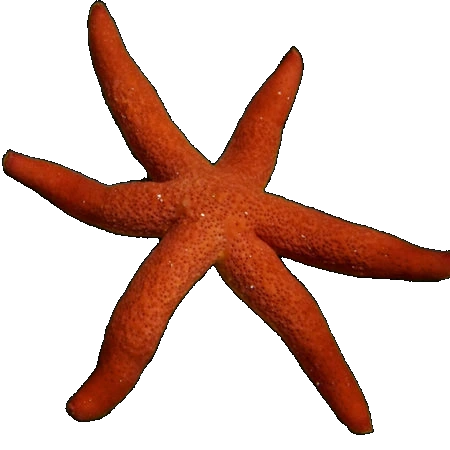
The Red Luzon Sea Starfish (Echinaster sp.), also called the Orange or Red Sea Star, ranges from orange to red and may have six arms. It grazes microbes and detritus over sandy or rubble substrate and live rock, is intolerant of sudden changes in oxygen, salinity, and pH, cannot tolerate copper medications, and should be drip-acclimated and never exposed to air; supplement with dried seaweed and clam meat.
Quick facts
Identity
- Also known as
- Luzon Sea Star; Orange Sea Star; Red Starfish
- Synonyms
- Echinaster luzonicus
- Environment
- Saltwater
- Native to
- Indo-Pacific, Philippines, Indonesia, Australia, East Africa, Madagascar
- Habitat
- Shallow coral reefs, reef crests, intertidal and reef flat areas with rubble, sand, and live rock
- Sourcing
- Wild-caught
- Conservation
- Not Evaluated
Care
- Care level
- Moderate
- Temperament
- Peaceful
- Adult size
- 3 – 8 in (7.6 – 20 cm)
- Lifespan
- 2 – 5 yrs
- Min tank
- 30 gal (114 L)
- Growth rate
- Slow
- Placement
- Bottom
Water
- Temperature
- 75 – 82 °F (24 – 28 °C)
- pH
- 8.0 – 8.4
- dKH
- 8 – 12 dKH
- Salinity
- 1.023 – 1.026 SG
- Flow
- Low-Moderate
Behavior & compatibility
- Social
- Solitary
- Aggression to own kind
- Low
- Active
- Night
- Reef safe
- Yes
- Invert safe
- With caution
- Shrimp safe
- With caution
- Clean-up role
- Algae, Biofilm, Detritus
- Population boom risk
- Low
Feeding & breeding
- Diet
- Omnivore
- Foods
- Algae, Biofilm, Frozen
- Breeding type
- Broadcast spawner
- Breeding difficulty
- Not bred in captivity
- Sexing
- Sexes are not externally distinguishable; gonochoric but this species also reproduces asexually by arm autotomy
- Target feeding
- Beneficial
Something wrong or missing? Submit a correction
Care guide
Overview
Reef flats and rubble zones across the Indo-Pacific and Philippines supply this deep orange-to-red sea star, occasionally with more than five arms, to the trade. It creeps slowly over live rock and sand grazing biofilm and detritus, tolerating little swing in salinity, pH, or oxygen. Keepers must avoid air exposure and copper treatments entirely.
Care
This sea star does best in a mature, well-established reef aquarium with abundant live rock and sand where it can graze continuously on biofilm and detritus. It is sensitive to swings in salinity, pH, and dissolved oxygen, so stable, pristine water quality is more important than any single parameter. Copper-based medications are lethal to it and must never be used in a tank housing this species or its future quarantine system.
Feeding
In the wild it grazes on bacterial films, algae, and organic detritus over sand, rubble, and rock. In captivity it benefits from supplemental feeding of dried seaweed, small pieces of clam or shrimp meat, and other meaty marine foods placed near its body so it can absorb them slowly. Because it is a slow grazer, it needs a tank with enough standing biofilm and detritus to forage between feedings.
Tank mates
Generally peaceful and safe with corals, fish, and most other reef invertebrates, though very small ornamental shrimp or slow snails could occasionally be preyed upon opportunistically. Avoid keeping it with aggressive crabs, large wrasses, or puffers that may pick at its arms. It should not be combined with copper-treated fish or invertebrates recovering in a medicated system.
Breeding
Reproduction in aquaria is almost always asexual, through spontaneous or induced autotomy of an arm, which then regenerates a new central disc and additional arms over several weeks. Sexual reproduction with planktonic larvae has been documented in the wild but is not achievable in home aquarium settings. Hobbyists occasionally propagate specimens intentionally by separating a healthy arm segment with part of the central disc.
Health
Arm loss from stress, poor acclimation, or physical injury is common but not necessarily fatal, since the star can usually regenerate lost arms if the central disc remains intact and water quality is good. Exposure to air, rapid salinity or temperature shifts, or copper medication can cause fatal tissue damage. A shrinking or discolored disc, disintegrating arm tips, or a persistent bad odor from the animal are signs of a failing specimen.
Sources
More Sea stars
Something wrong or missing? Submit a correction
In the community
Popular tanks using Red Luzon Sea Starfish
No public tanks are showcasing Red Luzon Sea Starfish yet.