
Marine Invertebrates
Orange Marble Sea Star
Fromia sp.OphidiasteridaeSea stars
Price: $14.10 USD
Add from My tanks →1 photos
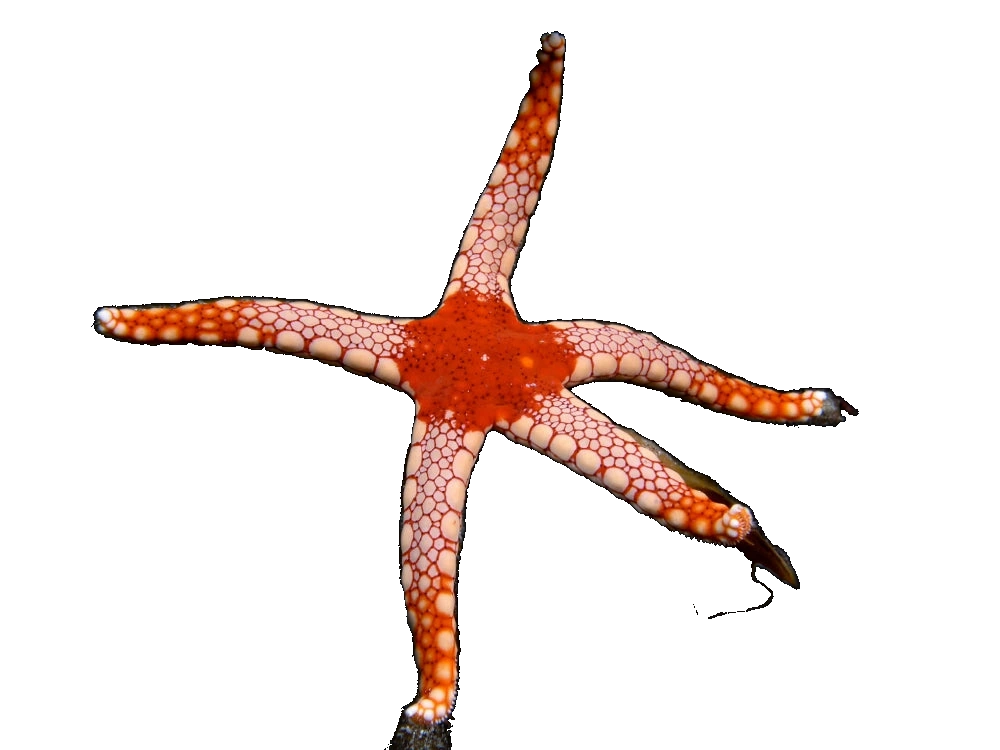
The Orange Marble Sea Star (Fromia sp.) has white to off-white marbling over an orange to burnt-orange body and can regrow injured or damaged arms. It is a peaceful, reef-safe scavenger and detritivore feeding on organic matter and algae, needs a well-established aquarium with a deep sand bed and open area, does not tolerate copper medications, and should be supplemented with sinking shrimp pellets if natural foods are lacking.
Quick facts
Identity
- Also known as
- Necklace Starfish; Marble Starfish; Tile Sea Star
- Synonyms
- Fromia monilis
- Environment
- Saltwater
- Native to
- Indo-Pacific, Red Sea, East Africa, Madagascar, Philippines, Australia, Vanuatu
- Habitat
- Shallow coral reefs, lagoons, and outer reef slopes to about 40 m, on live rock rich in biofilm and microalgae
- Sourcing
- Wild-caught
- Conservation
- Not Evaluated
Care
- Care level
- Difficult
- Temperament
- Peaceful
- Adult size
- 2 – 5 in (5.1 – 13 cm)
- Lifespan
- 4 – 7 yrs
- Min tank
- 40 gal (151 L)
- Growth rate
- Slow
- Placement
- Bottom, Rock & glass
Water
- Temperature
- 74 – 80 °F (23 – 27 °C)
- pH
- 8.1 – 8.4
- dKH
- 8 – 12 dKH
- Salinity
- 1.023 – 1.025 SG
- Flow
- Low-Moderate
Behavior & compatibility
- Social
- Solitary
- Aggression to own kind
- Low
- Active
- Daytime
- Reef safe
- Yes
- Invert safe
- Yes
- Shrimp safe
- Yes
- Clean-up role
- Algae, Biofilm, Detritus
- Population boom risk
- Low
Feeding & breeding
- Diet
- Detritivore
- Foods
- Frozen, Biofilm, Algae
- Breeding type
- Broadcast spawner
- Breeding difficulty
- Not bred in captivity
- Sexing
- Sexes are not visually distinguishable
- Target feeding
- Beneficial
Something wrong or missing? Submit a correction
Care guide
Overview
Grazes slowly across live rock and sand, picking biofilm and detritus from crevices with white marbling patterned over an orange to burnt-orange body. Regrowth of lost arms is possible over time. Only suited to established reef systems with months of run time, stable parameters, and no copper-based treatments.
Care
This sea star needs a mature, well-established reef system with several months to a year of run time so it can graze on the biofilms, microalgae, and detritus that accumulate on live rock. It is sedentary and moves little from day to day, so a lack of movement is not unusual, but complete inactivity paired with discolored patches or a soft, deflating body signals real trouble. Copper-based medications are lethal to it and must never be dosed in a tank housing this animal, and water parameters should stay very stable, since sudden shifts in salinity, pH, or temperature are poorly tolerated. A deep sand bed and plenty of open rockwork give it room to forage.
Feeding
In the wild and in a mature aquarium, this species grazes bacterial films, organic detritus, sponges, and microalgae off live rock and substrate, so it rarely touches prepared foods. Where natural food sources are scarce, keepers can supplement with sinking shrimp pellets or small bits of fish, mussel, or shrimp flesh placed directly under an arm a few times a week. A newly set up tank without established biofilm cannot sustain it, which is why aquarists are advised to wait until the system has matured before adding one.
Tank mates
Peaceful and defenseless, it poses no threat to corals, fish, or other invertebrates and is a good fit for calm reef community tanks. Predatory or invertebrate-eating tankmates such as puffers, triggerfish, boxfish, large wrasses, and aggressive crustaceans should be avoided, since this star has no real defenses against them. It tends to coexist well with sessile invertebrates and simply crawls over them without causing harm.
Breeding
Reproduction in home aquaria is essentially unreported, and this species is not bred commercially. Wild populations reproduce by broadcast spawning, releasing eggs and sperm into the water column, but the resulting larvae are planktonic and have specific requirements that are impractical to replicate in captivity. Almost all specimens in the trade are wild collected rather than propagated.
Health
Because sea stars can look outwardly normal right up until they die, close observation of behavior is more useful than appearance alone for judging health. Warning signs include a body that stops moving entirely, whitish or discolored patches on the skin, arm tips curling upward, or visible tissue discharging fluid, any of which indicate a specimen in decline. New arrivals benefit from being held back at the dealer for a week or more to recover from shipping stress before being introduced to a display tank, and slow drip acclimation over several hours reduces losses from osmotic shock.
Sources
More Sea stars
Something wrong or missing? Submit a correction
In the community
Popular tanks using Orange Marble Sea Star
No public tanks are showcasing Orange Marble Sea Star yet.