
Coral
ORA Metallic Green Galaxea Coral
Galaxea sp.EuphylliidaeLPS corals
Add from My tanks →1 photos
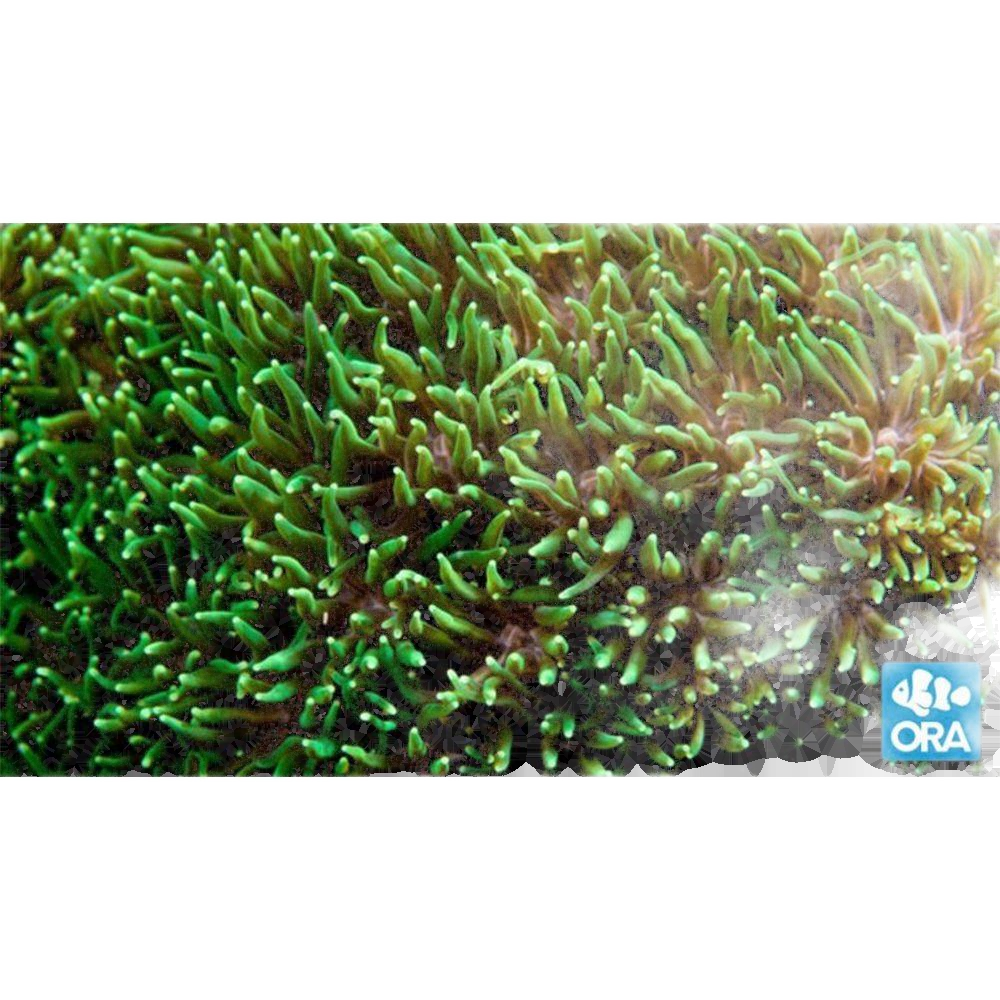
The ORA Metallic Green Galaxea is a relatively fast-growing LPS coral with bright green coloration and a mound-like growth form. It is less aggressive than many Galaxea varieties but can still extend sweeper tentacles, so provide space from other corals; it is ideal for lower areas of the tank or placement on the sand under medium light and medium flow.
Quick facts
Handling caution: Sweeper tentacles can sting skin and irritate other corals; handle with gloves
Identity
- Also known as
- Galaxy Coral; Star Coral; Crown Coral
- Synonyms
- Galaxea fascicularis
- Environment
- Saltwater
- Native to
- Indo-Pacific
- Habitat
- Reef flats and slopes with moderate to strong water movement, often forming large mounding colonies in shallow to mid-depth reef zones
- Sourcing
- Both
- Conservation
- Not Evaluated
Care
- Care level
- Easy
- Coral type
- LPS
- Temperament
- Aggressive
- Growth form
- Massive
- Adult size
- 1 – 12 in (2.5 – 30 cm)
- Spread
- 12 in (30 cm)
- Growth rate
- Moderate
- Placement
- Low, Sand bed
Water
- Temperature
- 76 – 80 °F (24 – 27 °C)
- pH
- 8.1 – 8.4
- dKH
- 8 – 12 dKH
- Salinity
- 1.024 – 1.026 SG
- PAR
- 75 – 150 PAR
- Flow
- Moderate
- Light
- Medium
Reef care
- Nutrient preference
- Medium
- Alk/Ca uptake
- Medium
- Target feeding
- Beneficial
- Give it room
- 10 in (25 cm)
- Colors
- Green
Feeding & breeding
- Diet
- Photosynthetic
- Foods
- Frozen, Coral food, Zooplankton
- Propagation
- Fragging
Something wrong or missing? Submit a correction
Care guide
Overview
Suited to reef tanks with open sand or low rockwork where a mounding colony can spread without crowding neighbors. This green Galaxea grows relatively quickly and is comparatively docile, though sweeper tentacles still warrant clearance. Medium light and moderate flow, plus occasional target feeding, encourage full polyp extension.
Care
Galaxea is a hardy large polyp stony coral that grows in mounding colonies of individual corallites, each tipped with a pale, star-like point when the polyps retract. It adapts to a range of lighting from moderate to fairly strong but should be introduced gradually since sudden intense exposure can cause bleaching or tissue recession. Moderate to fairly brisk, varied flow keeps detritus from settling between the corallites without blasting the tissue directly, and stable calcium, alkalinity and magnesium levels support steady skeletal growth.
Placement & acclimation
Acclimate new colonies to light gradually over one to two weeks, starting in a lower-light position and moving up if needed, since overexposure causes more damage than starting too dim. Mount frags or colonies on rock rubble or the sand bed with adequate open space around them so the sweeper tentacles cannot reach neighboring corals. Base rock or a stable substrate works well since Galaxea does not require a specific attachment method.
Feeding
Most of its energy comes from photosynthetic zooxanthellae, but supplemental feeding of small meaty foods such as mysis, brine shrimp or coral-specific zooplankton blends encourages fuller polyp extension and faster growth. Feeding once or twice a week during lights-out or low-flow periods, when the polyps are extended, gives the best results. Target feeding with a pipette or turkey baster reduces waste in the water column and directs food where the coral can capture it.
Neighbors
Galaxea is one of the more aggressive LPS corals kept in reef tanks, capable of extending sweeper tentacles several inches, sometimes reported over a foot, to sting neighboring corals competing for space. Leave generous clearance of at least six to twelve inches from any other coral, more for slow-growing or high-value specimens, and reassess spacing as the colony expands. It is best placed where it will not be brushed by other coral branches or where currents could carry its tentacles into contact with tankmates.
Fragging
Colonies can be fragged by cutting between corallites with a bandsaw, rotary tool, or bone cutters, ideally leaving several polyps per frag for reliable healing. Fresh cuts should be placed in low flow and moderate light until tissue recovers over the cut edges, typically within one to two weeks. Frags are generally hardy and recover well once past the initial healing period.
Pests & problems
Direct, unbroken flow aimed at one side of the colony can cause localized tissue recession, so flow should be varied rather than constant and laminar. Sudden increases in light intensity after acquisition or relocation within the tank can trigger paling or bleaching, so acclimate gradually over one to two weeks. Watch for brown jelly infections or tissue necrosis following physical damage from shipping or fragging, and isolate affected colonies promptly if lesions appear.
Sources
Varieties in the catalog
More LPS corals
Something wrong or missing? Submit a correction
In the community
Popular tanks using ORA Metallic Green Galaxea Coral
No public tanks are showcasing ORA Metallic Green Galaxea Coral yet.