
Aquatic Plant
Lagenandra Meeboldii 'Red'
Lagenandra meeboldii 'Red'AraceaeCrypts
Price: $34.99 USD
Add from My tanks →1 photos
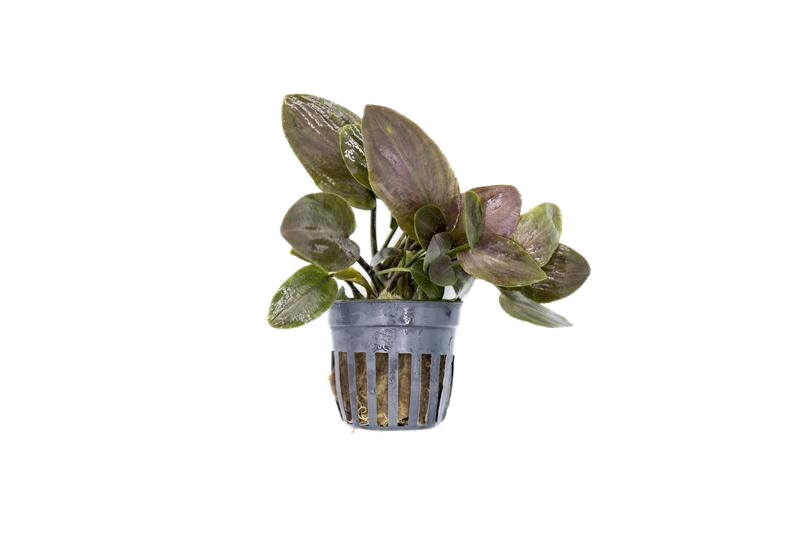
Lagenandra Meeboldii is a rare plant in the same family as Bucephalandra and Homalomena, suitable for aquarium use like Cryptocorynes. Its wide growth pattern shows dusty green with bright violet to red-violet, often on the same leaf; new leaves emerge in pale pink.
Quick facts
Identity
- Also known as
- Red Lagenandra
- Synonyms
- Lagenandra meeboldii 'Pink' (misapplied)
- Environment
- Freshwater
- Native to
- India (Karnataka, Kerala)
- Habitat
- Shaded, marshy stream and riverbanks in south-west India, growing emersed or half-submerged in loamy soil at elevations up to about 1200 m
- Sourcing
- Aquacultured
- Conservation
- Not Evaluated
Care
- Care level
- Easy
- Growth form
- Rhizome
- Max height
- 4 – 12 in (10 – 30 cm)
- Spread
- 12 in (30 cm)
- Growth rate
- Slow
- Placement
- Midground
Water
- Temperature
- 72 – 82 °F (22 – 28 °C)
- pH
- 6.0 – 7.5
- GH
- 0 – 20 dGH
- Flow
- Low-Moderate
- Light
- Medium
- CO₂
- Beneficial
Planting
- Substrate
- Nutrient-rich preferred
- Feeds from
- Roots
- Fertilizer needs
- Medium
- Colors
- Green, Red, Purple, Pink
Feeding & breeding
- Propagation
- Rhizome division
Something wrong or missing? Submit a correction
Care guide
Overview
Broad rosettes reach roughly 4 to 12 inches, with lance-shaped leaves shifting from dusty green to violet-red depending on light intensity, and new growth unfurling pale pink before darkening. Like a large crypt, it grows slowly from an unbranching rhizome that should sit crown-up in nutrient-rich substrate. Expect occasional melt after planting, with recovery in a few weeks if left undisturbed.
Care
This aroid behaves like an oversized, slow-growing crypt and is handled the same way: plant the rhizome with the crown sitting proud of the substrate rather than buried, since covering it invites rot. It tolerates a wide range of light levels, drifting toward dusty green in low light and developing deeper violet-red tones under medium to strong lighting. Because it does not send out runners like Cryptocoryne, once established it stays put in the same spot for years, making it a reliable long-term midground or focal specimen.
Planting & trimming
Split potted specimens apart, remove as much rock wool or packing material as possible from the roots, and anchor the rhizome in substrate with the crown exposed above the surface. It suits solitary placement or a loose small group in the midground, and its broad leaf canopy can shade neighbouring low plants, so leave clearance around it. It also grows well emersed in paludariums and vivariums, where it can flower with a distinctive pink and felty spathe.
Fertilizing
Root feeding matters more than water column dosing for this plant, so push root tabs into a nutrient-rich substrate near the base to support its substantial root mass. A weekly all-in-one liquid fertilizer with iron helps sustain leaf colour and rosette growth, and CO2 injection, while optional, noticeably speeds growth and intensifies the red-violet hues. Yellowing leaves, holes, or stalled growth are usually signs of a nutrient shortfall rather than disease.
Propagation
Propagate by dividing the creeping rhizome into sections a few centimetres long, each with some roots and at least one growing point, then replant separately. Side shoots often form naturally on the rhizome and can simply be cut away once they have their own roots. Division is best done during routine maintenance rather than while the plant is actively pushing new leaves, to reduce transplant shock.
Problems
Melt is common after planting, transplanting, or a large water change, with leaves dropping while the rhizome and roots remain viable; new growth typically returns within a few weeks if the base is left undisturbed. Algae on the older, slow-growing leaves is the most frequent complaint and usually points to excess light relative to available nutrients or weak flow rather than a problem with the plant itself. Adjusting photoperiod, adding fertilizer, and improving circulation generally resolves it.
Sources
More Crypts
Something wrong or missing? Submit a correction
In the community
Popular tanks using Lagenandra Meeboldii 'Red'
No public tanks are showcasing Lagenandra Meeboldii 'Red' yet.