
Aquatic Plant
Hydrocotyle Verticillata
Hydrocotyle verticillataAraliaceaeCarpet plants
Price: $7.99 USD
Add from My tanks →1 photos
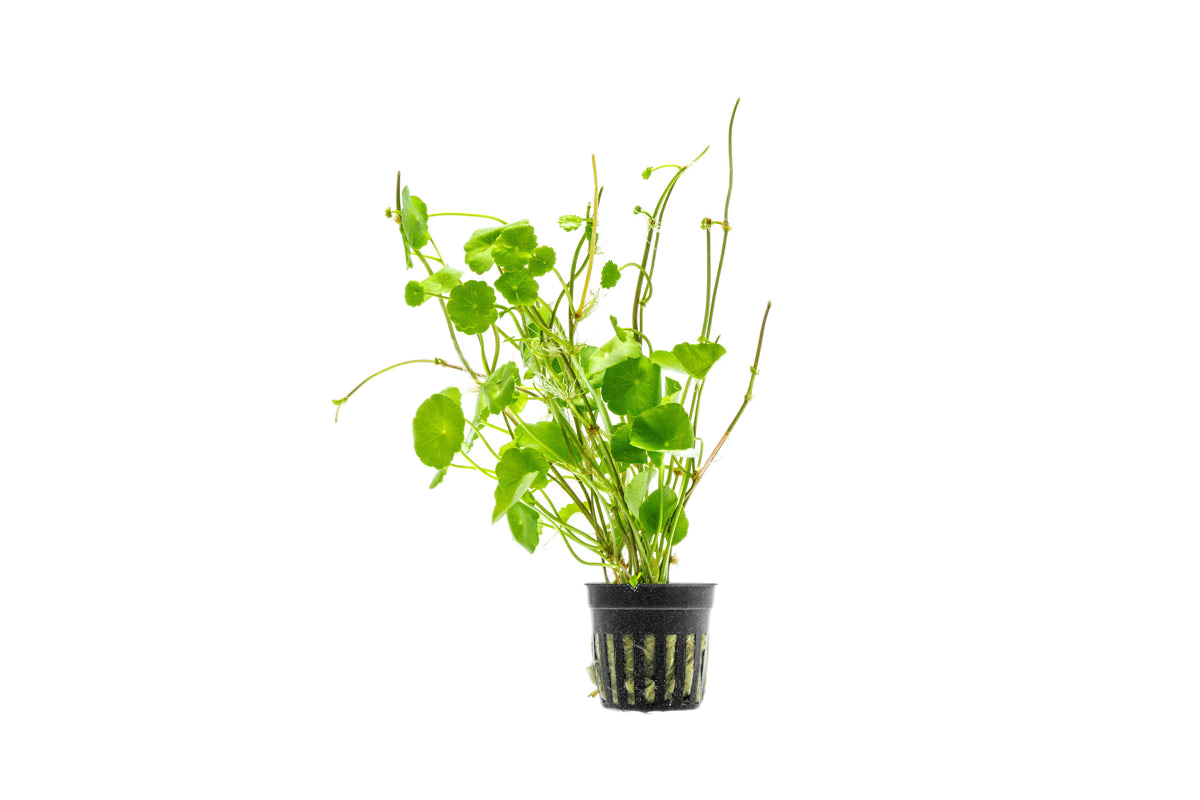
Hydrocotyle Verticillata, commonly known as Whorled Pennywort, is a unique fast-growing aquatic plant native to North and South America and the West Indies. Its miniature umbrella-like circular green leaves on upright stalks add a whimsical woodland texture; frequent trimming with strong lighting trains it into a dense, low-growing foreground carpet.
Quick facts
Identity
- Also known as
- Whorled Marsh-pennywort; Shield Pennywort
- Synonyms
- Hydrocotyle verticillata var. triradiata
- Environment
- Freshwater
- Native to
- United States, Central America, South America, West Indies
- Habitat
- Marshes, pond margins, ditches, and shallow wetlands with damp soil or shallow standing water throughout warmer parts of the Americas
- Sourcing
- Aquacultured
- Conservation
- Not Evaluated
Care
- Care level
- Moderate
- Growth form
- Rhizome
- Max height
- 1 – 4 in (2.5 – 10 cm)
- Spread
- 6 in (15 cm)
- Growth rate
- Moderate
- Placement
- Foreground, Midground, Carpet
Water
- Temperature
- 64 – 81 °F (18 – 27 °C)
- pH
- 5.5 – 7.5
- GH
- 4 – 18 dGH
- dKH
- 0 – 15 dKH
- Flow
- Low-Moderate
- Light
- High
- CO₂
- Beneficial
Planting
- Substrate
- Nutrient-rich preferred
- Feeds from
- Both
- Fertilizer needs
- Medium
- Colors
- Green
Feeding & breeding
- Propagation
- Runners, Cuttings, Splitting
Something wrong or missing? Submit a correction
Care guide
Overview
Foreground carpets and paludariums suit this creeping rhizome plant best, since round, parasol-shaped green leaves stay low and dense only under strong light. Left dim, stems stretch leggy and untidy. Regular trimming, a nutrient-rich substrate, and patience through the emersed-to-submerged adjustment period keep the mat compact and shrimp-safe.
Care
Whorled pennywort grows along a creeping horizontal stem that sends up round, parasol-shaped leaves on short vertical petioles at each node. It performs far better emersed or in paludariums, where it spreads quickly into a dense mat, than fully submerged, where growth slows and bright light with CO2 injection is needed to keep it compact. Under strong light it stays low and dense, forming a usable carpet, while under weak light it grows tall and leggy and loses its neat form. It tolerates a wide temperature range and is not fussy about water hardness, but it is a fairly brittle plant that can suffer from being uprooted or nibbled.
Planting & trimming
Separate a bunch into smaller sections, each retaining at least one node with leaves and roots, and plant the base into fine, nutrient-rich substrate while keeping the crown just above the substrate line. It spreads via creeping runners that travel along the surface of the substrate, so give it room to fill in horizontally and trim runners with scissors to maintain a tidy, low foreground carpet. Regular trimming of both leaves and runners keeps growth compact and prevents it from climbing over neighboring plants.
Fertilizing
Plant it in a nutrient-rich substrate or use root tabs, since it draws much of its nourishment through its roots as a rooted crawler rather than purely from the water column. Regular liquid fertilizer dosing with iron and micronutrients helps sustain fast, dense growth, particularly under high light and CO2. Pale or yellowing new leaves usually point to iron or nitrogen deficiency, while leggy stretched growth signals insufficient light.
Propagation
Propagation is mainly by lateral runners that produce plantlets at each node, which root readily once they contact substrate. Sections of the creeping stem can also be cut away as long as each piece includes at least one node and a leaf, then replanted elsewhere. Splitting established clumps is another simple way to generate new plants for relocation or sharing.
Problems
Melt or die-back can occur after transplanting or when moving a specimen from emersed to submerged growth, since the plant needs time to adjust its leaf structure to underwater conditions. Slow-growing submerged specimens under low light are prone to algae fouling on their round leaves. Because the leaves and stems are somewhat brittle and palatable, they are also vulnerable to being shredded or grazed by boisterous or omnivorous fish.
Sources
More Carpet plants
Something wrong or missing? Submit a correction
In the community
Popular tanks using Hydrocotyle Verticillata
No public tanks are showcasing Hydrocotyle Verticillata yet.