
Aquatic Plant
Hydrocotyle Tripartita
Hydrocotyle tripartitaAraliaceaeCarpet plants
Price: $28.99 USD
Add from My tanks →1 photos
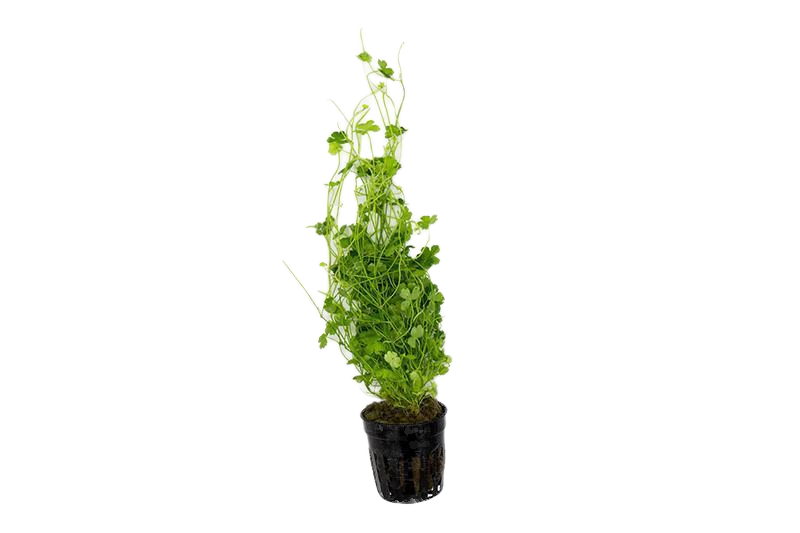
Hydrocotyle Japan (Hydrocotyle Tripartita) brings a unique, whimsical texture to your tank with its distinct, clover-like leaves. Made famous by legendary aquascapers like Takashi Amano, this fast-growing favorite is incredibly versatile and can be used in the foreground, midground, or background; exceptionally undemanding and energetic grower.
Quick facts
Identity
- Also known as
- Hydrocotyle Japan; Japanese Pennywort; Australian Hydrocotyle; Dwarf Pennywort
- Synonyms
- Hydrocotyle sp. "Japan"; Hydrocotyle cf. tripartita
- Environment
- Freshwater
- Native to
- Southeast Asia, Australia (Queensland)
- Habitat
- Swampy areas, shaded stream edges, and moist muddy soils; grows as a creeping emersed species along banks or fully submerged during seasonal flooding
- Sourcing
- Aquacultured
- Conservation
- Not Evaluated
Care
- Care level
- Easy
- Growth form
- Carpeting
- Max height
- 1 – 4 in (2.5 – 10 cm)
- Growth rate
- Fast
- Placement
- Foreground, Midground, Carpet, Epiphyte
Water
- Temperature
- 68 – 82 °F (20 – 28 °C)
- pH
- 6.0 – 7.5
- GH
- 2 – 12 dGH
- dKH
- 2 – 10 dKH
- PAR
- 50 – 100 PAR
- Flow
- Low-Moderate
- Light
- Medium
- CO₂
- Beneficial
Planting
- Substrate
- Nutrient-rich preferred
- Feeds from
- Both
- Fertilizer needs
- Medium
- Colors
- Green
Feeding & breeding
- Propagation
- Runners, Cuttings, Splitting
Something wrong or missing? Submit a correction
Care guide
Overview
Tiny three-lobed leaves resembling miniature clover spread across thread-like stolons that root at every node encountered. Under medium-high light and CO2 it flattens into a dense low carpet, while weaker light produces a looser, more upright habit. Easy and fast-growing, it suits foreground or midground placement but needs regular trimming to prevent overrunning neighboring plants.
Care
A vigorous creeping plant with small three-lobed leaves that resemble tiny clover, spreading by thread-like stolons that root at every node. Under medium to high light with CO2 injection the runners flatten and the leaves shrink down to form a dense low carpet, while in weaker light it grows more upright with longer petioles and spaced leaves. Regular trimming and physically pressing the mat down during maintenance keeps growth low and compact rather than letting it pile up. It tolerates a wide range of water chemistry and can be grown planted in substrate, tied to hardscape, or even left floating.
Planting & trimming
Plant runners with at least one node buried in the substrate, spacing small clumps a couple of inches apart to let it fill in naturally, or tuck stems into cracks in rock or wood where the roots will tangle into the hardscape over time. Pressing the carpet down by hand during routine maintenance discourages vertical climbing and keeps the mat tight and low. Trim regularly, cutting back new vertical shoots to redirect energy into horizontal spreading.
Fertilizing
Feeds heavily through its dense adventitious roots but also draws a large amount of nitrogen and potassium from the water column, so regular liquid fertilizing suits it better than relying on substrate alone. Root tabs can help when planted directly in substrate, especially in nutrient-poor setups. Pale or yellowing leaf edges, or leaves turning whitish, usually signal a macronutrient or iron deficiency that needs correcting.
Propagation
Propagates readily from stem cuttings and runners that have developed nodes; simply cut a section with a node and replant it in substrate or against hardscape. Mature mats can also be divided into smaller sections and replanted elsewhere in the tank. Strong light, CO2, and good nutrient availability speed up both propagation success and lateral spread.
Problems
Fast growth means it can quickly overrun and shade out slower neighboring plants if left untrimmed. Leaves that pale or turn white at the margins point to a lack of iron or other macronutrients rather than disease. Emersed-grown stock can melt back somewhat when first submerged, so a gradual transition or patience during the first few weeks helps it settle in.
Sources
More Carpet plants
Something wrong or missing? Submit a correction
In the community
Popular tanks using Hydrocotyle Tripartita
No public tanks are showcasing Hydrocotyle Tripartita yet.