
Terrarium Plant
Heterogonium Pinnatum
Heterogonium pinnatumTectariaceaeFerns
Price: $9.99 USD
Add from My tanks →1 photos
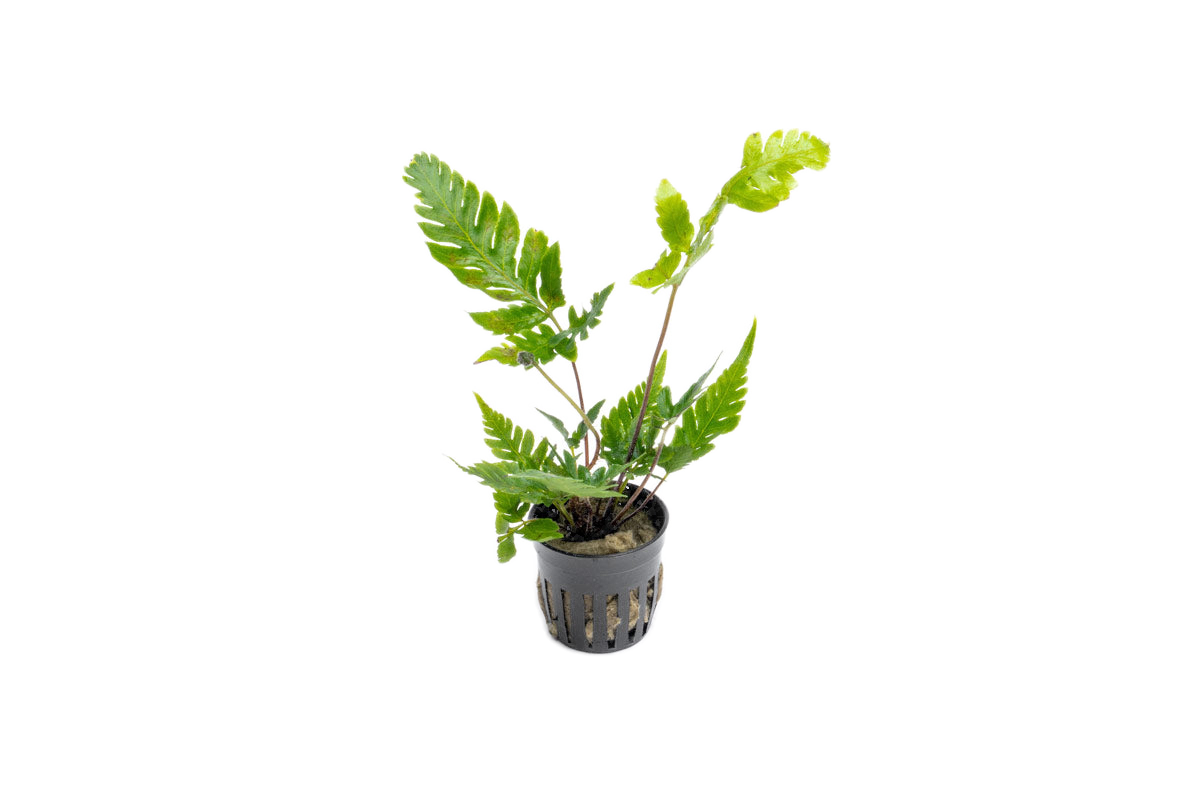
Heterogonium Pinnatum is a dimorphic fern from Southeast Asian rainforests, with sterile and fertile fronds 10 to 15 inches long bearing a dark purple-brown stripe; young plants are more compact with wider, greener leaves. It suits humid terrariums and paludariums with partial shade; it must not be submerged or placed in direct light.
Quick facts
Identity
- Also known as
- Stenosemia Fern
- Synonyms
- Stenosemia pinnata
- Environment
- Terrestrial
- Native to
- Philippines, Thailand, Laos, Cambodia, Southeast Asia
- Habitat
- Rainforest understory near streams at low altitudes, growing on humid soil banks in shaded, moist conditions
- Sourcing
- Aquacultured
- Conservation
- Not Evaluated
Care
- Care level
- Moderate
- Growth form
- Rhizome
- Max height
- 6 – 15 in (15 – 38 cm)
- Spread
- 12 in (30 cm)
- Growth rate
- Slow
- Placement
- Foreground, Midground
Water
- Temperature
- 68 – 82 °F (20 – 28 °C)
- Humidity
- 70 – 95%
Planting
- Substrate
- Nutrient-rich preferred
- Feeds from
- Roots
- Fertilizer needs
- Low
- Colors
- Green, Brown, Purple
Feeding & breeding
- Propagation
- Rhizome division
Something wrong or missing? Submit a correction
Care guide
Overview
A dark purple-brown stripe runs along the sterile and fertile fronds of mature specimens, while younger plants stay more compact with wider, greener leaves. Reaching 10 to 15 inches, this rhizomatous fern spreads slowly and belongs in a shaded terrarium or paludarium land section rather than an open aquarium. Keep humidity high, soil moist but draining, and never submerge it.
Care
This fern needs consistently high humidity and gentle, filtered or indirect light, making it best suited to closed terrariums and paludarium land sections rather than open tanks. Direct sun or strong grow lights tend to scorch the fronds, causing browning and dieback, while soggy, waterlogged soil leads to root rot. Provide airflow to prevent fungal issues, but keep the surrounding air moist through misting or a humid enclosure.
Planting & trimming
Remove any packing material such as cotton or sphagnum from around the roots before planting into a well-draining, organic-rich terrarium soil mix. Keep the rhizome and crown at or just above the soil surface rather than burying it deeply, and situate the plant in a partially shaded, humid microclimate away from direct light or splashing water. Established clumps can be trimmed of old or damaged fronds at the base to keep growth tidy.
Fertilizing
Light dosing of a diluted liquid fertilizer or an occasional root tab worked gently into the soil supports steady growth, since this fern draws nutrients through its roots rather than from water or air. Iron supplementation can help maintain deeper green coloration in mature fronds. Pale or yellowing new growth usually signals a nutrient deficiency rather than overwatering, which instead shows up as generalized yellowing of older leaves.
Propagation
New plants are produced by dividing the creeping rhizome into sections, each with at least one growth point and a few roots attached, then replanting the divisions in humid soil. Growth is slow to moderate, so divisions should be given time to establish before further splitting. Spore propagation is possible in principle for ferns but is rarely practiced in the hobby for this species.
Problems
Yellowing leaves typically point to overly wet soil or poor drainage around the roots. Browning or crisping fronds usually indicate too much light or insufficient humidity in the enclosure. Because it cannot tolerate submersion, any prolonged contact with standing water in a paludarium will lead to rapid melt and eventual death of the plant.
Sources
More Ferns
Something wrong or missing? Submit a correction
In the community
Popular tanks using Heterogonium Pinnatum
No public tanks are showcasing Heterogonium Pinnatum yet.