
Aquatic Plant
Ceratopteris Cornuta
Ceratopteris cornutaPteridaceaeFerns
Price: $8.99 USD
Add from My tanks →1 photos
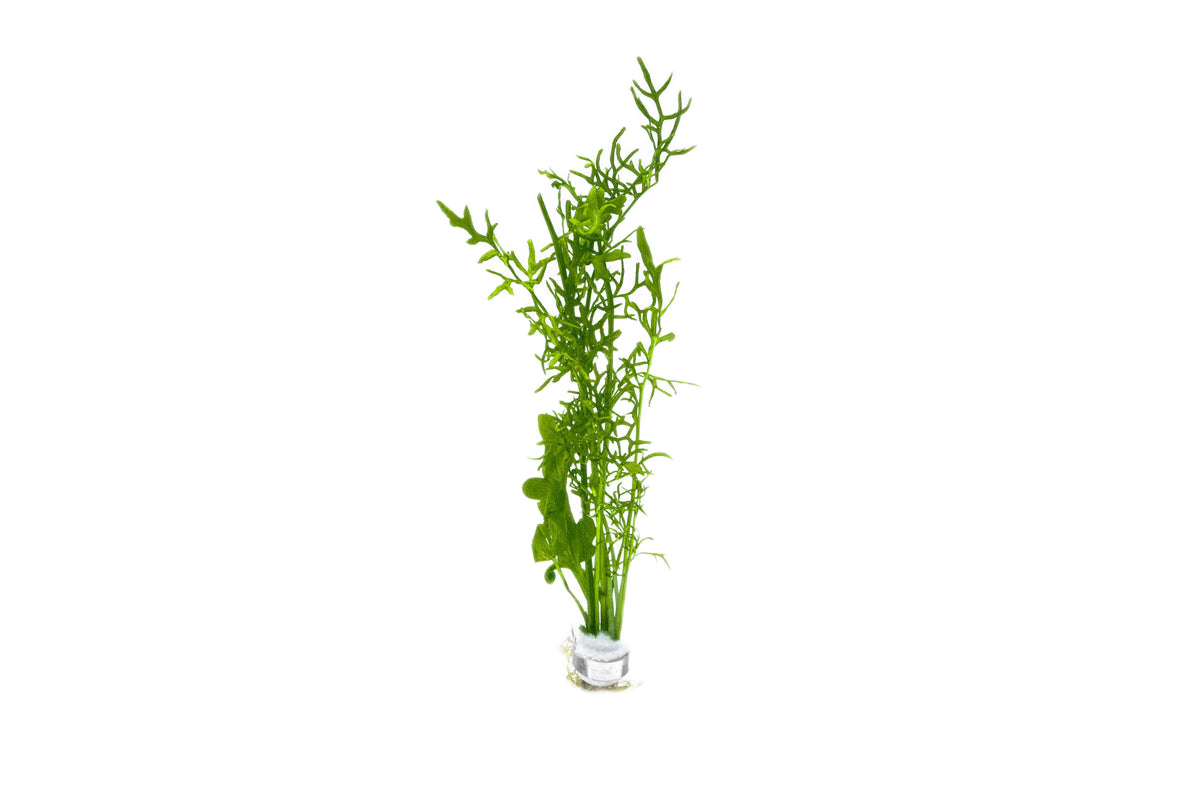
Ceratopteris cornuta, commonly known as Broad-leaf Water Sprite, is a classic aquatic fern and longtime favorite for outcompeting algae. Float it as an intricate canopy or plant it as a lush background centerpiece; this prolific nutrient sponge absorbs excess nitrates, providing shelter and grazing for fry and shrimplets.
Quick facts
Identity
- Also known as
- Broad-leaf water sprite; Lobed water sprite; Horned water fern
- Synonyms
- Ceratopteris thalictroides var. cornuta; Acrostichum cornutum
- Environment
- Freshwater
- Native to
- Sub-Saharan Africa, Madagascar, Southeast Asia, Northeast India, Northern Australia
- Habitat
- Stagnant ponds, warm swamps, and calm riverbanks with nutrient-rich, sunlit water, growing both submersed and as a floating plant
- Sourcing
- Captive-bred
- Conservation
- Not Evaluated
Care
- Care level
- Easy
- Growth form
- Rosette
- Max height
- 4 – 16 in (10 – 41 cm)
- Spread
- 16 in (41 cm)
- Growth rate
- Fast
- Placement
- Midground, Background, Floating
Water
- Temperature
- 64 – 86 °F (18 – 30 °C)
- pH
- 5.0 – 8.0
- GH
- 0 – 30 dGH
- dKH
- 0 – 21 dKH
- Flow
- Low-Moderate
- Light
- Medium
- CO₂
- Beneficial
Planting
- Substrate
- Nutrient-rich preferred
- Feeds from
- Both
- Fertilizer needs
- High
- Colors
- Green
Feeding & breeding
- Propagation
- Plantlets, Rhizome division
Something wrong or missing? Submit a correction
Care guide
Overview
Reaching up to 16 inches with deeply lobed, broad fronds, this rosette-forming fern can be anchored in a nutrient-rich substrate or left to drift as a floating mat. It grows quickly under medium light, pulling nitrate and phosphate straight from the water column, and multiplies readily via plantlets along its leaf margins. Easy for beginners, shrimp-safe, and useful as cover for fry.
Care
Broad-leaf water sprite adapts readily to either rooted or free-floating culture, making it forgiving for beginners while still rewarding more advanced layouts. It tolerates a wide pH and hardness range and grows well without CO2 injection, though supplemental CO2 and rich nutrients push it toward its fastest growth. Medium to high lighting keeps the rosette compact and prevents the lower leaves from thinning out, especially in submersed form.
Planting & trimming
Set the rosette shallowly in the substrate with the crown, where new fronds emerge, kept above the surface rather than buried. It can also be pinned down with a plant weight or simply left to float until roots lengthen enough for planting. Older, larger, or damaged fronds should be trimmed at the base periodically, and floating mats need regular thinning to stop them from shading the rest of the tank.
Fertilizing
This fern is a heavy consumer of nitrate, phosphate, and potassium, so it benefits from liquid fertilization or a nutrient-rich water column rather than root tabs alone. Iron supplementation helps prevent the pale, chlorotic new growth that signals a deficiency. Because it draws much of its nutrition directly from the water rather than the substrate, dosing a general macro and micro fertilizer routine suits it well.
Propagation
Propagation happens naturally through adventitious plantlets that sprout along the margins and tips of mature or damaged fronds. These plantlets can be separated once they develop a few small roots and either replanted in substrate or left to float independently. The plant also reproduces by spores, though vegetative plantlet production is by far the more common method in aquarium culture.
Problems
Newly potted specimens often arrive with minimal roots and can detach easily from rockwool during transport, but they recover quickly once floated or lightly anchored. Insufficient light causes leggy, sparse rosettes, while shading from surface coverage can stunt plants growing below a floating mat. Otherwise this species is largely free of the melting issues common to more delicate stem plants.
Sources
More Ferns
Something wrong or missing? Submit a correction
In the community
Popular tanks using Ceratopteris Cornuta
No public tanks are showcasing Ceratopteris Cornuta yet.