
Aquatic Plant
Bolbitis Heteroclita
Bolbitis heteroclitaDryopteridaceaeFerns
Price: $8.99 USD
Add from My tanks →1 photos
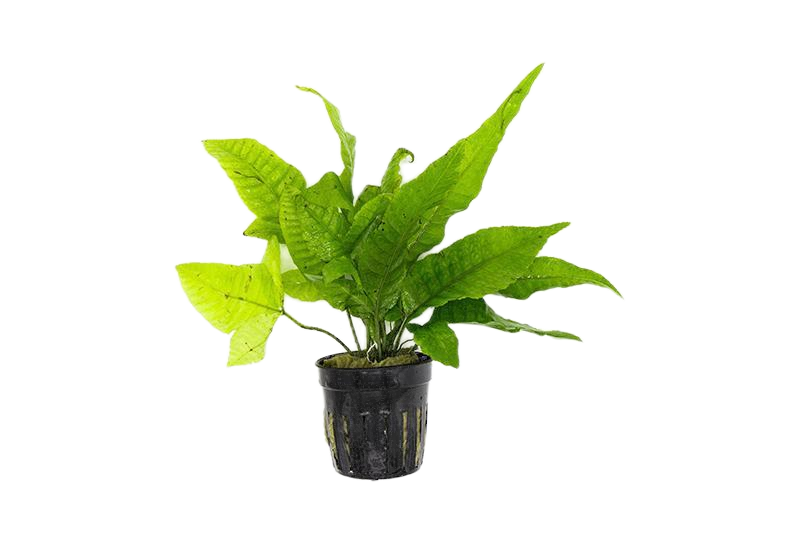
Bolbitis heteroclita is a slow-growing fern resembling Java Fern that can be grown submerged or emersed, with rhizomes attached directly to wood or rock. It prefers areas of the aquarium with higher flow rates and makes an easy-care, vibrant green epiphytic addition.
Quick facts
Identity
- Also known as
- Bolbitis Mini; Creeping Fern; El Nino Fern; Asian Water Fern; Broadleaf Bolbitis
- Synonyms
- Bolbitis heteroclita 'difformis'
- Environment
- Freshwater
- Native to
- Southeast Asia, Melanesia, northeastern South Asia, southern East Asia, Micronesia
- Habitat
- Shaded rocks and banks beside streams and waterfalls, mostly above the waterline in the splash zone with only occasional flooding
- Sourcing
- Aquacultured
- Conservation
- Not Evaluated
Care
- Care level
- Moderate
- Growth form
- Rhizome
- Max height
- 4 – 10 in (10 – 25 cm)
- Spread
- 7 in (18 cm)
- Growth rate
- Slow
- Placement
- Epiphyte, Midground
Water
- Temperature
- 72 – 77 °F (22 – 25 °C)
- pH
- 6.0 – 7.0
- GH
- 1 – 10 dGH
- dKH
- 0 – 10 dKH
- Flow
- Low-Moderate
- Light
- Low
- CO₂
- Beneficial
Planting
- Substrate
- Not needed
- Feeds from
- Water column
- Fertilizer needs
- Low
- Colors
- Green
Feeding & breeding
- Propagation
- Rhizome division, Plantlets
Something wrong or missing? Submit a correction
Care guide
Overview
Broad, dark green pinnate fronds branch off a creeping rhizome that must be tied or glued to wood or rock rather than buried. Growth is slow both underwater and emersed, so patience matters more than dosing. Best suited to soft, slightly acidic water with gentle flow and subdued light in a paludarium or planted tank.
Care
This creeping-rhizome fern grows very slowly whether kept submersed or emersed, and slow growth is normal rather than a sign of poor health. It does best in a paludarium or with part of the plant above the waterline where humidity stays high, since it is naturally more of a streambank plant than a fully aquatic one. Kept fully underwater it needs soft, slightly acidic water, gentle flow, subdued light, and stable parameters to avoid stalling or melting.
Planting & trimming
Attach the rhizome to driftwood or rock with thread, fishing line, or glue rather than planting it in substrate, since burying it causes rot. Position it where flow is gentle to moderate and light is low to moderate, and be patient, as it can take months to visibly anchor and establish. Old, established fronds can be left in place, since they often produce the plantlets used for propagation.
Fertilizing
Fertilizer demand is low. Occasional liquid fertilization with trace iron supports steady leaf production, and root tabs are unnecessary since the rhizome should never be buried in substrate. Yellowing or stunted new leaves usually point to insufficient iron or unstable water rather than a need for heavier dosing.
Propagation
The easiest method is dividing a mature rhizome into sections that each retain some roots and fronds, then reattaching the pieces to hardscape. Older fronds also form small plantlets at their tips that root down and grow into independent plants when they touch a surface or are gently detached and secured to wood or rock.
Problems
Fully submerged specimens are prone to stalling out or melting in hard, alkaline, or unstable water, so consistency matters more than any single parameter. Algae can build up on the broad, slow-growing leaves if flow and light are not well matched, so regular water changes and gentle current help keep surfaces clean. Because new growth is so slow, any leaf loss takes a long time to replace, making prevention more important than correction.
Sources
More Ferns
Something wrong or missing? Submit a correction
In the community
Popular tanks using Bolbitis Heteroclita
No public tanks are showcasing Bolbitis Heteroclita yet.