
Aquatic Plant
Echinodorus Horemanii Red Sword
Echinodorus horemaniiAlismataceaeSwords
Price: $9.99 USD
Add from My tanks →1 photos
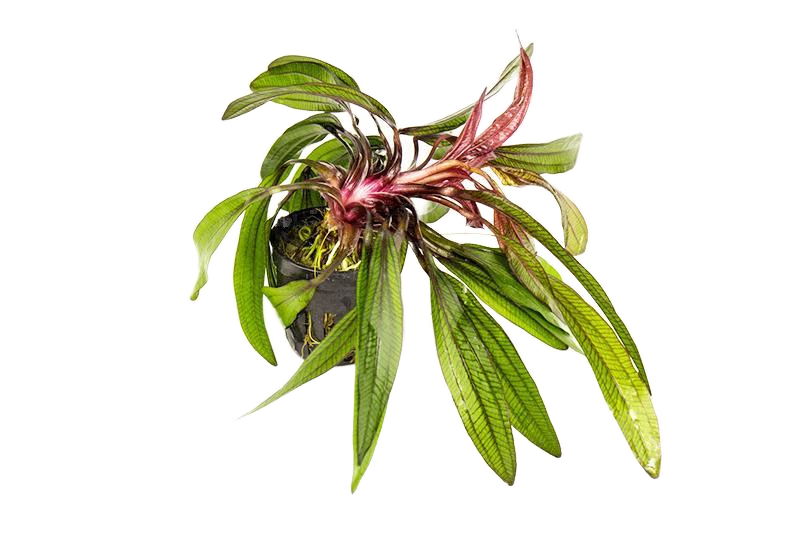
Echinodorus Horemanii Red is a spectacular sword with new leaves completely red like the stem, older leaves turning greener while retaining red outlines. Plant directly into substrate, supplementing with root tabs in inert substrates as heavy root feeders; easy and undemanding, grown emersed or submerged, suited for larger tanks.
Quick facts
Identity
- Also known as
- Horemanii Red Sword; Red Horemanii Sword
- Synonyms
- Echinodorus uruguayensis (misapplied); Aquarius uruguayensis
- Environment
- Freshwater
- Native to
- Brazil, Uruguay, Argentina, Paraguay
- Habitat
- Slow to moderately flowing, cool, soft, acidic rivers and rivulets of subtropical South America, growing submersed or emersed along margins depending on water level.
- Sourcing
- Captive-bred
- Conservation
- Not Evaluated
Care
- Care level
- Moderate
- Growth form
- Rosette
- Max height
- 6 – 20 in (15 – 51 cm)
- Spread
- 14 in (36 cm)
- Growth rate
- Slow
- Placement
- Background
Water
- Temperature
- 68 – 78 °F (20 – 26 °C)
- pH
- 6.5 – 7.5
- GH
- 4 – 12 dGH
- Flow
- Low-Moderate
- Light
- Medium
- CO₂
- Beneficial
Planting
- Substrate
- Nutrient-rich preferred
- Feeds from
- Roots
- Fertilizer needs
- High
- Colors
- Red, Green, Brown
Feeding & breeding
- Propagation
- Adventitious plantlets
Something wrong or missing? Submit a correction
Care guide
Overview
New leaves emerge fully red along with the stem, while older foliage shifts toward green but keeps a red outline. This rosette-forming sword is a slow, heavy root feeder best suited to background placement in larger tanks, doing well planted directly in nutrient-rich substrate or fed via root tabs, whether grown emersed or fully submerged.
Care
This sword rewards a well-fed substrate and moderate to strong lighting with deep red-brown coloration on its broad, wavy leaves; under weaker light or poor nutrition the color fades toward green. It is a slow grower and a heavy root feeder, so a substrate depth of a few inches with root tabs or aquasoil beneath the crown makes the biggest difference in both size and color. CO2 injection is not mandatory but noticeably speeds growth and intensifies color, and the plant tolerates a fairly wide temperature range though it does best on the cooler side of tropical.
Planting & trimming
Plant the crown directly in the substrate with roots covered but the growing point left exposed at surface level, since a buried crown rots from the center outward. Give it several inches of nutrient-rich substrate or root tabs placed beneath where the crown will sit, and space it well away from neighboring plants to allow its broad, arching leaves room to spread. It can be grown emersed in a paludarium setting or started that way before transitioning underwater, though expect some leaf melt during the switch.
Fertilizing
As a heavy root feeder, this plant depends more on substrate nutrition than on water column dosing, so push root tabs into the substrate near the crown every few weeks and pair this with a liquid iron or all-in-one fertilizer for the leaves. Yellowing leaves, pinholes, or stalled growth are almost always nutrient deficiency rather than disease, and usually resolve once root feeding is corrected. In inert gravel setups, root tabs become essential rather than optional since the substrate itself offers little.
Propagation
Propagation is mainly through adventitious plantlets that form along an aerial floral stalk rather than through runners along the substrate. Each plantlet should be left attached to the mother plant until it has developed four or five leaves and its own root system, at which point it can be cut free and planted separately. Flowering and plantlet production is more reliable when the plant is allowed to grow emersed or has its leaves breach the water surface.
Problems
Newly planted specimens, especially those converted from emersed nursery growth, commonly melt back their older leaves within the first few weeks before pushing a stronger submersed flush. Algae on the older, slow-growing leaves is a frequent complaint and usually points to excess light relative to available nutrients or weak flow rather than a flaw in the plant itself. A crown buried too deep in the substrate is prone to rot at the growing point, so the rhizome crown should always sit at or just above the substrate line.
Sources
More Swords
Something wrong or missing? Submit a correction
In the community
Popular tanks using Echinodorus Horemanii Red Sword
No public tanks are showcasing Echinodorus Horemanii Red Sword yet.