
Aquatic Plant
Cryptocoryne Striolata
Cryptocoryne striolataAraceaeCrypts
Price: $29.99 USD
Add from My tanks →1 photos
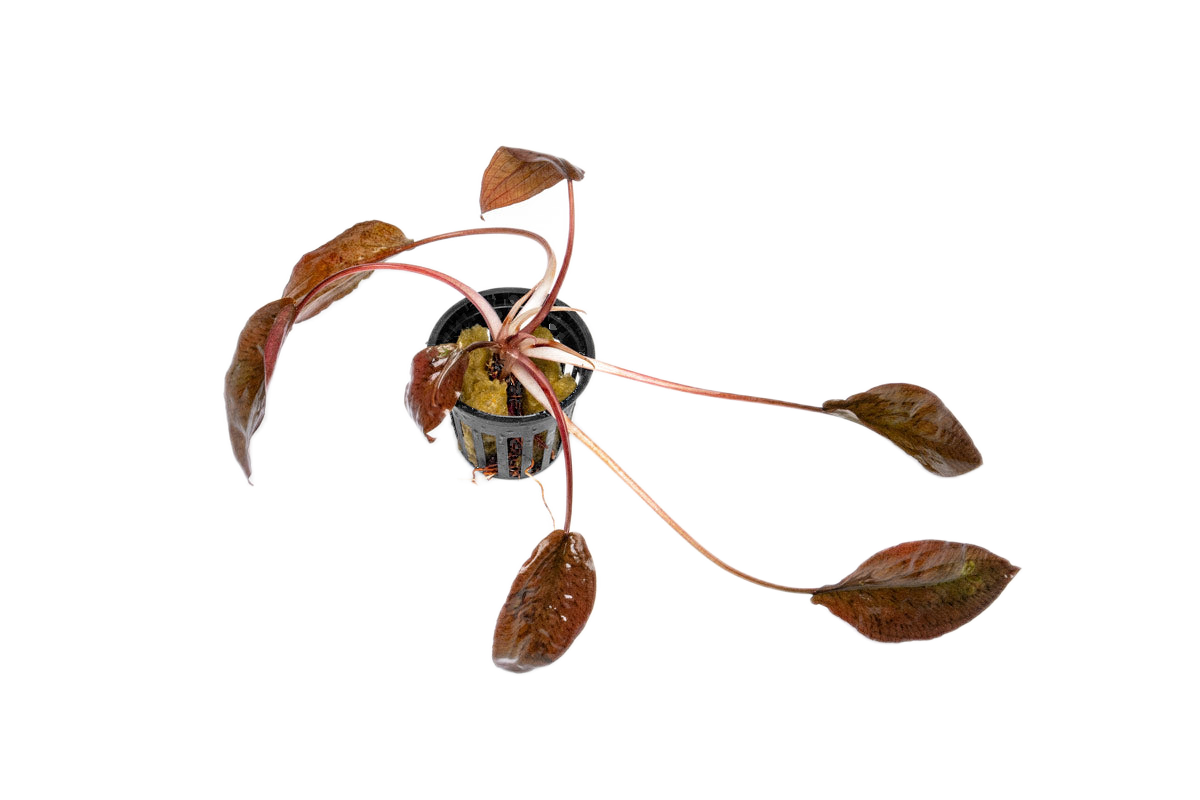
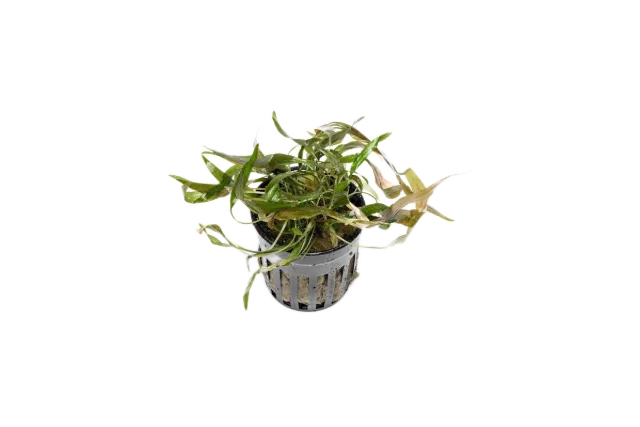
Cryptocoryne striolata is an uncommon rosette plant from Sarawak, Borneo, with long slender stalks topped by compact reddish-brown leaves for midground or background accents. It is a heavy root feeder sensitive to moves and parameter changes, needs low to medium light, and grows slowly with CO2 optional.
Quick facts
Identity
- Also known as
- Striped water trumpet
- Synonyms
- Cryptocoryne striolata var. striolata; Cryptocoryne striolata var. grabowskii
- Environment
- Freshwater
- Native to
- Malaysia (Sarawak, Borneo)
- Habitat
- Rheophyte of shallow, fast-flowing forest streams in Sarawak, growing on rocks and submerged tree roots, also found in peat swamps and on limestone.
- Sourcing
- Wild-caught
- Conservation
- Not Evaluated
Care
- Care level
- Expert Only
- Growth form
- Rosette
- Max height
- 4 – 8 in (10 – 20 cm)
- Spread
- 6 in (15 cm)
- Growth rate
- Slow
- Placement
- Midground, Background
Water
- Temperature
- 72 – 82 °F (22 – 28 °C)
- pH
- 5.5 – 7.0
- GH
- 1 – 8 dGH
- Flow
- Moderate
- Light
- Low
- CO₂
- Beneficial
Planting
- Substrate
- Nutrient-rich required
- Feeds from
- Roots
- Fertilizer needs
- High
- Colors
- Green, Brown, Red
Feeding & breeding
- Propagation
- Rhizome division
Something wrong or missing? Submit a correction
Care guide
Overview
Slender stalks up to 8 inches carry compact, reddish-brown leaves in a rosette form suited to midground or background planting. As a Bornean rheophyte, it demands stable soft acidic water, moderate flow, and a nutrient-rich substrate, and is best attempted by experienced growers or in emersed setups. Once settled it should be left undisturbed, as melt readily follows disruption.
Care
This is one of the most demanding crypts in the hobby, a rheophyte adapted to clinging on rocks and roots in fast, well-oxygenated Bornean streams, which makes it collapse easily in the still, warm water of a typical tank. Stable soft to slightly hard acidic water, gentle but steady current, and a nutrient-rich substrate are the baseline requirements, and even then long-term submersed success is inconsistent. Many growers have far better luck raising it emersed in a terrarium or riparium setup, where it also flowers more reliably. Once established, avoid moving it or disturbing the substrate, since this plant resents any disruption.
Planting & trimming
Plant the rhizome shallowly in a nutrient-rich substrate such as aquasoil or a peat-based mix, leaving the crown at the surface rather than burying it deeply. In emersed or riparium culture, keep water levels low so the fine upward-growing roots can interact with the air-water interface, and provide high humidity and low to moderate light. Trim only fully decayed leaves and otherwise leave the plant undisturbed once it has settled in.
Fertilizing
Cryptocoryne striolata draws most of its nutrition through its root system, so a nutrient-rich substrate or buried root tabs matter more than water column dosing. In its natural habitat it also gathers fine detritus and silt trapped by its aerial roots when grown emersed, effectively feeding on organic particulate matter. Pale or thin new leaves point to a substrate that has become nutrient-depleted and due for supplementation.
Propagation
Propagation is achieved by dividing rhizome offshoots once a clump has established several leaves, separating them with a portion of root intact. Growth is slow, so new plantlets take considerable time to appear, and plants are best left undivided until clearly overcrowded. Flowering and seed production occur mainly in emersed cultivation, offering another slow route to propagation for patient growers.
Problems
Sudden collapse or so-called crypt melt is common after transplanting or when water parameters shift, though the rhizome usually survives and can regrow new leaves if left undisturbed. Excess light or unstable water chemistry is a frequent trigger for dieback in this species specifically. Algae fouling on the slow-growing leaves can become an issue in brighter or nutrient-heavy submersed setups.
Sources
More Crypts
Something wrong or missing? Submit a correction
In the community
Popular tanks using Cryptocoryne Striolata
No public tanks are showcasing Cryptocoryne Striolata yet.