
Aquatic Plant
Cryptocoryne Pontederiifolia
Cryptocoryne pontederiifoliaAraceaeCrypts
Price: $6.99 USD
Add from My tanks →1 photos
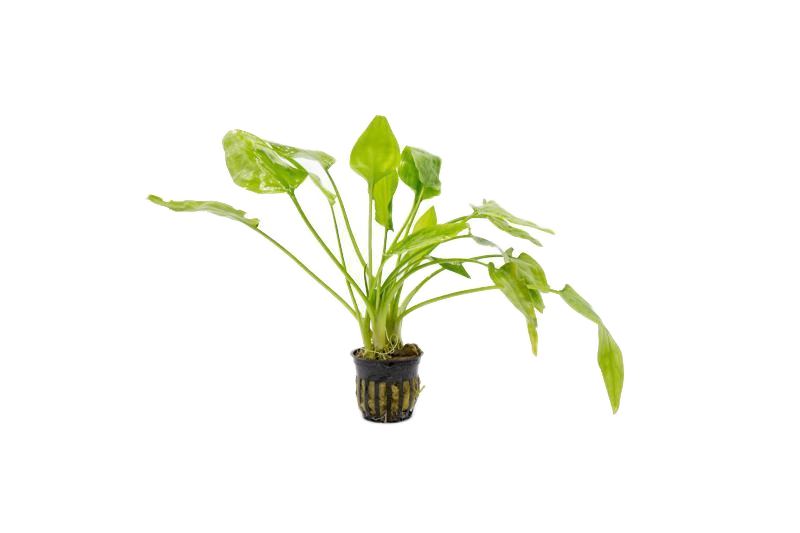
Cryptocoryne pontederiifolia, native to the riverbanks and freshwater tidal zones of Sumatra, has long petioles topped with broad, arrowhead-shaped leaves, light-to-olive green topsides and subtle pinkish undersides. Extremely hardy and adaptable in low-tech tanks; sensitive to sudden parameter shifts and should not be moved.
Quick facts
Identity
- Also known as
- Water trumpet; Crypt pontederiifolia
- Synonyms
- Cryptocoryne cordata var. pontederiifolia
- Environment
- Freshwater
- Native to
- Indonesia (Sumatra), Singapore (introduced)
- Habitat
- Freshwater tidal zones and riverbanks on the northwest coast of Sumatra, growing emersed or submersed alongside nipa palm, occasionally exposed to brackish influence
- Sourcing
- Aquacultured
- Conservation
- Not Evaluated
Care
- Care level
- Easy
- Growth form
- Rosette
- Max height
- 4 – 10 in (10 – 25 cm)
- Spread
- 8 in (20 cm)
- Growth rate
- Slow
- Placement
- Midground, Background
Water
- Temperature
- 72 – 82 °F (22 – 28 °C)
- pH
- 6.0 – 7.5
- GH
- 3 – 15 dGH
- dKH
- 2 – 14 dKH
- PAR
- 20 – 50 PAR
- Flow
- Low-Moderate
- Light
- Low
- CO₂
- Beneficial
Planting
- Substrate
- Nutrient-rich preferred
- Feeds from
- Roots
- Fertilizer needs
- Medium
- Colors
- Green, Pink
Feeding & breeding
- Propagation
- Runners
Something wrong or missing? Submit a correction
Care guide
Overview
Leaves reach 4 to 10 inches on long petioles, forming broad arrowhead blades in olive-green with a pink blush beneath. This rosette-forming crypt spreads slowly by runners into a dense clump and tolerates a wide range of hardness and pH. It resists melt after transplant but sulks if uprooted or rescaped once established.
Care
This crypt tolerates a wide swing of water hardness and mildly acidic to neutral pH, making it forgiving in both soft and hard tap water. It grows well under low to medium light without CO2 injection, though added CO2 speeds up establishment and can intensify leaf coloration. Once planted, it prefers to be left undisturbed, as it settles slowly and resents frequent uprooting or rescaping.
Planting & trimming
Plant individual crowns in the substrate with roots covered but the rhizome crown left exposed, spacing them a few inches apart to allow leaves room to spread. Pressing root tabs into the substrate near the base helps the plant settle in and establish faster. Avoid moving or replanting it once it has rooted, since disturbance often triggers melt.
Fertilizing
Roots draw heavily on nutrients, so a nutrient-rich substrate or regular root tabs are the most effective way to feed it. A weekly dose of a liquid all-in-one fertilizer supplements the water column, particularly for iron and micronutrients. Yellowing leaves, holes, or stalled growth usually point to a nutrient shortfall rather than disease.
Propagation
New plantlets form from runners sent out along the root system, gradually forming a dense clump around the parent plant. Once a daughter plant has developed its own root system, it can be gently separated from the runner and replanted elsewhere. Division is best done during routine maintenance rather than as a dedicated propagation event, since the plant grows slowly.
Problems
Compared with most crypts, this species is unusually resistant to crypt melt after transplanting, a trait linked to its native tolerance of fluctuating tidal water conditions. Algae fouling on the leaves is the most common complaint and typically traces back to excess light, weak flow, or insufficient fertilization rather than a fault in the plant itself. When melt does occur, leaving the root system undisturbed allows new, better-adapted leaves to emerge within a few weeks.
Sources
More Crypts
Something wrong or missing? Submit a correction
In the community
Popular tanks using Cryptocoryne Pontederiifolia
No public tanks are showcasing Cryptocoryne Pontederiifolia yet.