Cryptocoryne
Cryptocoryne Lucens
Cryptocoryne lucensAraceaeCrypts
Price: $24.99 USD
Add from My tanks →1 photos
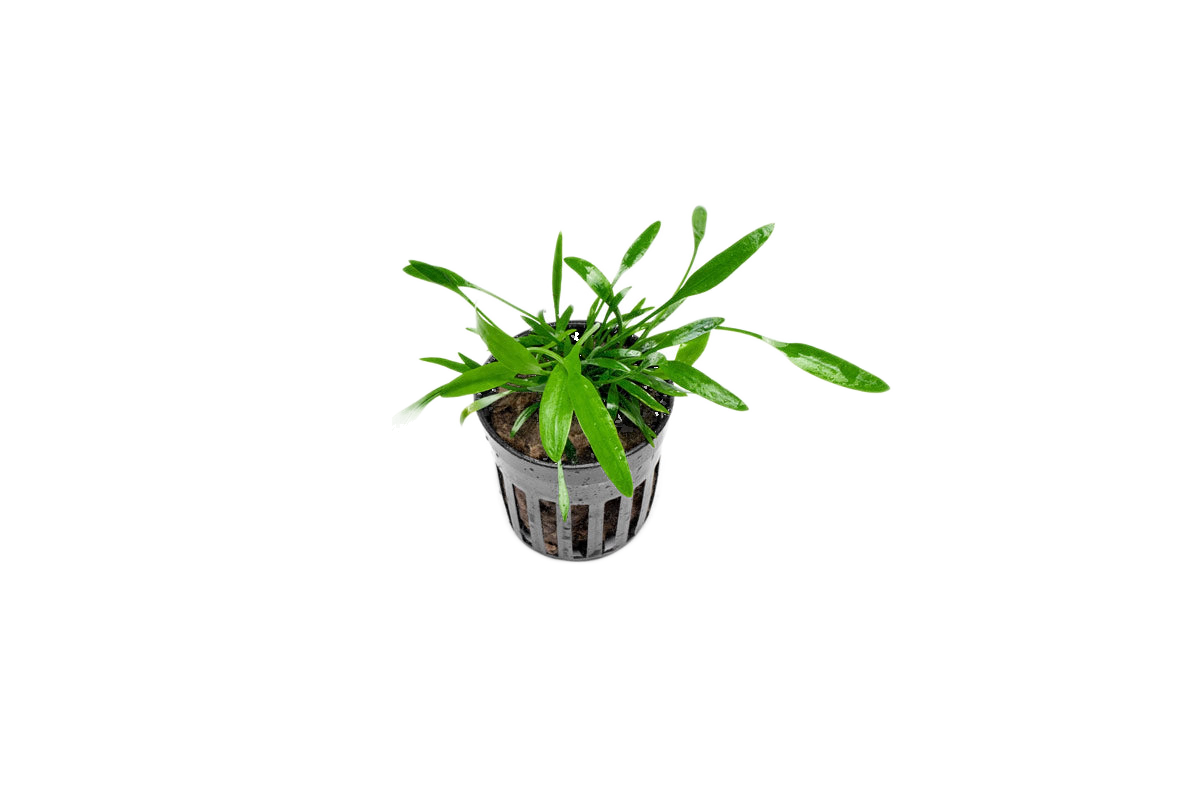
Cryptocoryne lucens, native to Sri Lanka, is a foolproof low-tech plant creating the look of a miniature grassy meadow without high-light maintenance. Narrow, bright emerald-green leaves on brown stems form lush, reed-like thickets in groups; easy care, low to medium light, sensitive to water parameter changes.
Quick facts
Identity
- Also known as
- Willisii Lucens; Cryptocoryne willisii lucens
- Synonyms
- Cryptocoryne × willisii "lucens"
- Environment
- Freshwater
- Native to
- Sri Lanka
- Habitat
- River banks and streams in the central highlands of Sri Lanka near Kandy
- Sourcing
- Aquacultured
- Conservation
- Not Evaluated
Care
- Care level
- Easy
- Growth form
- Rosette
- Max height
- 4 – 8 in (10 – 20 cm)
- Spread
- 6 in (15 cm)
- Growth rate
- Slow
- Placement
- Foreground, Midground
Water
- Temperature
- 72 – 82 °F (22 – 28 °C)
- pH
- 6.5 – 7.5
- GH
- 3 – 10 dGH
- Flow
- Low-Moderate
- Light
- Low
- CO₂
- Beneficial
Planting
- Substrate
- Nutrient-rich preferred
- Feeds from
- Roots
- Fertilizer needs
- Medium
- Colors
- Green, Brown
Feeding & breeding
- Propagation
- Runners, Splitting
Something wrong or missing? Submit a correction
Care guide
Overview
Narrow emerald leaves rise on slender brown stems, forming reed-like tufts that thicken into a grassy meadow effect as runners spread. It suits low to medium light foreground or midground planting and needs no CO2, though a nutrient-rich substrate speeds growth. Keep water parameters stable, as this crypt is prone to melt after disturbance.
Care
This crypt is a compact, narrow-leaved rosette plant that forms dense, reed-like clumps once established. It tolerates a wide range of light levels and does not require CO2 injection, though growth is noticeably faster and denser when CO2 is supplied. Like most Cryptocoryne species, it dislikes sudden changes in water chemistry and may drop leaves in response, so it is best kept in a tank with stable, mature conditions rather than one undergoing frequent parameter swings.
Planting & trimming
Plant individual rosettes into the substrate so only the roots are buried, leaving the crown and rhizome exposed, and space plants a few inches apart to allow the clump to fill in with runners. It adapts to foreground or midground placement depending on aquascape scale, and older leaves or spent runners can be trimmed periodically to keep the stand neat. Handle transplants gently since Cryptocoryne roots are sensitive to disturbance during the initial settling period.
Fertilizing
Roots benefit from a nutrient-rich substrate or buried root tabs, as this plant draws much of its nutrition through the root system. Iron and micronutrient deficiencies can show up as pale or yellowing new growth, which liquid fertilizing can help correct in low-tech setups. In CO2-enriched, well-fertilized tanks growth becomes noticeably faster and the foliage takes on a darker green tone.
Propagation
Propagation happens mainly through underground runners that produce plantlets around the base of the mother plant, which can be left in place to form a dense mat or separated once they have their own root system. Mature rosettes can also be divided by cutting the crown radially into sections, though this should be reserved for larger, well-established plants and limited to a few divisions at a time.
Problems
Newly planted specimens, especially those converted from emersed nursery stock, commonly experience melt as old leaves die back before new submersed growth appears; the rhizome and roots usually survive and regrowth follows within a few weeks. Sudden shifts in hardness, pH, or lighting can also trigger leaf loss in an otherwise established plant. Algae can accumulate on the slow-growing older leaves in low-light or nutrient-poor tanks, so trimming affected leaves helps keep the clump tidy.
Sources
More Crypts
Something wrong or missing? Submit a correction
In the community