
Cryptocoryne
Cryptocoryne Blassii
Cryptocoryne cordata var. blassiiAraceaeCrypts
Price: $24.99 USD
Add from My tanks →1 photos
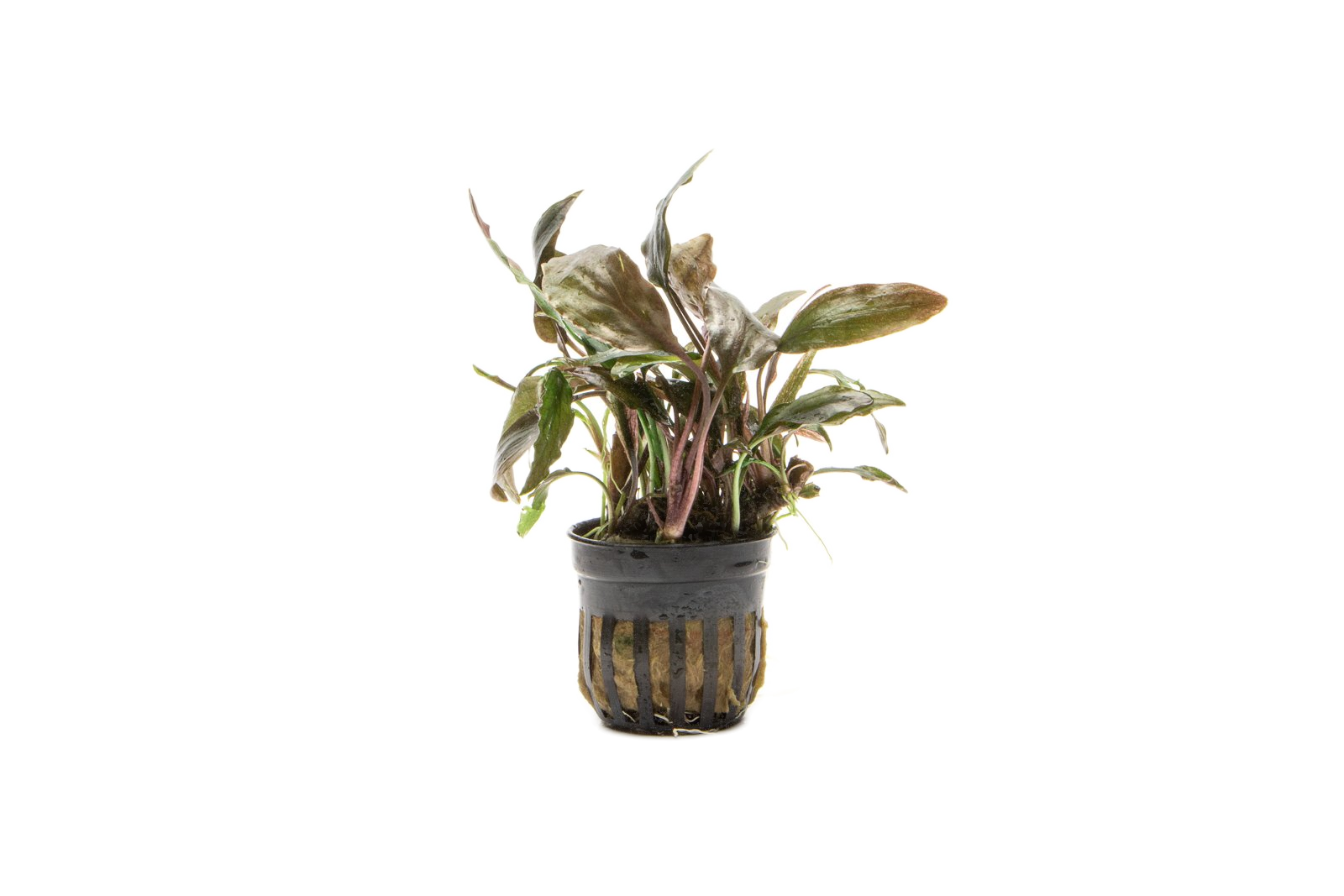
Cryptocoryne cordata var. blassii (Water Trumpet) is a Southeast Asian rosette plant with large oval leaves having deep olive-green tops and rich purple-red undersides, forming a bold midground centerpiece. Medium-difficulty and slow-growing, it is a heavy root feeder needing stable water parameters, moderate light and a permanent planting spot; propagate by rhizome division or offshoot runners.
Quick facts
Identity
- Also known as
- Water Trumpet; Blassii Crypt
- Synonyms
- Cryptocoryne blassii; Cryptocoryne cordata var. cordata "blassii"; Cryptocoryne cordata var. siamensis "blassii"
- Environment
- Freshwater
- Native to
- Thailand, Malaysia, Borneo
- Habitat
- Marshy areas, swamps, shaded streams and ditches in lowland Southeast Asian forests
- Sourcing
- Aquacultured
- Conservation
- Not Evaluated
Care
- Care level
- Moderate
- Growth form
- Rosette
- Max height
- 6 – 16 in (15 – 41 cm)
- Spread
- 12 in (30 cm)
- Growth rate
- Slow
- Placement
- Midground, Background
Water
- Temperature
- 72 – 82 °F (22 – 28 °C)
- pH
- 5.5 – 7.0
- GH
- 2 – 12 dGH
- dKH
- 1 – 10 dKH
- Flow
- Low-Moderate
- Light
- Low
- CO₂
- Beneficial
Planting
- Substrate
- Nutrient-rich required
- Feeds from
- Roots
- Fertilizer needs
- High
- Colors
- Green, Brown, Purple, Red
Feeding & breeding
- Propagation
- Rhizome division, Runners
Something wrong or missing? Submit a correction
Care guide
Overview
Lowland swamps and shaded streams of Thailand, Malaysia and Borneo are home to the wild form of this crypt. It builds a large rosette of olive to bronze-brown leaves with purple-red undersides, staying put once rooted rather than tolerating repeated moves. Expect slow, steady growth and a need for stable, nutrient-rich conditions.
Care
This large crypt forms a bold rosette of oval, olive to bronze-brown leaves with a deep wine-red to purple underside, and it needs a permanent spot since it resents being uprooted once established. Low to medium lighting suits it best, as intense light without adequate CO2 tends to invite algae on its slow-growing leaves. Water parameters should stay stable, since sudden shifts in temperature, pH or hardness are the main trigger for melt in this species.
Planting & trimming
Plant the rhizome shallow with the crown at or just above the substrate line, leaving generous space around it since the mature rosette spreads wide and can shade shorter neighboring plants. It is best treated as a permanent focal plant rather than moved repeatedly, as disturbance to the root system slows recovery. Grouping a few specimens together produces a fuller, cohesive stand in the midground to background.
Fertilizing
Being a heavy root feeder, it depends on a nutrient-rich substrate supplemented with root tabs containing iron and trace elements. Clay-based substrates or a mature aquasoil work well to sustain its dense root system over the long term. Liquid fertilization can help but does not replace the need for enrichment at the roots, and pale or thin new leaves usually signal a lack of substrate nutrients.
Propagation
New plantlets form readily from the creeping rhizome and from runners (stolons) sent out by the mother plant. Once a plantlet has developed a few leaves and its own roots, it can be separated with a clean cut and replanted elsewhere. Division of an overgrown rhizome clump is also effective for multiplying established stands.
Problems
Cryptocoryne melt, a sudden dissolving of leaf tissue, is the most common issue and is usually brought on by transplanting, poor water quality, or abrupt parameter changes rather than disease. The rhizome typically survives beneath the substrate and will send up new growth once conditions settle, so plants should not be discarded after a melt event. Because growth is slow, algae can become a problem if lighting outpaces nutrient uptake, so shading with driftwood or floating plants can help during establishment.
Sources
More Crypts
Something wrong or missing? Submit a correction
In the community
Popular tanks using Cryptocoryne Blassii
No public tanks are showcasing Cryptocoryne Blassii yet.