
Aquatic Plant
Samolus Parviflorus Red
Samolus parviflorusPrimulaceaeStem plants
Price: $10.99 USD
Add from My tanks →1 photos
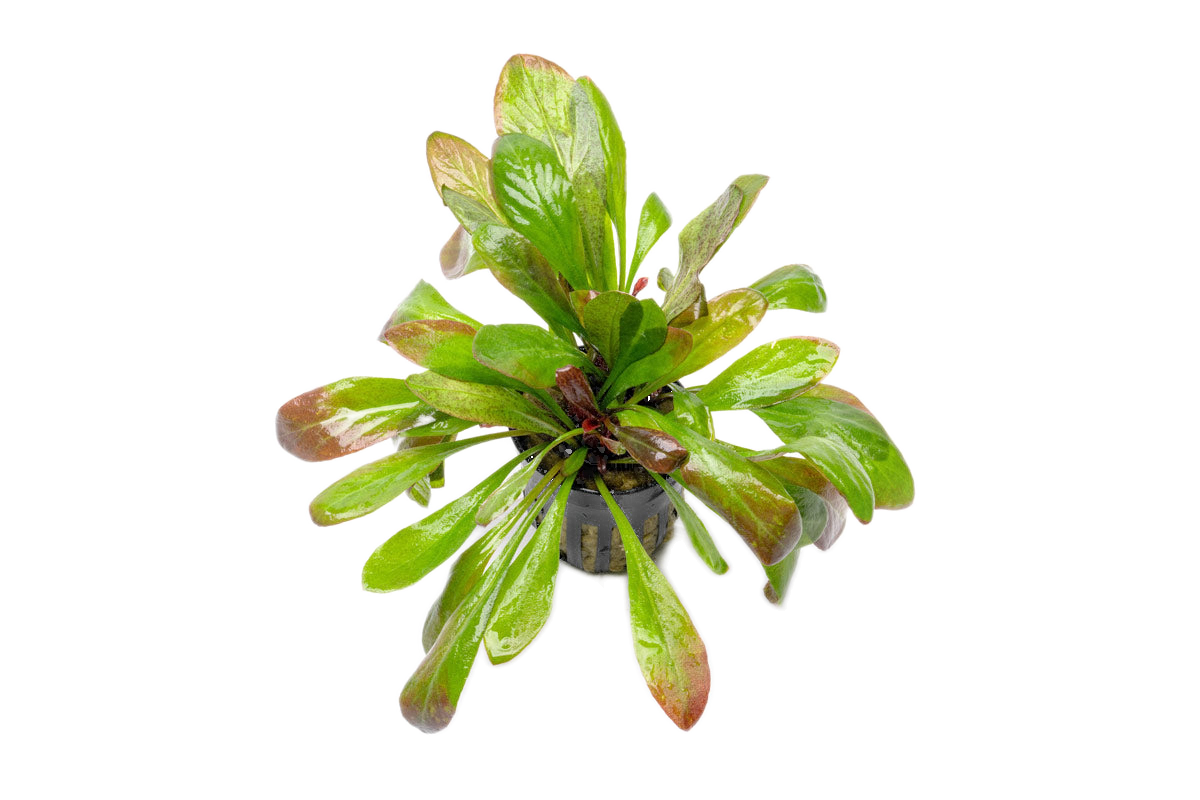
Samolus parviflorus 'Red' is a hardy stem plant with soft red, orange and bronze foliage that forms compact midground bushes, deepening to crimson and copper under brighter light and CO2. Easy to intermediate, it needs moderate to high light, benefits from CO2 and iron for fuller redder leaves, and propagates from stem cuttings.
Quick facts
Identity
- Also known as
- Samolus Red; Lysimachia Parviflora; Red Samolus
- Synonyms
- Lysimachia parvifolia; Samolus parviflorus 'Red'
- Environment
- Freshwater
- Native to
- China (Guangxi)
- Habitat
- Stream banks, ditches and rice paddy margins in limestone karst country of southern China; found fully submersed in rivers as well as growing emersed along banks
- Sourcing
- Aquacultured
- Conservation
- Not Evaluated
Care
- Care level
- Easy
- Growth form
- Stem
- Max height
- 2 – 4 in (5.1 – 10 cm)
- Spread
- 4 in (10 cm)
- Growth rate
- Moderate
- Placement
- Midground
Water
- Temperature
- 64 – 82 °F (18 – 28 °C)
- pH
- 6.0 – 8.0
- GH
- 3 – 18 dGH
- dKH
- up to 8 dKH
- PAR
- 100 – 200 PAR
- Flow
- Low-Moderate
- Light
- Medium
- CO₂
- Beneficial
Planting
- Substrate
- Nutrient-rich preferred
- Feeds from
- Both
- Fertilizer needs
- Medium
- Colors
- Red, Orange, Green, Brown
Feeding & breeding
- Propagation
- Cuttings, Rhizome division, Plantlets
Something wrong or missing? Submit a correction
Care guide
Overview
Deep red to bronze foliage forms a tight, rosette-like cluster rather than tall spaced stems, giving this midground plant a fuller, bushier look than typical Lysimachia species. Moderate to strong lighting with iron-rich fertilization and CO2 brings out its deepest coloration, while low light leaves it thin and green. Easy-going and tolerant of harder, alkaline water, it propagates readily from cuttings and side shoots.
Care
This compact stem plant forms a tight rosette-like cluster of leaves underwater rather than the tall spaced stems typical of most Lysimachia. It tolerates a wide range of water chemistry, including harder and more alkaline water, and grows without injected CO2 or intense light, though both push growth and coloration considerably. Under weaker light the foliage stays thin and greenish, while stronger light in the 100-150+ PAR range combined with steady nutrients produces fuller, rounder, deep red leaves. Growth is moderate, so pruning is needed only occasionally to maintain a dense shape.
Planting & trimming
Plant the rooted base in substrate, though the crown does not strictly need to be buried to grow well since the plant will root and establish with the crown exposed. As it matures it produces side shoots and daughter plantlets that can be separated and replanted, and cut stem tops with visible internodes can also be trimmed and replanted like typical stem plants. Space plants a few inches apart to allow the rosette clusters to fill out without immediately shading each other.
Fertilizing
Regular liquid fertilization dosing iron and micronutrients brings out the strongest red and bronze tones, while a nutrient-rich substrate or root tabs encourage fuller, rounder leaf growth. Nutrient-poor conditions cause the foliage to thin out and fade to green. CO2 injection is not required but noticeably improves leaf density and color saturation.
Propagation
Propagates readily from stem cuttings, which root quickly when replanted in substrate. It also naturally forms side shoots and daughter plantlets around the base that can be separated once large enough and replanted in open spaces of the layout. Occasionally, individual severed leaves are reported to sprout new plantlets on their own.
Problems
Plants kept in low light or poor nutrient conditions gradually lose red pigmentation and revert to plain green, which is a sign to raise light intensity or increase fertilization rather than a disease. Overcrowded clumps tend to send up taller, leggier shoots instead of staying in a tight rosette, so thinning out crowded stems helps maintain compact growth. It is not particularly prone to melt when replanted, unlike many rosette or crypt species.
Sources
More Stem plants
Something wrong or missing? Submit a correction
In the community
Popular tanks using Samolus Parviflorus Red
No public tanks are showcasing Samolus Parviflorus Red yet.