
Aquatic Plant
Rotala Mexicana
Rotala mexicanaLythraceaeStem plants
Price: $6.99 USD
Add from My tanks →1 photos
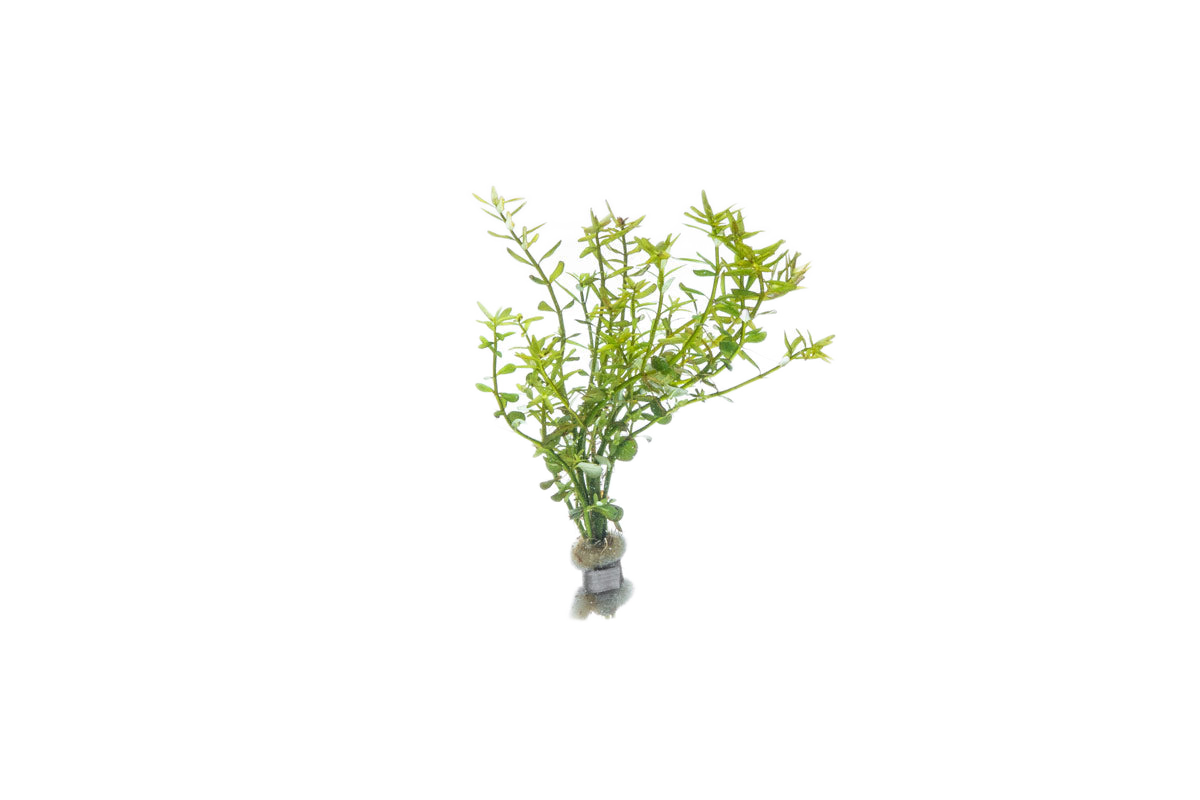
Rotala mexicana is a sought-after fast-growing stem plant from tropical and subtropical regions worldwide, with rounded emersed leaves that transition to narrow needle-like submerged foliage in green, salmon and pink-orange tones on reddish stems. Medium difficulty, it prefers high light, CO2 and iron-rich nutrients for full color, and propagates from stem cuttings.
Quick facts
Identity
- Also known as
- Mexican Rotala; Goias Rotala
- Synonyms
- Rotala pusilla; Rotala sp. 'Goias'; Rotala mexicana 'Goias'; Rotala mexicana 'Araguaia'
- Environment
- Freshwater
- Native to
- Brazil, tropical South America, Central America, western Africa, Australia, Japan
- Habitat
- Seasonally wet ground, rice paddies, and pond and stream margins across tropical and subtropical regions; grows both emersed and submersed.
- Sourcing
- Aquacultured
- Conservation
- Not Evaluated
Care
- Care level
- Moderate
- Growth form
- Stem
- Max height
- 2 – 5 in (5.1 – 13 cm)
- Spread
- 4 in (10 cm)
- Growth rate
- Fast
- Placement
- Foreground, Midground
Water
- Temperature
- 72 – 82 °F (22 – 28 °C)
- pH
- 4.5 – 7.0
- dKH
- 0 – 7 dKH
- Flow
- Low-Moderate
- Light
- High
- CO₂
- Required
Planting
- Substrate
- Nutrient-rich preferred
- Feeds from
- Both
- Fertilizer needs
- High
- Colors
- Green, Red, Orange, Pink
Feeding & breeding
- Propagation
- Cuttings, Runners
Something wrong or missing? Submit a correction
Care guide
Overview
Found across tropical wetlands, rice paddies and pond margins from Brazil to Africa and Japan, this stem plant transitions from rounded emersed leaves to fine needle-like submerged foliage on reddish stems. Under strong light and injected CO2 it forms dense low bushes in orange, pink and salmon tones. It demands consistent high-tech care and iron dosing, making it unsuitable for beginner or low-tech tanks.
Care
Success with this stem plant hinges on keeping conditions consistently high-tech: strong lighting, injected CO2, and a full macro/micro fertilizing regimen. Under those conditions it forms dense, low, needle-leaved bushes that color up in shades of orange and pink, but any shortfall in light, carbon, or nutrients quickly leads to blackened tips and stalled growth. It is not a forgiving choice for low-tech or beginner setups despite its diminutive size.
Planting & trimming
Strip the lower inch of foliage from each cutting and use fine-tipped pinsettes to push stems an inch or two into the substrate, spacing them closely for a dense carpet-like or bushy effect. It can be grown emersed for a paludarium or grown-out prior to submersion, and trimming tops once they near the water surface keeps the lower stems from being shaded out. Replant trimmed tops to thicken the group over time.
Fertilizing
Plant in a nutrient-rich substrate or supplement with root tabs, since the fine root system benefits from steady access to iron and trace elements. Regular liquid fertilizer dosing that includes iron is important for maintaining the reddish-orange coloration; pale or yellowing new growth usually signals an iron or nitrogen deficiency. Potassium and phosphate should also be kept in adequate supply to avoid stunted, weak stems.
Propagation
Propagates readily from stem cuttings: trim the growing tip once it reaches a suitable height and replant it directly into the substrate to root. Runners can also spread the plant laterally along the substrate surface in dense, well-lit setups.
Problems
Insufficient light or CO2 commonly causes blackening of lower leaves and general melt shortly after planting or trimming. Because the foliage is delicate and thin, rough handling during planting can shred leaves, though the plant recovers quickly once established. Algae can accumulate on the fine leaves in tanks with excess nutrients relative to light and CO2, so parameters should be kept balanced.
Sources
More Stem plants
Something wrong or missing? Submit a correction
In the community
Popular tanks using Rotala Mexicana
No public tanks are showcasing Rotala Mexicana yet.