
Aquatic Plant
Rotala Indica
Rotala indicaLythraceaeStem plants
Price: $25.99 USD
Add from My tanks →1 photos
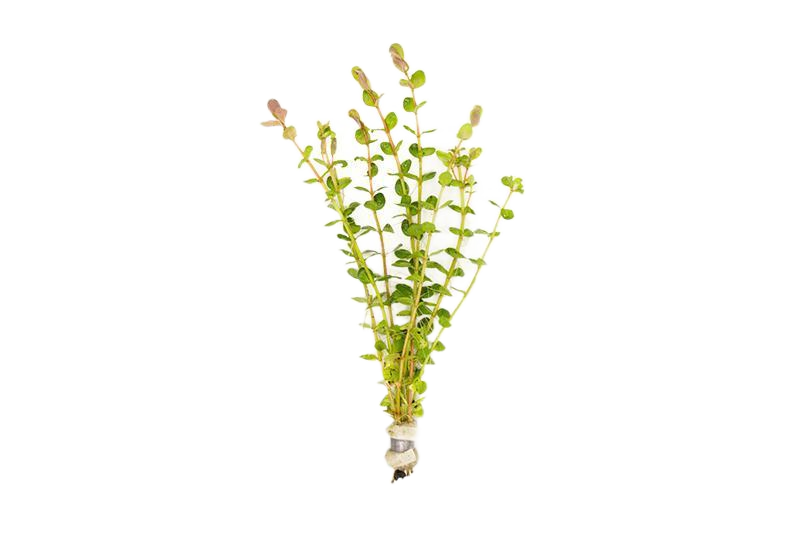
Rotala Indica is a classic aquatic stem plant native to the rice paddies, wetlands, and slow-moving waterways of Southeast Asia and India. Characterized by thick, vertical stems lined with small, rounded, cup-like leaves growing horizontally in opposite pairs, its lower foliage stays light-green while growing tips shift into soft pink, orange, and reddish tones under high light and fertilization.
Quick facts
Identity
- Also known as
- Indian toothcup
- Synonyms
- Ammannia sp. 'Bonsai'; often confused with Rotala rotundifolia
- Environment
- Freshwater
- Native to
- India, Southeast Asia
- Habitat
- Rice paddies, marshes, ditches, and slow-moving shallow waterways across tropical and subtropical Asia
- Sourcing
- Tissue culture
- Conservation
- Not Evaluated
Care
- Care level
- Moderate
- Growth form
- Stem
- Max height
- 4 – 16 in (10 – 41 cm)
- Spread
- 4 in (10 cm)
- Growth rate
- Moderate
- Placement
- Midground, Background
Water
- Temperature
- 72 – 82 °F (22 – 28 °C)
- pH
- 6.0 – 7.5
- GH
- 3 – 8 dGH
- dKH
- 1 – 4 dKH
- PAR
- 30 – 80 PAR
- Flow
- Moderate
- Light
- Medium
- CO₂
- Beneficial
Planting
- Substrate
- Nutrient-rich preferred
- Feeds from
- Both
- Fertilizer needs
- Medium
- Colors
- Green, Pink, Red, Orange
Something wrong or missing? Submit a correction
Care guide
Overview
Rounded, cup-shaped leaves line thick upright stems in opposite pairs, with lower growth staying light green while the tips blush pink, orange, or red under strong light. It suits midground to background planting in groups, adapts to a wide range of water parameters, and needs regular topping to stay dense rather than leggy.
Care
Rotala indica grows as an upright, relatively thick stem with rounded leaves held in opposite pairs, staying compact under bright light and stretching out with wide internode gaps when light is weak. It adapts to a fairly broad range of temperatures and water chemistry, tolerating both soft and moderately hard water, but color and density improve noticeably with stronger lighting and a full fertilization routine. Regular topping keeps the lower stem from becoming bare and encourages branching for a fuller stand.
Planting & trimming
Plant stems in groups of five to ten, pushing them a short distance into the substrate with a couple of centimeters between individual cuttings so the group fills in as a dense stand. Trim tops once the stems approach the desired height and replant the cuttings after stripping the lowest leaves, which also encourages side shoots to form near the base. Regular pruning keeps the stand compact and prevents the lower portions from thinning out and going bare.
Fertilizing
Although it draws most of its nutrition from the water column, planting in a nutrient-rich substrate or using root tabs gives new plantings a stronger start and better root development. Liquid fertilizer with a good iron component brings out the pink and red tones in the growing tips, while pale or yellowing new leaves usually point to an iron or micronutrient shortfall. CO2 injection is not mandatory but noticeably speeds growth and produces tighter internode spacing and richer coloration.
Propagation
Propagation is done by cutting healthy stem tops and replanting them directly into the substrate, where they root readily from the lower nodes within days. Side shoots also form at leaf axils and along cut stems, which can be separated and replanted once established. Given adequate light and nutrients a small planting can fill in a section of the tank within a month or two.
Problems
Newly planted stems often look dull or drop a few lower leaves for the first day or two while adjusting, which is normal and not a sign of failure. Under low light without supplemental CO2, growth turns leggy with sparse, spaced-out foliage rather than the tight, bushy form seen under stronger conditions. Poor water circulation or shading from taller neighbors can lead to algae settling on the slower-growing lower leaves.
Sources
More Stem plants
Something wrong or missing? Submit a correction
In the community
Popular tanks using Rotala Indica
No public tanks are showcasing Rotala Indica yet.