
Aquatic Plant
Pogostemon Sampsonii
Pogostemon sampsoniiLamiaceaeStem plants
Price: $4.99 USD
Add from My tanks →1 photos
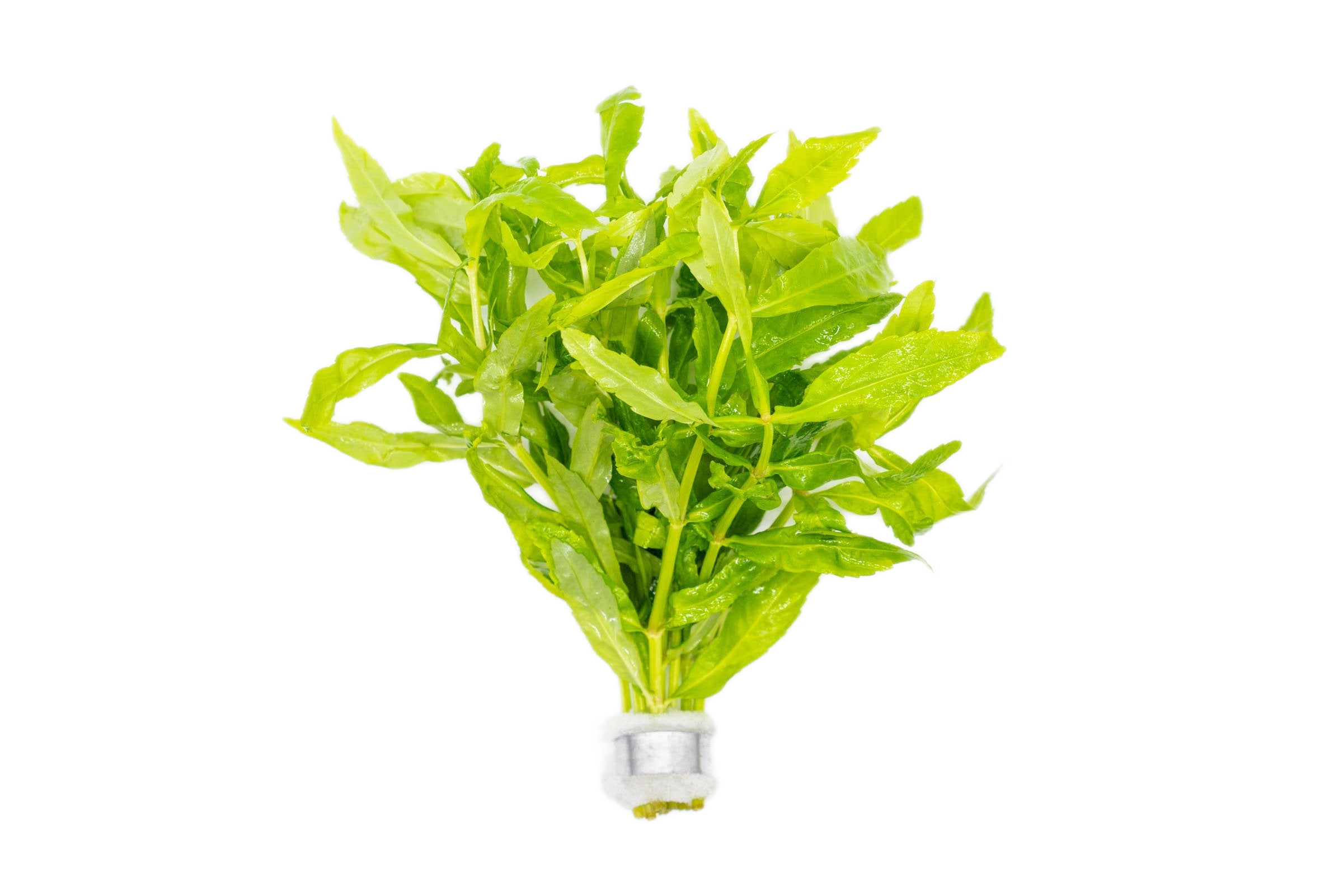
Pogostemon Sampsonii is a unique, attention-grabbing aquatic stem plant native to Thailand's tropical waterways, with narrow, spiky leaves radiating outwards from rigid central stems in symmetrical whorls. It creates an eye-catching background or midground bush with a distinct starburst texture, branching aggressively under routine pruning.
Quick facts
Identity
- Also known as
- Starburst Pogostemon
- Synonyms
- Limnophila punctata; Pogostemon cf. pumilus
- Environment
- Freshwater
- Native to
- Southern China (Guangdong, Guangxi, Guizhou, Hunan, Jiangxi), Vietnam
- Habitat
- Wet ground and margins of streams, ditches and paddy fields; grows emersed on saturated soil and submersed when flooded
- Sourcing
- Aquacultured
- Conservation
- Not Evaluated
Care
- Care level
- Moderate
- Growth form
- Stem
- Max height
- 4 – 9.8 in (10 – 25 cm)
- Spread
- 4 in (10 cm)
- Growth rate
- Moderate
- Placement
- Midground, Background
Water
- Temperature
- 72 – 82 °F (22 – 28 °C)
- pH
- 6.0 – 7.5
- dKH
- 2 – 10 dKH
- Flow
- Low-Moderate
- Light
- Medium
- CO₂
- Beneficial
Planting
- Substrate
- Nutrient-rich preferred
- Feeds from
- Both
- Fertilizer needs
- Medium
- Colors
- Green
Feeding & breeding
- Propagation
- Cuttings
Something wrong or missing? Submit a correction
Care guide
Overview
Whorls of narrow, pointed leaves radiate outward from upright stems at evenly spaced nodes, giving the plant its starburst look. Under medium to high light the whorls stay tight and compact, making a dense midground or background bush that branches readily when trimmed. It grows moderately, adapts to submersed culture from emersed stock, and tolerates a wide community of fish and shrimp.
Care
Pogostemon sampsonii sits in the middle of the genus for difficulty, easier than the notoriously fussy Pogostemon stellatus but a bit more demanding than a basic beginner stem. Medium to high lighting keeps the whorls tight and the internodes short; under weak light the whorls open up and the lower stem bares out, which is the most common complaint with this species. CO2 injection and a nutrient-rich substrate are not mandatory but noticeably speed up branching and deepen leaf color.
Planting & trimming
Plant stem cuttings directly into the substrate, spacing several stems together to form a bushy cluster typical of the midground or background of the layout. Trim at any point along the stem; cut sections branch below the cut, thickening the remaining bush, and the trimmed tops can be replanted to start new stems.
Fertilizing
A fertile substrate or root tabs placed near the root zone support steady growth, and regular liquid dosing of iron and potassium helps prevent yellowing of the lower leaves. As with most fast-growing stems, nutrient deficiencies show first in older leaves as pale or chlorotic patches. It responds well to both root feeding and water column fertilization, so either approach or a combination works in practice.
Propagation
Propagated by cutting healthy side shoots or stem tops and replanting them in the substrate, where new roots typically form within about a week. Lateral shoots that emerge from the upper half of older stems can also be removed and used as fresh cuttings once they reach a usable length.
Problems
Under insufficient light or CO2 the stem stretches upward, internodes elongate, and lower leaves drop off, giving a leggy and sparse appearance rather than the tight starburst whorls it is grown for. It is not particularly prone to melt after planting, though newly submersed emersed-grown stock may shed a few older leaves as it converts to the underwater form. Algae can settle on the slower-growing lower stem sections if light is excessive relative to nutrient availability.
Sources
More Stem plants
Something wrong or missing? Submit a correction
In the community
Popular tanks using Pogostemon Sampsonii
No public tanks are showcasing Pogostemon Sampsonii yet.