
Aquatic Plant
Pogostemon Erectus
Pogostemon erectusLamiaceaeStem plants
Price: $8.99 USD
Add from My tanks →1 photos
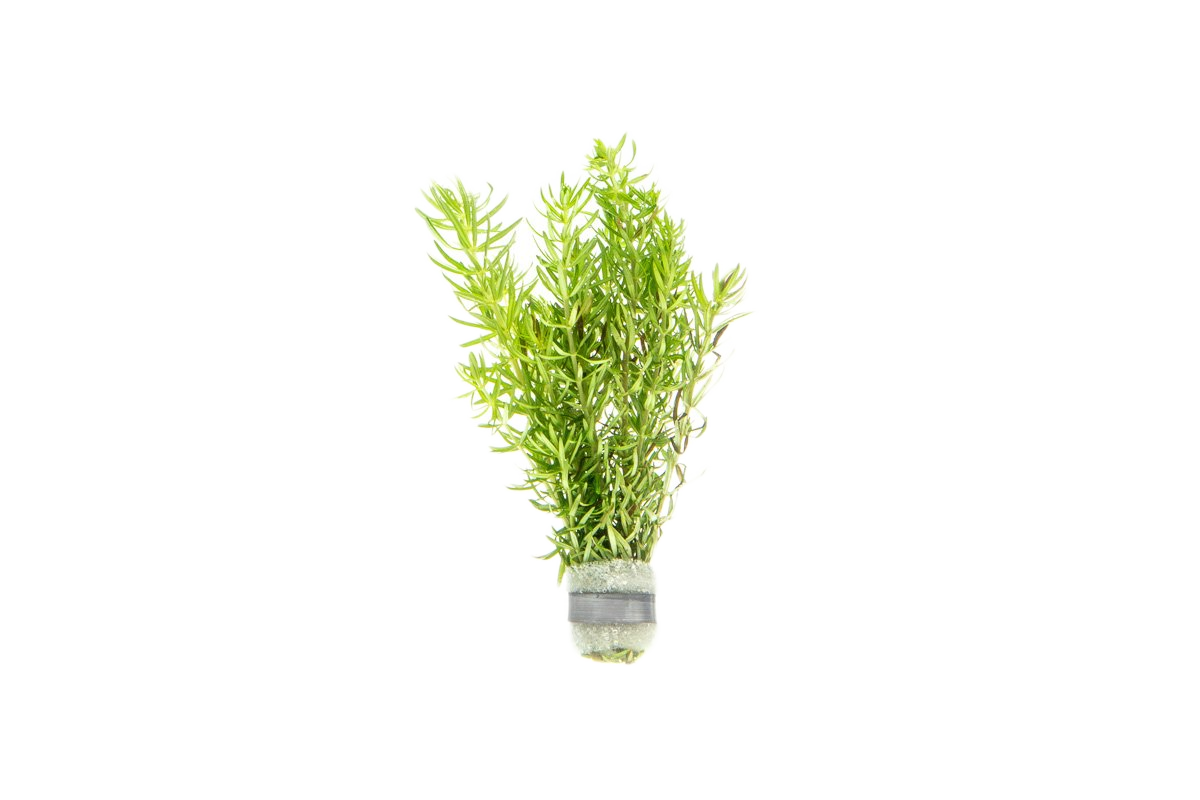
Pogostemon Erectus (Pine Needle) is a striking, fine-textured aquatic stem plant native to the tropical wetlands of India and Southeast Asia, renowned for its pine-cone or needle-like appearance. Dense whorls of bright emerald-green, needle-shaped leaves radiate from sturdy vertical stems, forming a lush, forest-like thicket in tight groups.
Quick facts
Identity
- Also known as
- Indian Star Plant; Pine Needle Plant
- Synonyms
- Misapplied as Rotala verticillaris; Pogostemon sp. "erectus"
- Environment
- Freshwater
- Native to
- India (Western Ghats, Maharashtra)
- Habitat
- Marshes, ditches, and shallow seasonal wetlands in the Western Ghats and surrounding lowlands of India
- Sourcing
- Aquacultured
- Conservation
- Not Evaluated
Care
- Care level
- Moderate
- Growth form
- Stem
- Max height
- 4 – 16 in (10 – 41 cm)
- Spread
- 4 in (10 cm)
- Growth rate
- Fast
- Placement
- Midground, Background
Water
- Temperature
- 70 – 82 °F (21 – 28 °C)
- pH
- 5.5 – 7.5
- GH
- 2 – 12 dGH
- dKH
- 1 – 14 dKH
- Flow
- Low-Moderate
- Light
- Medium
- CO₂
- Beneficial
Planting
- Substrate
- Nutrient-rich preferred
- Feeds from
- Both
- Fertilizer needs
- Medium
- Colors
- Green
Feeding & breeding
- Propagation
- Cuttings
Something wrong or missing? Submit a correction
Care guide
Overview
Reaching up to 16 inches tall while staying a compact few inches wide, this stem plant grows in tight, upright columns of whorled, needle-like leaves resembling small conifer sprigs. Medium-high light and steady CO2 keep the whorls dense rather than leggy, and regular topping maintains a full background wall. It roots best left undisturbed once established.
Care
This upright stem plant forms dense whorls of fine, needle-like leaves that give it a conifer-like silhouette unlike most other aquarium stems. Medium to high lighting keeps the whorls tight and compact; under weaker light the lower leaves drop and the stems become bare and leggy. CO2 injection is not strictly required but makes a marked difference in density and growth speed, and the plant responds well to a nutrient-rich substrate with root tabs. Trim the tops regularly and replant cuttings to maintain a dense, bushy background wall.
Planting & trimming
Plant stems individually or in small groups of three to five, spacing them enough that light reaches the lower whorls, and push several centimeters of stem into the substrate so it anchors firmly. An aquasoil or other nutrient-rich substrate is preferred, though it will grow in inert substrate if root tabs are added. Trim the growing tips as the stems near the surface to keep the stand dense rather than letting it grow leggy.
Fertilizing
Feed through both the root system and the water column, since this species draws nutrients well from either source. A nutrient-rich substrate or root tabs support strong lower growth, while a weekly liquid fertilizer dosed for nitrate, potassium, and iron sustains the fast-growing tops. Yellowing leaves or thinning whorls usually point to iron or micronutrient deficiency rather than disease, and increasing dosing along with steady CO2 typically resolves it.
Propagation
Propagate by cutting several centimeters off a healthy stem tip and replanting the cutting directly into the substrate, where it will root and produce new side shoots. The remaining lower stem will also branch and send up fresh growth after topping, so a single stand can be multiplied repeatedly over time.
Problems
The most common issue is algae fouling the fine leaves, usually from too much light relative to available nutrients and CO2, so trimming light duration or boosting fertilization and flow generally clears it. Some lower leaf shedding after planting or transplanting is normal while the stem adjusts to submersed conditions. Roots dislike disturbance, so once established the plant is best left undisturbed rather than frequently uprooted and moved.
Sources
More Stem plants
Something wrong or missing? Submit a correction
In the community
Popular tanks using Pogostemon Erectus
No public tanks are showcasing Pogostemon Erectus yet.