
Aquatic Plant
Myriophyllum Tuberculatum
Myriophyllum tuberculatumHaloragaceaeStem plants
Price: $23.97 USD
Add from My tanks →1 photos
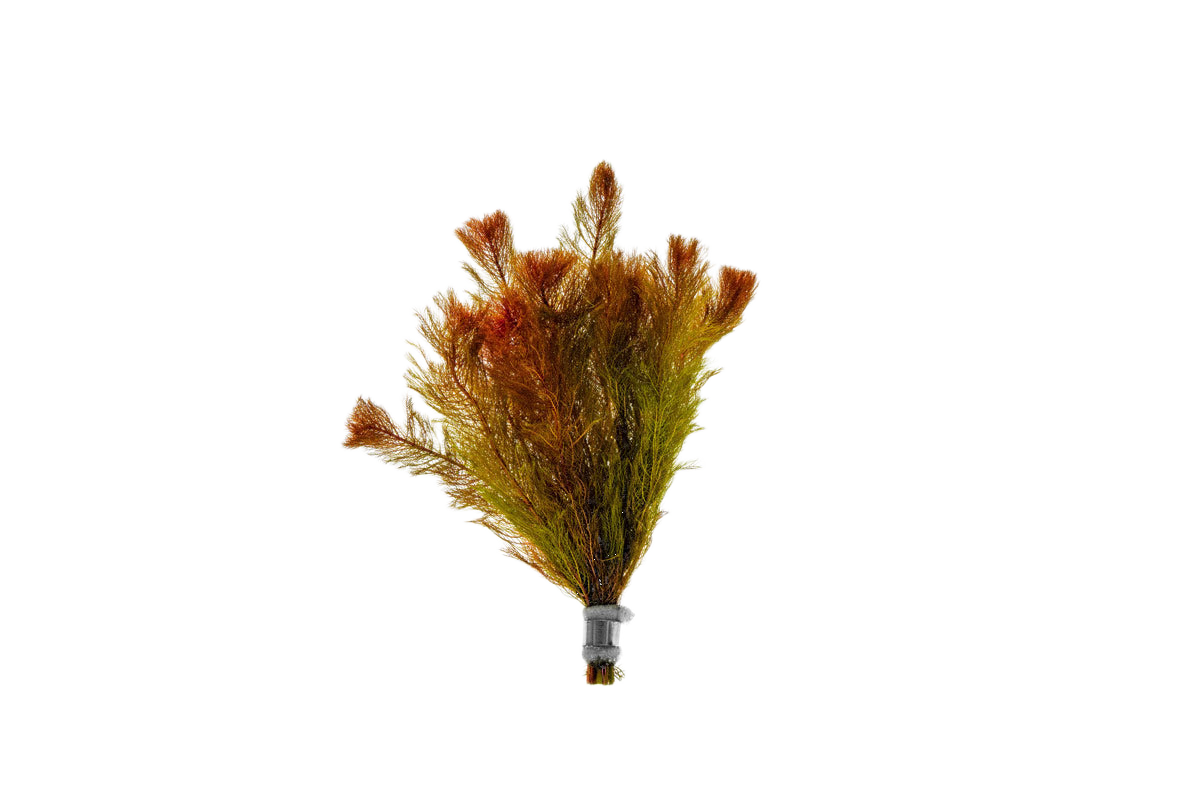
Myriophyllum Tuberculatum (Red Watermilfoil) is a striking, highly sought-after aquatic stem plant famous for its fine, needle-like foliage radiating in delicate fir-like whorls along sturdy stems. Under high-tech conditions its foliage displays a fiery spectrum of rusty orange, salmon, and deep copper-red, serving as a spectacular centerpiece.
Quick facts
Identity
- Also known as
- Red Watermilfoil; Red Myriophyllum
- Synonyms
- Myriophyllum mattogrossense (misapplied); Myriophyllum pinnatum (misapplied)
- Environment
- Freshwater
- Native to
- Tropical Asia
- Habitat
- Slow-flowing and stagnant shallow waters in tropical Asia
- Sourcing
- Both
- Conservation
- Not Evaluated
Care
- Care level
- Difficult
- Growth form
- Stem
- Max height
- 4 – 20 in (10 – 51 cm)
- Spread
- 4 in (10 cm)
- Growth rate
- Fast
- Placement
- Midground, Background
Water
- Temperature
- 72 – 82 °F (22 – 28 °C)
- pH
- 6.0 – 7.0
- GH
- 2 – 8 dGH
- dKH
- 0 – 6 dKH
- PAR
- 50 – 80 PAR
- Flow
- Low-Moderate
- Light
- High
- CO₂
- Required
Planting
- Substrate
- Nutrient-rich preferred
- Feeds from
- Both
- Fertilizer needs
- High
- Colors
- Red, Orange, Brown, Green
Feeding & breeding
- Propagation
- Cuttings
Something wrong or missing? Submit a correction
Care guide
Overview
Fine, needle-like whorls climb along slender stems that can reach 20 inches, radiating outward in a fir-branch pattern. Under strong light and steady CO2 the foliage shifts from rusty orange to deep copper-red, but growth stalls and colour fades quickly under weaker setups. Best suited to established, clean, nutrient-dosed high-tech tanks rather than low-maintenance setups.
Care
This fine-leaved milfoil is one of the more demanding red stem plants, needing strong, unshaded lighting and consistent CO2 injection to hold its rusty-orange to copper coloration. It is fussy about water cleanliness, since its feathery whorls are easily fouled by debris or algae, which then smothers photosynthesis and causes decline. A loose, fine-grained substrate and gentle but steady flow help keep the fragile stems and root system intact.
Planting & trimming
Plant stems carefully in a loose, nutrient-rich substrate to avoid damaging the roots, spacing groups roughly 2-4 inches apart so light reaches lower leaves. As stems reach the surface they branch heavily and develop a bushy habit, so trim by removing the older lower stem and replanting the stronger upper cutting, since the remaining rooted base regrows slowly. Avoid planting too densely, as the fine leaves need good light penetration throughout the whorl.
Fertilizing
Nitrates and phosphates should be kept at moderate, stable levels (roughly 5-15 ppm nitrate and 1-2 ppm phosphate) since this plant reacts poorly to nutrient swings or depletion. It has a higher demand for iron and trace elements than most stem plants, and a shortage shows up as dark, stunted growth or a dying shoot tip. Root tabs in the substrate combined with a complete liquid fertilizer dosed regularly give the most reliable results.
Propagation
Propagation is done vegetatively by cutting lateral shoots or the upper portion of a stem and replanting them directly into the substrate. New cuttings root readily under strong light and stable nutrient dosing.
Problems
Old leaves are prone to algae colonization when phosphate runs low, and poor micronutrient supply causes stunted, dark growth or dieback of the growing tip. The plant is intolerant of cold temperatures and does poorly outside a warm tropical range. Because the foliage is delicate and easily clogged by fine debris, cultivation is best limited to clear, well-filtered, low-algae tanks.
Sources
More Stem plants
Something wrong or missing? Submit a correction
In the community
Popular tanks using Myriophyllum Tuberculatum
No public tanks are showcasing Myriophyllum Tuberculatum yet.