
Aquatic Plant
Myriophyllum Aquaticum (Parrot's Feather)
Myriophyllum aquaticumHaloragaceaeStem plants
Price: $20.97 USD
Add from My tanks →1 photos
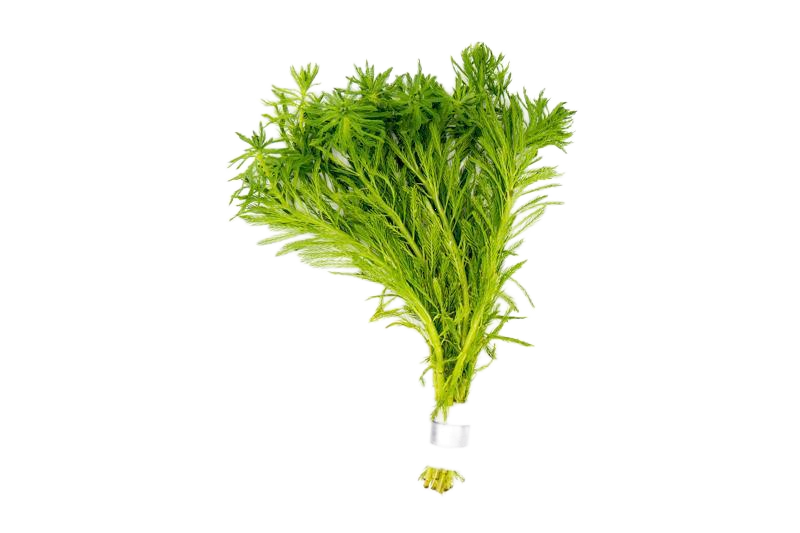
Myriophyllum Aquaticum (Parrot's Feather) is a fast-growing, highly textured aquatic stem plant native to the Amazon Basin. Its needle-like foliage creates a delicate feather-like look; emersed growth builds fir-like mini forests at the surface while submerged foliage stays soft and bright green.
Quick facts
Identity
- Also known as
- Parrot's feather; Brazilian watermilfoil; Red-stemmed parrot feather
- Synonyms
- Myriophyllum brasiliense; Myriophyllum proserpinacoides
- Environment
- Freshwater
- Native to
- South America (Amazon Basin and southern regions)
- Habitat
- Shallow wetlands, slow-moving streams, canals, lake and pond margins, rooted in soft mud with stems trailing to the surface
- Sourcing
- Captive-bred
- Conservation
- Not Evaluated
Care
- Care level
- Easy
- Growth form
- Stem
- Max height
- 4 – 16 in (10 – 41 cm)
- Spread
- 6 in (15 cm)
- Growth rate
- Fast
- Placement
- Background, Midground, Floating
Water
- Temperature
- 64 – 82 °F (18 – 28 °C)
- pH
- 6.0 – 7.5
- GH
- 3 – 16 dGH
- dKH
- 2 – 14 dKH
- PAR
- 40 – 80 PAR
- Flow
- Low-Moderate
- Light
- High
- CO₂
- Beneficial
Planting
- Substrate
- Nutrient-rich preferred
- Feeds from
- Both
- Fertilizer needs
- Medium
- Colors
- Green, Blue, Red
Feeding & breeding
- Propagation
- Cuttings
Something wrong or missing? Submit a correction
Care guide
Overview
South American wetlands and slow canals of the Amazon Basin are the source of this whorled stem plant, now grown almost entirely as female clones propagated by cuttings. Submersed stems stay soft and green, while emergent growth turns stiffer and blue-green under strong light. Fast-growing and easy, it needs regular trimming and careful cutting disposal to avoid spreading outdoors.
Care
Parrot's feather is easy to grow in a wide range of water conditions, tolerating both soft and moderately hard water and a broad temperature span, though it performs best in bright light with rich substrate. Given a strong light source and an open top it will grow past the waterline, forming the stiff, blue-green emergent foliage that gives the plant its feathery look, while submersed growth stays softer and more uniformly green. Regular trimming keeps stems from tangling and shading the rest of the layout, and any node left in the water will root, so pruned cuttings need to be disposed of carefully rather than discarded outdoors.
Planting & trimming
Plant stem cuttings directly into fine gravel or nutrient-rich substrate, burying the lower node while leaving the growing tip exposed, and space stems a few inches apart to allow light to reach lower foliage. It adapts well to both fully submersed setups and open-top tanks or ponds where it is allowed to emerge, and trimming the tops regularly encourages bushier, more compact growth rather than long leggy stems reaching for the surface.
Fertilizing
Growth is fast in nutrient-rich water, and the plant draws heavily through both roots and water column, so root tabs in the substrate paired with a balanced liquid fertilizer support the strongest growth. Iron supplementation helps maintain leaf color, and pale or thin emergent growth usually signals a lack of light or macronutrients rather than a specific deficiency. CO2 injection is not required but noticeably speeds up growth and produces denser, more compact stems.
Propagation
Propagation is done almost entirely by cuttings, since flowering plants outside South America are exclusively female and produce no viable seed. Any stem fragment containing a node will readily root in substrate or even float and root at the surface, making it one of the easiest aquatic plants to multiply, though this same trait makes uncontrolled disposal of trimmings a serious invasive-species risk in outdoor waterways.
Problems
Lower leaves on older stems tend to thin out and drop as the plant reaches for the surface, which is normal rather than a sign of disease, and is best managed by replanting fresh cuttings from the healthy tips. Mechanical damage from digging or burrowing fish can uproot the shallow-rooted stems, so a stable substrate and some protection around new plantings helps establishment. Because it grows so quickly, algae can build up on the older, slower-growing lower portions of the stem if light or flow is uneven across the tank.
Sources
More Stem plants
Something wrong or missing? Submit a correction
In the community
Popular tanks using Myriophyllum Aquaticum (Parrot's Feather)
No public tanks are showcasing Myriophyllum Aquaticum (Parrot's Feather) yet.