
Aquatic Plant
Ludwigia Sphaerocarpa
Ludwigia sphaerocarpaOnagraceaeStem plants
Price: $12.99 USD
Add from My tanks →1 photos
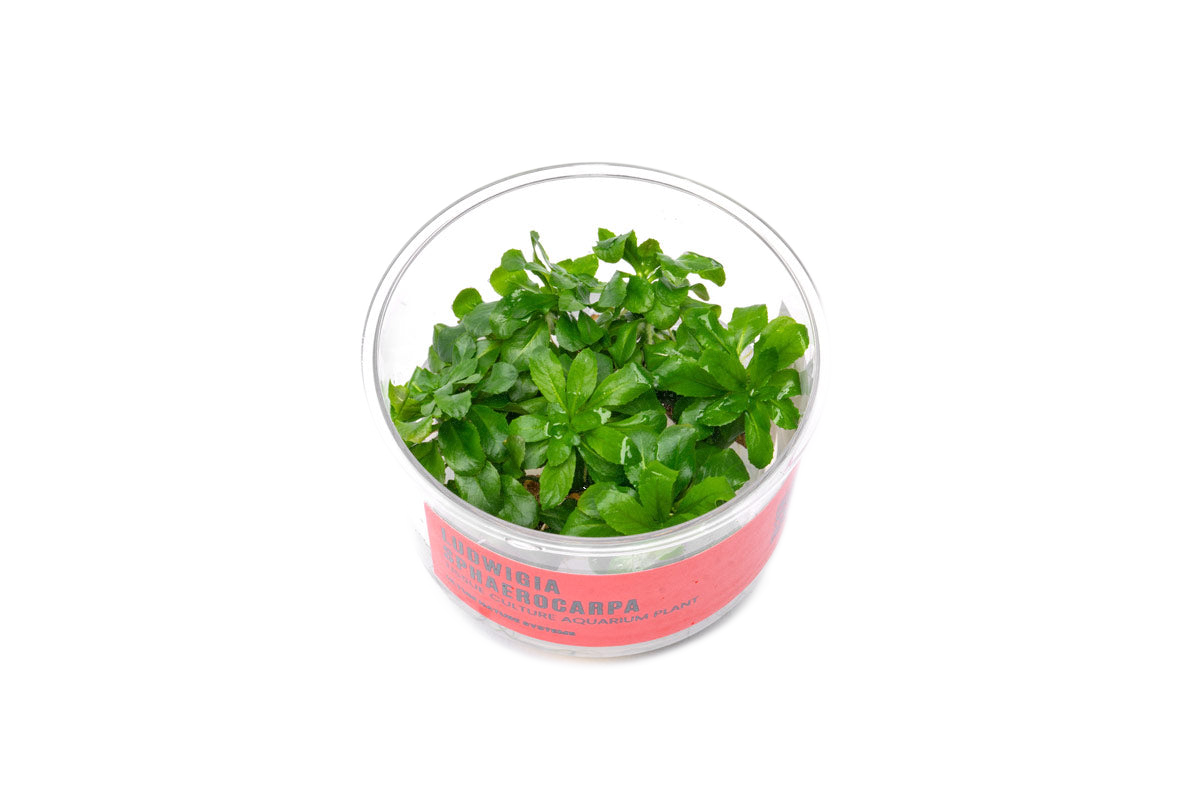
Ludwigia sphaerocarpa is a US-native stem plant unusual for its low, horizontal growth, forming red-to-orange crowns in the foreground and midground with consistent pruning. It needs medium to high light (shade dulls its color), benefits from CO2 and quality soil, and propagates easily from cuttings.
Quick facts
Identity
- Also known as
- Globefruit Primrose-willow; Sphere-fruit Ludwigia
- Synonyms
- Ludwigia pilosa
- Environment
- Freshwater
- Native to
- United States (Massachusetts to Florida, west to Texas)
- Habitat
- Wet coastal marshes, pond margins, and swampy ditches of the eastern and southeastern United States
- Sourcing
- Aquacultured
- Conservation
- Not Evaluated
Care
- Care level
- Moderate
- Growth form
- Stem
- Max height
- 4 – 12 in (10 – 30 cm)
- Spread
- 8 in (20 cm)
- Growth rate
- Moderate
- Placement
- Foreground, Midground
Water
- Temperature
- 68 – 82 °F (20 – 28 °C)
- pH
- 6.0 – 7.5
- GH
- 2 – 12 dGH
- PAR
- 50 – 80 PAR
- Flow
- Moderate
- Light
- High
- CO₂
- Required
Planting
- Substrate
- Nutrient-rich required
- Feeds from
- Both
- Fertilizer needs
- High
- Colors
- Green, Orange, Red, Brown
Feeding & breeding
- Propagation
- Cuttings
Something wrong or missing? Submit a correction
Care guide
Overview
Spreads low and horizontal rather than climbing upward, forming a compact crown of red, orange and brown leaves at the front or middle of the tank when trimmed regularly. High light, CO2, and rich substrate keep it dense; without these it stretches and turns plain green. A moderate-care species suited to nutrient-heavy planted setups.
Care
This is a demanding stem plant that needs strong light and a nutrient-rich substrate to stay compact and colored, otherwise it stretches and fades to plain green. Unlike most Ludwigia species it branches poorly on its own, so its low, almost rosette-like crown depends on regular topping and replanting of cuttings rather than side shoots. CO2 injection and consistent dosing of iron and micronutrients bring out the orange, brown, and red tones in the crown leaves.
Planting & trimming
Plant stems or rooted cuttings into a nutrient-rich substrate in the foreground or midground, spacing them enough apart that light reaches lower leaves. Because it does not branch readily on its own, regular trimming of the growing tip is needed to keep the crown low and encourage a denser, bushier habit. Trimmed tops can be replanted directly to fill out a group.
Fertilizing
Feed with root tabs pushed into the substrate along with a complete liquid fertilizer dosed weekly, since this species draws heavily from both roots and the water column. Iron supplementation is especially important for the orange-red coloration in the upper leaves. Yellowing, pinholes, or a halt in growth usually point to a nutrient shortfall rather than disease, and dropped lower leaves with long internodes signal insufficient light.
Propagation
Propagation is by stem cuttings: snip a few centimeters off a healthy growing tip and replant it directly into the substrate, where it will root and branch into a new crown. This is the primary and most reliable method, as the species is not commonly grown from seed in the hobby.
Problems
Under weak light or thin fertilization the plant loses its compact form, drops lower leaves, and develops stretched internodes as it reaches for light. Algae on the leaves is common when light is too strong relative to nutrient levels or flow, and is best corrected by trimming light duration and boosting fertilization rather than treating the plant itself. Some leaf loss after planting or replanting cuttings is normal during adjustment to submersed conditions.
Sources
More Stem plants
Something wrong or missing? Submit a correction
In the community
Popular tanks using Ludwigia Sphaerocarpa
No public tanks are showcasing Ludwigia Sphaerocarpa yet.