
Aquatic Plant
Ludwigia Senegalensis
Ludwigia senegalensisOnagraceaeStem plants
Price: $7.99 USD
Add from My tanks →1 photos
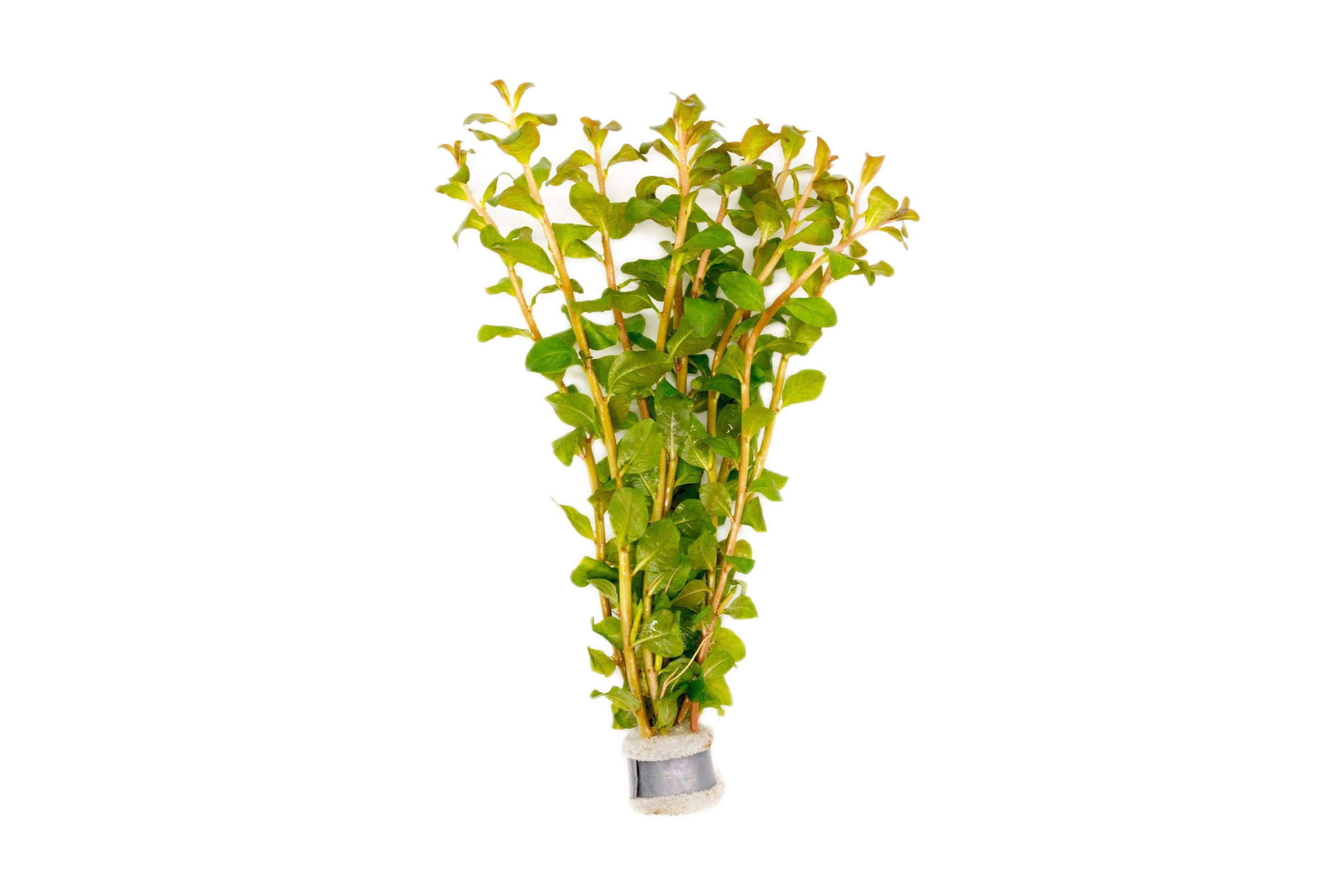
Ludwigia Senegalensis is a rare African aquatic stem plant with oval, slightly reflexed leaves showing an intricate lattice-like mosaic of brick-red, copper, and orange marbling over a golden-green base. Experienced hobbyists prize it for centerpiece or midground Dutch streets in dense, well-lit groups.
Quick facts
Identity
- Also known as
- Ludwigia sp. Guinea
- Synonyms
- Ludwigia sp. Guinea
- Environment
- Freshwater
- Native to
- West Africa, Guinea
- Habitat
- Shallow, soft, warm freshwater margins and seasonally flooded areas in tropical West Africa
- Sourcing
- Both
- Conservation
- Not Evaluated
Care
- Care level
- Difficult
- Growth form
- Stem
- Max height
- 4 – 15 in (10 – 38 cm)
- Spread
- 4 in (10 cm)
- Growth rate
- Moderate
- Placement
- Midground, Background
Water
- Temperature
- 72 – 82 °F (22 – 28 °C)
- pH
- 5.0 – 7.5
- GH
- 0 – 8 dGH
- PAR
- from 50 PAR
- Flow
- Moderate
- Light
- High
- CO₂
- Required
Planting
- Substrate
- Nutrient-rich required
- Feeds from
- Both
- Fertilizer needs
- High
- Colors
- Red, Orange, Brown, Green
Feeding & breeding
- Propagation
- Cuttings
Something wrong or missing? Submit a correction
Care guide
Overview
Reaches roughly 4 to 15 inches tall as an upright stem plant, with oval leaves marbled in brick-red, copper, and orange over a golden-green base. It demands high light, injected CO2, and a nutrient-rich substrate to hold this coloration, otherwise stretching and fading to plain green. Best kept as a generously spaced group for Dutch-style midground or focal-point plantings, with attentive micronutrient dosing to avoid spotted or deformed new growth.
Care
This is one of the more demanding Ludwigia species, needing high light, injected CO2, and a nutrient-rich substrate to hold its color and grow in a compact form. Under weak light it stretches out and fades to plain green, losing the red and copper marbling that makes it desirable. Stems should be spaced generously so lower leaves still receive light, since shading quickly leads to decline in this species.
Planting & trimming
Plant stems individually into a nutrient-rich substrate, leaving enough space between them for light to reach lower leaves as the group fills in. It adapts to both submersed and emersed cultivation, creeping along the substrate surface when grown emersed and standing upright underwater. Regular trimming of the growing tips keeps the plant bushy and prevents the lower stem from becoming bare and leggy.
Fertilizing
Feeds through both roots and the water column, so a nutrient-rich substrate paired with regular liquid fertilization works best. Iron and trace element dosing should be higher than for typical stem plants to achieve full red coloration across the leaves. Deficiencies show up quickly as black or translucent spots on new growth, which is a signal to increase micronutrient dosing right away.
Propagation
Propagated like other stem plants by cutting healthy side shoots or stem tops and replanting them directly into the substrate. Side shoots form readily along the main stem once established, giving a steady supply of cuttings for filling out a group planting.
Problems
New leaves are prone to developing black or transparent spotting when micronutrients run low, and if the cause isn't corrected the following growth emerges deformed. The transition from tissue-cultured or emersed stock to submersed growth is often rough, with some melting of the original leaves before new growth adapts. Once established in stable water conditions it holds up reasonably well, but sudden swings in CO2 or nutrients can send it downhill within a day or two.
Sources
More Stem plants
Something wrong or missing? Submit a correction
In the community
Popular tanks using Ludwigia Senegalensis
No public tanks are showcasing Ludwigia Senegalensis yet.