
Aquatic Plant
Ludwigia Peruensis/Gladulosa var. Diamond
Ludwigia glandulosaOnagraceaeStem plants
Price: $20.97 USD
Add from My tanks →1 photos
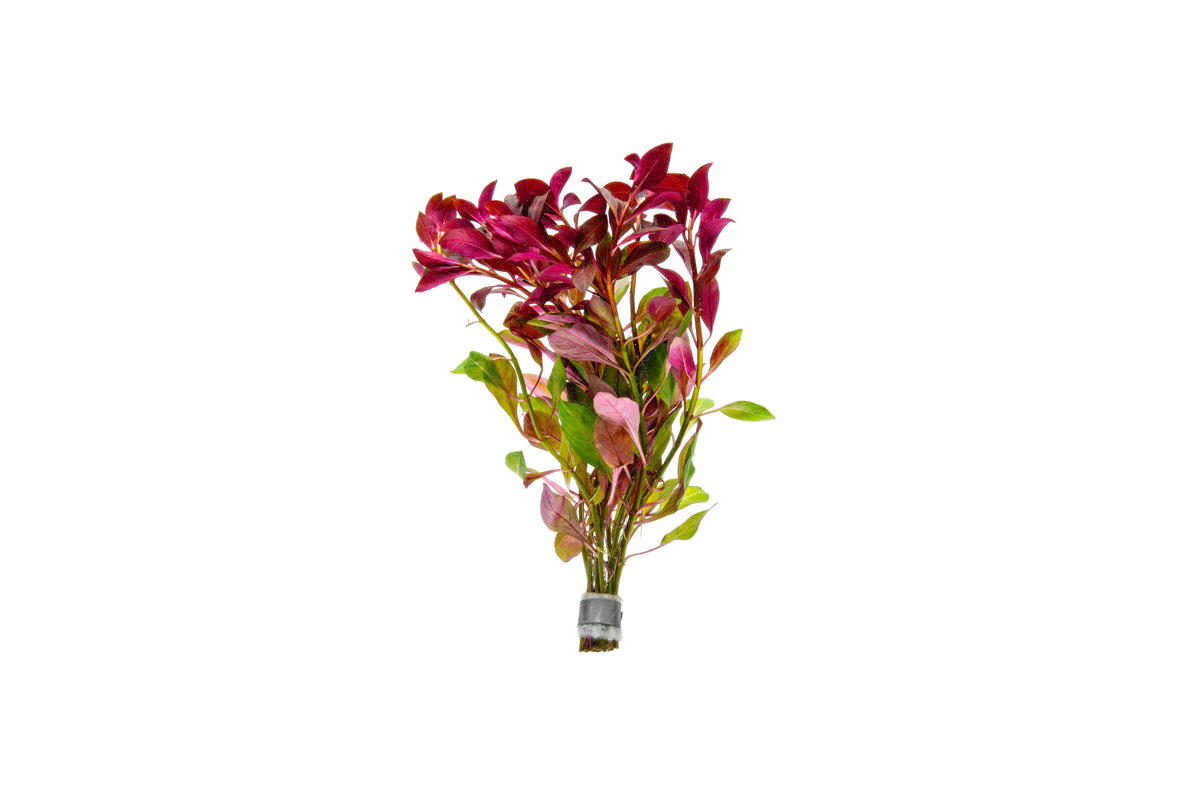
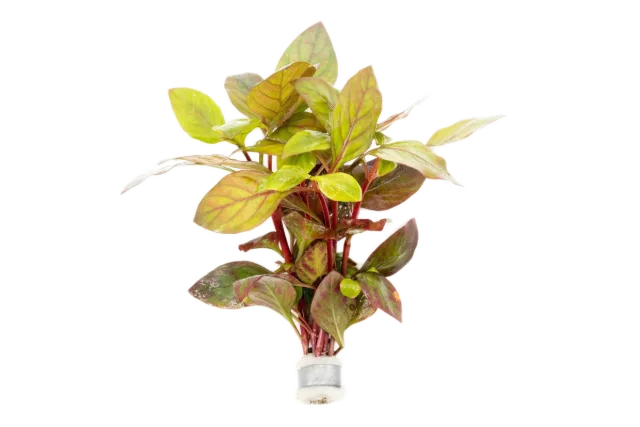
Diamond Ludwigia is a stem plant with olive-to-golden leaf tops and ruby-red undersides even in lower-tech setups. With high-intensity lighting, pressurized CO2, and iron supplementation, it turns into a deep, saturated purplish-red centerpiece; clusters of 10–12 stems form a bold focal point.
Quick facts
Identity
- Also known as
- Cylindric-fruited Primrose Willow; Cylindricfruit Primrose-Willow
- Synonyms
- Ludwigia glandulosa ssp. brachycarpa; often mislabeled as Ludwigia perennis or "Ludwigia peruensis" in the trade
- Environment
- Freshwater
- Native to
- United States (southeastern and central states, north to Illinois and Indiana)
- Habitat
- Wetlands, shallow marshes, roadside ditches, and margins of slow-moving water in the southeastern United States
- Sourcing
- Aquacultured
- Conservation
- Not Evaluated
Care
- Care level
- Difficult
- Growth form
- Stem
- Max height
- 4 – 16 in (10 – 41 cm)
- Spread
- 2 in (5.1 cm)
- Growth rate
- Slow
- Placement
- Midground, Background
Water
- Temperature
- 68 – 82 °F (20 – 28 °C)
- pH
- 6.0 – 7.2
- GH
- 4 – 12 dGH
- Flow
- Low-Moderate
- Light
- High
- CO₂
- Beneficial
Planting
- Substrate
- Nutrient-rich preferred
- Feeds from
- Both
- Fertilizer needs
- Medium
- Colors
- Green, Red, Purple, Orange, Brown
Feeding & breeding
- Propagation
- Cuttings
Something wrong or missing? Submit a correction
Care guide
Overview
Suited to high-tech planted tanks with strong lighting and CO2 injection, this Diamond Ludwigia variant shows olive-to-gold upper leaves with ruby undersides even under modest conditions, deepening to purplish-red with iron dosing. Growth stays slow and upright, so stems are typically grouped 10-12 together and topped periodically to build a dense colored backdrop rather than left to branch on their own.
Care
This is one of the more demanding red stem plants, requiring intense lighting and a steady supply of iron and other micronutrients to hold its wine-red to purplish coloration; without that combination the foliage fades to dull olive-green and the plant sheds its lower leaves. Growth is slow and strictly upright with little natural branching, so the central stem is usually topped and replanted to encourage a bushier habit. Nitrate in the 5-25 mg/L range and phosphate around 0.1-3 mg/L support steady growth without the need for particularly lean macronutrient dosing.
Planting & trimming
Plant stems individually or in groups of 10-12 into a fine, nutrient-rich substrate, spacing them close enough to form a dense colored backdrop or a "plant street" in Dutch-style layouts. Because the submersed form rarely branches on its own, periodically trim and replant the tops to force lateral shoots and keep the group bushy. Remove any packing material from the roots before planting and avoid disturbing newly placed stems while they establish.
Fertilizing
Root tabs pushed into a nutrient-rich substrate help fuel the slow, upright growth, and liquid iron supplementation is particularly important for developing and maintaining the red-purple leaf color. A lack of iron or other micronutrients shows up quickly as leaves turning green before dropping. Macronutrient demand is moderate rather than heavy, but nitrate and phosphate should still be present at measurable levels rather than kept ultra-lean.
Propagation
Propagate by cutting a healthy top or lateral shoot, stripping the lower leaves, and inserting the bare stem into the substrate to root. New roots typically form within a few weeks under adequate light and nutrients. Occasional lateral shoots that appear after trimming the main stem can also be separated and replanted as new cuttings.
Problems
Insufficient light is the most common problem, causing leaves to green up and drop from the bottom of the stem even when overall growth looks otherwise healthy. Because the plant grows slowly, damaged or melted sections take a long time to recover, so stable water parameters and consistent dosing matter more than with faster-growing stems. Handle stems gently when planting since they can be somewhat brittle and prone to snapping or melting after a rough transplant.
Sources
More Stem plants
Something wrong or missing? Submit a correction
In the community
Popular tanks using Ludwigia Peruensis/Gladulosa var. Diamond
No public tanks are showcasing Ludwigia Peruensis/Gladulosa var. Diamond yet.