
Aquatic Plant
Hydrocotyle Leucocephala
Hydrocotyle leucocephalaAraliaceaeStem plants
Price: $7.99 USD
Add from My tanks →1 photos
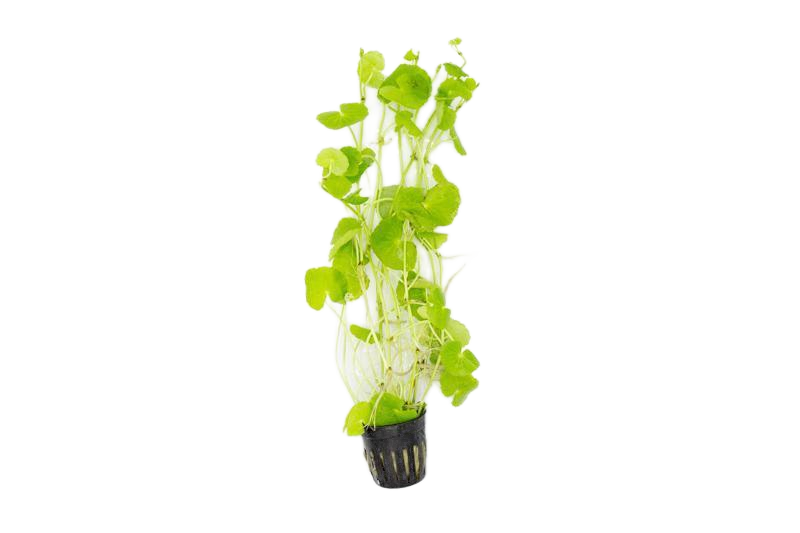
Hydrocotyle Leucocephala, better known as Brazilian Pennywort, is the ultimate fast-growing multitasker from South America's wetlands. Featuring iconic half-dollar-shaped circular leaves along creeping stems, it is absurdly versatile: anchor in substrate, weave through driftwood, or float at the surface; routine trimming keeps it as a tight midground bush or creeping foreground carpet.
Quick facts
Identity
- Also known as
- Pennywort; Marble pennywort; Water pennywort
- Synonyms
- Hydrocotyle asiatica var. leucocephala
- Environment
- Freshwater
- Native to
- Brazil, Central America, South America
- Habitat
- Boggy ground, stream banks, marshes and slow-moving wetlands across Central and South America, growing emersed, floating, or rooted at the water's edge
- Sourcing
- Aquacultured
- Conservation
- Not Evaluated
Care
- Care level
- Easy
- Growth form
- Stem
- Max height
- 2 – 24 in (5.1 – 61 cm)
- Growth rate
- Fast
- Placement
- Foreground, Midground, Background, Floating
Water
- Temperature
- 68 – 82 °F (20 – 28 °C)
- pH
- 6.0 – 7.5
- GH
- 3 – 15 dGH
- Flow
- Low-Moderate
- Light
- Medium
- CO₂
- Beneficial
Planting
- Substrate
- Any
- Feeds from
- Both
- Fertilizer needs
- High
- Colors
- Green, Cream, Variegated
Feeding & breeding
- Propagation
- Cuttings
Something wrong or missing? Submit a correction
Care guide
Overview
Circular, half-dollar-sized leaves line creeping stems that root wherever a node touches surface, whether planted, wound through driftwood, or drifting as a floating mat. Easy and fast-growing in low to moderate flow under medium light, it suits foreground, midground or background placement in tanks from 10 gallons and needs regular trimming to stay bushy rather than leggy.
Care
A creeping stem plant with round, scalloped, coin-shaped leaves that root at each node as they spread. It adapts to almost any placement, planted in substrate where it climbs upward, trained along hardscape, or simply left to float as a surface mat. Medium to strong lighting produces the fastest, densest growth, though it will tick along more slowly under lower light. Because it grows so quickly it needs regular trimming to stay in bounds and keep a bushy shape rather than reaching straight for the surface.
Planting & trimming
Plant individual stems or small bunches a couple inches apart directly into the substrate, or simply let cuttings float freely at the surface. Rooted stems will climb upward and can be trained along driftwood or rockwork, while floating portions form a shading canopy that fish and shrimp use for cover. Regular trimming just above a leaf node keeps the plant dense and compact instead of reaching straight to the surface.
Fertilizing
It draws nutrients through both roots and the water column, so it benefits from a nutrient-rich substrate or root tabs plus regular liquid fertilizer dosing. Being a fast, heavy feeder it strips nitrates from the water effectively, which makes it useful for keeping algae in check, but it will stall and yellow if nutrients run short. CO2 is not required but supplementing it noticeably speeds growth and produces tighter, more compact stems. Watch new leaves for pale or stunted growth as an early sign of a deficiency.
Propagation
Propagation is done by cutting any stem segment that includes a leaf node and replanting it in substrate or simply floating it, since every node is capable of rooting. Trimmed tops can be replanted to thicken existing stands, while lower cuttings often continue growing from the remaining base. Growth is fast enough that a single stem can fill out a section of tank within a few weeks under good light.
Problems
Healthy stems show even, round leaves and short internode spacing; leggy stems with wide gaps between leaves usually indicate insufficient light. Algae can build up on older, slower-growing leaves, especially when the plant is grown emersed or under low flow, and is best managed by trimming away the affected foliage. The variegated form is prone to reverting to plain green, and any all-green shoots should be cut out at the base before they outcompete the marbled growth.
Sources
Varieties in the catalog
More Stem plants
Something wrong or missing? Submit a correction
In the community
Popular tanks using Hydrocotyle Leucocephala
No public tanks are showcasing Hydrocotyle Leucocephala yet.