
Aquatic Plant
Hedyotis Salzmannii
Hedyotis salzmanniiRubiaceaeStem plants
Price: $20.97 USD
Add from My tanks →1 photos
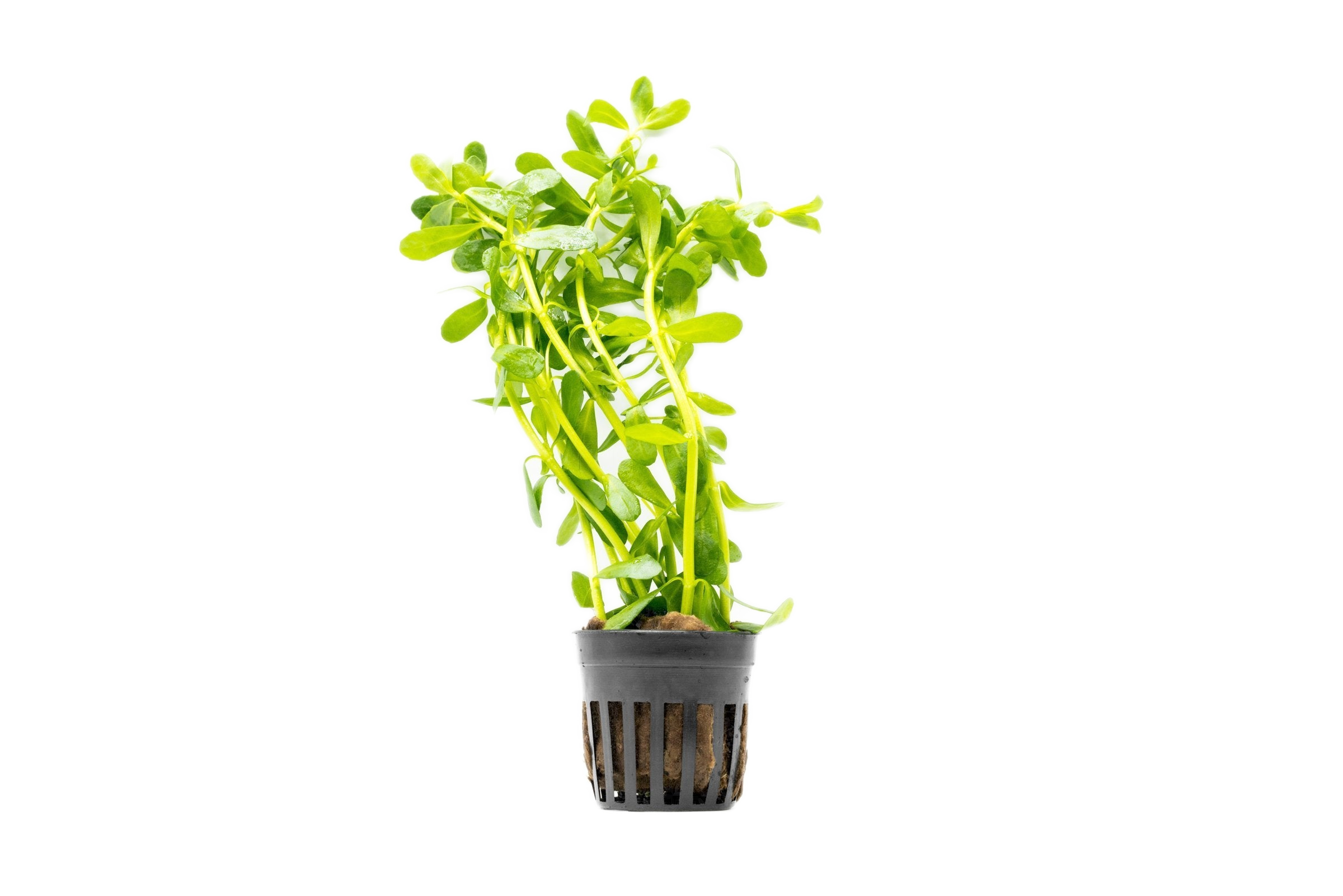
Hedyotis salzmannii is a South American stem plant resembling Bacopa monnieri, with bright green stalks and leaves. Easy and fast-growing, it adapts to most aquarium conditions, grows submerged or emersed, and propagates from cuttings; good light and quality soil help it thrive.
Quick facts
Identity
- Also known as
- Salzmann's mille graines; Dwarf Bacopa; Bacopa sp. "Pantanal"
- Synonyms
- Oldenlandia salzmannii; sold as Bacopa sp. "Pantanal"
- Environment
- Freshwater
- Native to
- Southern Brazil, Uruguay, Paraguay, northeastern Argentina; naturalized in southern United States
- Habitat
- Amphibious creeper in wet meadows, ditches, muddy coasts and the margins of streams and ponds; grows emersed on damp ground and submersed when flooded
- Sourcing
- Aquacultured
- Conservation
- Not Evaluated
Care
- Care level
- Easy
- Growth form
- Stem
- Max height
- 3 – 12 in (7.6 – 30 cm)
- Spread
- 4 in (10 cm)
- Growth rate
- Fast
- Placement
- Foreground, Midground
Water
- Temperature
- 59 – 80 °F (15 – 27 °C)
- pH
- 5.5 – 7.5
- GH
- 4 – 20 dGH
- dKH
- 0 – 14 dKH
- PAR
- 30 – 50 PAR
- Flow
- Low-Moderate
- Light
- Medium
- CO₂
- Beneficial
Planting
- Substrate
- Any
- Feeds from
- Both
- Fertilizer needs
- Medium
- Colors
- Green
Feeding & breeding
- Propagation
- Cuttings
Something wrong or missing? Submit a correction
Care guide
Overview
Suited to low-tech foreground or midground plantings, this fine-stemmed creeper grows fast under ordinary light without CO2, though injection thickens its internodes. Its weak root system means clumps often lift free over time, a normal quirk rather than a health problem, so periodic trimming and replanting keeps stands dense and rooted.
Care
A fine-stemmed, pale to fresh green plant that grows quickly under ordinary aquarium light and does not require CO2 injection, though supplementation speeds growth and produces denser internodes. It tolerates a wide temperature range and can be kept in unheated tanks or even moved outdoors to a pond for the warmer months. The main quirk to manage is its weak, thread-like root system, which anchors poorly in substrate and causes older stands to lift free over time.
Planting & trimming
Plant stems in small loose groups directly into the substrate rather than as single stalks, since the fine roots anchor weakly and isolated cuttings are easily uprooted by flow or fish activity. As stands mature and begin to lift out of the substrate, the practical routine is to snip and replant the healthy tips while discarding the bare, rootless lower sections. Regular trimming keeps the plant bushy and prevents it from stretching thin under lower light.
Fertilizing
Nutrient needs are modest compared to heavier feeders like Hygrophila, with uptake split between fine roots and direct absorption through the leaves from the water column. A basic gravel or sand substrate capped with root tabs, combined with weekly liquid fertilizer dosing for nitrogen, phosphorus, potassium and iron, is sufficient. Pale or thin new growth usually signals a need for more iron or micronutrients rather than macro deficiency.
Propagation
Propagation is done by cutting stem tips and replanting them, as the species branches readily from any cut or bent node. It can also be grown emersed in paludariums or wabi-kusa, where it creeps along damp substrate and produces small white or pale pink flowers.
Problems
Because its roots are so fine, established clumps often loosen and float free rather than rotting outright, which can be mistaken for disease when it is simply the plant's normal growth habit. Shoot tips sometimes detach and drift on their own, a behavior considered normal rather than a sign of poor health. Otherwise the species is not particularly prone to melt or algae fouling if light and nutrients are kept in reasonable balance.
Sources
More Stem plants
Something wrong or missing? Submit a correction
In the community
Popular tanks using Hedyotis Salzmannii
No public tanks are showcasing Hedyotis Salzmannii yet.