
Aquatic Plant
Didiplis Diandra
Didiplis diandraLythraceaeStem plants
Price: $6.99 USD
Add from My tanks →1 photos
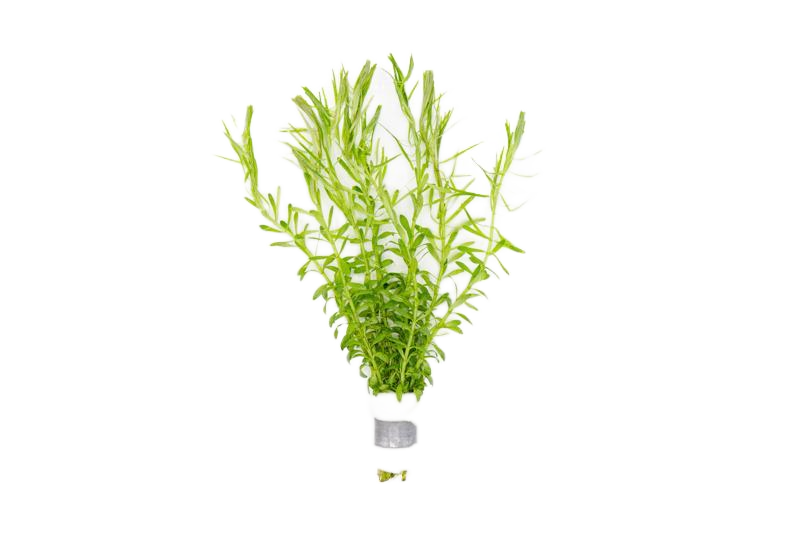
Didiplis Diandra (Water Hedge), native to the southeastern United States, is a refined stem plant with delicate, needle-like leaves in cross-shaped whorls forming soft, cloud-like bushes. Olive-green under moderate conditions; high lighting, CO2, and iron bring orange, salmon, and ruby-red tips. Easy to moderate care.
Quick facts
Identity
- Also known as
- Water Hedge; Screw-stem
- Synonyms
- Peplis diandra
- Environment
- Freshwater
- Native to
- United States (eastern, central, southern, southeastern)
- Habitat
- Shallow lake and pond margins, marshes, swamps, and slow-moving streams, growing on muddy banks or fully submerged depending on water level
- Sourcing
- Aquacultured
- Conservation
- Not Evaluated
Care
- Care level
- Moderate
- Growth form
- Stem
- Max height
- 4 – 16 in (10 – 41 cm)
- Spread
- 4 in (10 cm)
- Growth rate
- Moderate
- Placement
- Midground, Background
Water
- Temperature
- 72 – 82 °F (22 – 28 °C)
- pH
- 6.0 – 7.2
- GH
- 4 – 12 dGH
- dKH
- 2 – 6 dKH
- PAR
- 50 – 80 PAR
- Flow
- Low-Moderate
- Light
- High
- CO₂
- Beneficial
Planting
- Substrate
- Nutrient-rich preferred
- Feeds from
- Both
- Fertilizer needs
- High
- Colors
- Green, Orange, Red
Feeding & breeding
- Propagation
- Cuttings
Something wrong or missing? Submit a correction
Care guide
Overview
Needle-thin leaves form cross-shaped whorls along slender branching stems, giving mature clumps a soft, cloud-like texture. Under strong light, CO2, and steady iron dosing the tips shift from olive-green to orange, salmon, and red; weaker setups keep it plain green and leggy. Best planted as individual cuttings in a nutrient-rich substrate for a dense hedge effect.
Care
Water hedge is a fine-textured stem plant with needle-like leaves arranged in whorls along a slender, branching stem, giving mature clumps a soft, hedge-like texture. It needs bright to high lighting and a steady supply of CO2 to stay compact and to keep its lower leaves from dropping and rotting off. Under weaker light it stretches, loses density, and stays plain green rather than developing its orange to red tips. Stable, clean water with regular partial water changes helps prevent the melting and algae fouling this species is prone to under fluctuating conditions.
Planting & trimming
Plant individual stem cuttings into a fine, nutrient-rich substrate, spacing them a short distance apart since dense grouping produces the best hedge-like display. Insert stems gently to avoid crushing the fragile tissue, and strip lower leaves before planting to encourage rooting. Trim tops before they reach the surface or begin shading neighboring stems, then replant the healthy cuttings to keep the stand full and bushy.
Fertilizing
This species is a fairly heavy feeder on iron and other micronutrients, drawing on both a nutrient-rich substrate and the water column. Root tabs or a fertile aquasoil support strong root development, while regular dosing of chelated iron and a complete liquid fertilizer helps bring out the red and salmon coloration in the growing tips. Pale, yellowish new growth is a common sign of iron or micronutrient deficiency and usually resolves once dosing is increased.
Propagation
Propagation is done through stem cuttings and the lateral side shoots the plant naturally produces after trimming. Cut a healthy top section, remove the lowest leaves, and replant it directly in the substrate where it roots readily under good conditions. Repeated trimming and replanting of tops is the standard way to multiply stock and maintain a dense stand over time.
Problems
Lower stems can rot and shed leaves if lighting is too weak or nutrients run short, leaving bare, leggy bases. The delicate stems are brittle and can snap during handling or planting, so cuttings should be planted individually rather than in tight bunches. Because of its fine leaf surface, this plant is also somewhat prone to collecting algae if nutrients or flow are poorly balanced.
Sources
More Stem plants
Something wrong or missing? Submit a correction
In the community
Popular tanks using Didiplis Diandra
No public tanks are showcasing Didiplis Diandra yet.