
Aquatic Plant
Ceratophyllum Demersum / Hornwort
Ceratophyllum demersumCeratophyllaceaeStem plants
Price: $26.99 USD
Add from My tanks →1 photos
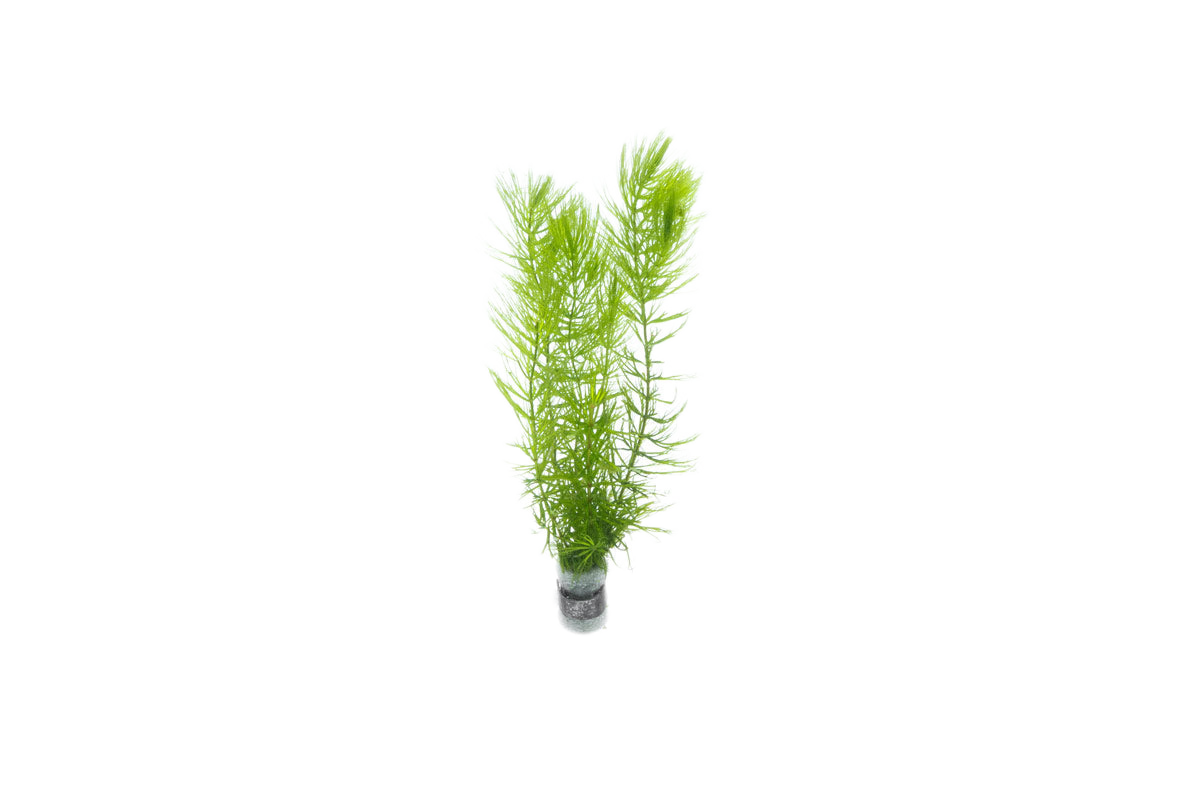
Meet Ceratophyllum demersum, aka Hornwort or Coontail, the aquatic plant that skipped roots entirely and thrives floating in quiet lakes, ponds, and streams worldwide. Its dense, needle-like whorls absorb nutrients straight through foliage, chewing through excess nitrates before algae gets a chance; a favorite for beginners, shrimp keepers, and breeders, providing hiding spots for fry and shrimplets.
Quick facts
Identity
- Also known as
- Coontail; Rigid hornwort; Coon's tail
- Synonyms
- Ceratophyllum demersum var. apiculatum; Ceratophyllum demersum var. inerme
- Environment
- Freshwater
- Native to
- Cosmopolitan, native to every continent except Antarctica
- Habitat
- Quiet or slow-flowing lakes, ponds, ditches, canals, and streams with nutrient-rich to eutrophic water
- Sourcing
- Aquacultured
- Conservation
- Not Evaluated
Care
- Care level
- Easy
- Growth form
- Stem
- Max height
- 4 – 78 in (10 – 198 cm)
- Spread
- 24 in (61 cm)
- Growth rate
- Fast
- Placement
- Midground, Background, Floating
Water
- Temperature
- 59 – 86 °F (15 – 30 °C)
- pH
- 6.0 – 8.5
- GH
- 3 – 18 dGH
- PAR
- 20 – 50 PAR
- Flow
- Low
- Light
- Low
- CO₂
- Not needed
Planting
- Substrate
- Not needed
- Feeds from
- Water column
- Fertilizer needs
- Low
- Colors
- Green
Feeding & breeding
- Propagation
- Cuttings
Something wrong or missing? Submit a correction
Care guide
Overview
Hornwort is a rootless stem plant sold as loose sprigs or bunches, identified by its whorls of fine, needle-like dark green leaves along branching stems. It can float at the surface or be anchored in the mid or background, growing fast enough to need trimming every week or two. Its rapid nutrient uptake and detritus-trapping tangle make it popular for fry and shrimp tanks, though shed needles can cloud water after handling.
Care
Hornwort tolerates almost any water chemistry and lighting level, which makes it forgiving for new fishkeepers setting up their first planted or fry-rearing tank. It can be left to float at the surface, where it grows fastest and shades the water below, or weighted down with plant lead or tied to a hardscape piece in the mid or back of the layout. Regular trimming is necessary since growth is rapid and untrimmed stems quickly shade out everything beneath them. Unlike most stem plants it has no true roots, so it draws nutrients directly through its foliage from the water column.
Planting & trimming
No true roots are formed, so hornwort can simply be left loose to float at the surface or anchored with a plant weight, gravel, or by tucking stems under a rock or driftwood. It does not need to be buried and will not root even if pushed into substrate. Trim the stems every one to two weeks to control size and replant or discard the cut portions, since untrimmed growth quickly overtakes a tank.
Fertilizing
Because the plant absorbs nutrients through its leaves rather than roots, root tabs are of no use and liquid or water-column fertilization is the only practical option. It grows well even in low-nutrient tanks, but in heavily stocked, nutrient-rich water its uptake rate increases noticeably and it can outcompete algae for nitrate and phosphate. Pale or thinning foliage toward the base of older stems usually just reflects self-shading rather than a nutrient deficiency, and is remedied by trimming and replanting the healthier tops.
Propagation
Propagation is by stem cuttings: any healthy side shoot or trimmed top section will continue growing on its own when left floating or lightly anchored. Broken fragments from an established plant also readily form new growth, which is part of why it spreads so easily in the wild. In temperate outdoor ponds it additionally produces turions, or winter buds, that sink and overwinter before regrowing in spring.
Problems
The main problem keepers encounter is shedding of the fine needle-like leaves when the plant is moved, handled roughly, or exposed to a sudden change in light or water chemistry, which can cloud the water and clog filters temporarily. Because it grows so quickly it can also become a tangled mass that traps detritus and blocks light to other plants if not thinned regularly. It is naturally resistant to most algae issues since it releases compounds that inhibit phytoplankton and cyanobacteria growth.
Sources
More Stem plants
Something wrong or missing? Submit a correction
In the community
Popular tanks using Ceratophyllum Demersum / Hornwort
No public tanks are showcasing Ceratophyllum Demersum / Hornwort yet.