
Aquatic Plant
Cabomba Piauhyensis Red
Cabomba piauhyensisCabombaceaeStem plants
Price: $29.97 USD
Add from My tanks →1 photos
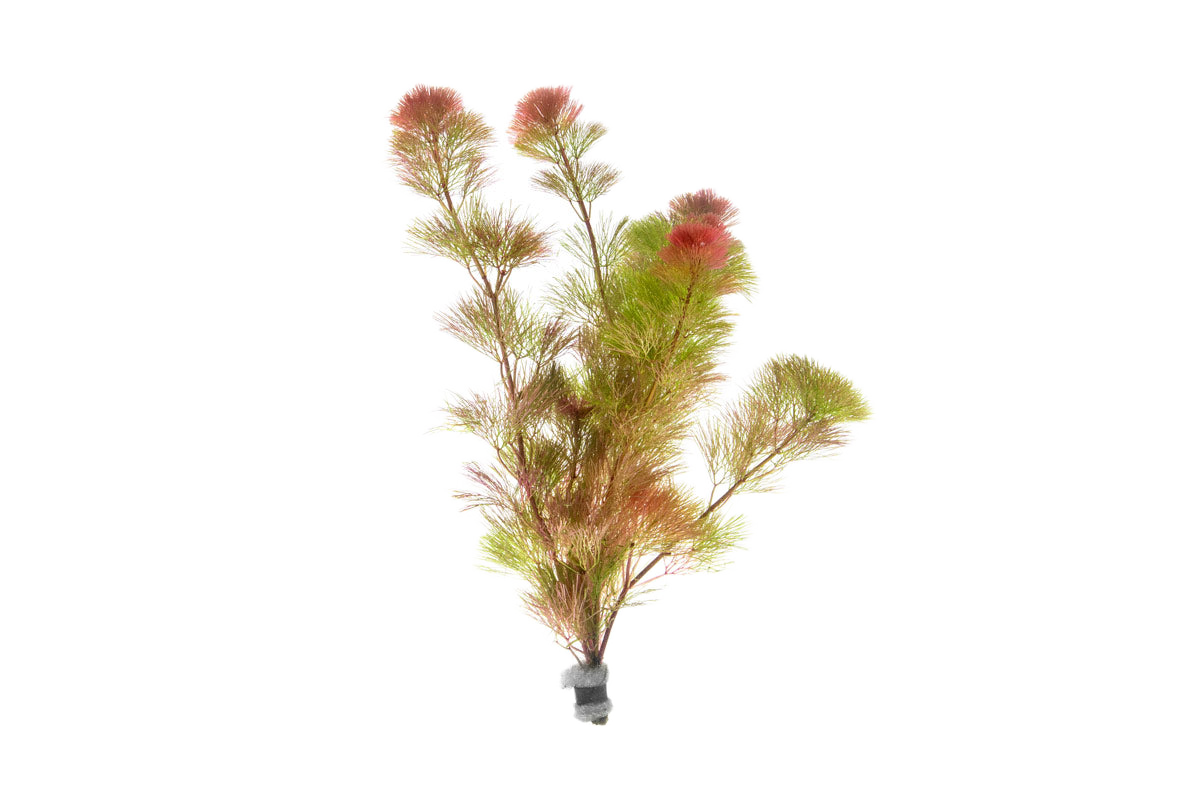
Red Cabomba (Cabomba piauhyensis) has fine, needle-like foliage radiating in delicate fan-like whorls, looking like brilliant red pine trees. Under high-tech conditions with intense lighting, soft acidic water, and pressurized CO2, it shifts from olive-pink into intense crimson-red to deep wine; reaching 10+ inches as a midground centerpiece or feathery background hedge.
Quick facts
Identity
- Also known as
- Purple cabomba
- Synonyms
- Cabomba furcata; Cabomba warmingii
- Environment
- Freshwater
- Native to
- Brazil, Colombia, Peru, Venezuela, Guyana, West Indies, Central America
- Habitat
- Warm, shallow, slow-moving to stagnant, acidic waters of lakes, streams and floodplains in tropical South and Central America
- Sourcing
- Aquacultured
- Conservation
- Not Evaluated
Care
- Care level
- Difficult
- Growth form
- Stem
- Max height
- 4 – 20 in (10 – 51 cm)
- Spread
- 4 in (10 cm)
- Growth rate
- Fast
- Placement
- Midground, Background
Water
- Temperature
- 75 – 82 °F (24 – 28 °C)
- pH
- 5.0 – 6.8
- GH
- 1 – 8 dGH
- dKH
- 0 – 7 dKH
- PAR
- 100 – 200 PAR
- Flow
- Low-Moderate
- Light
- High
- CO₂
- Required
Planting
- Substrate
- Nutrient-rich preferred
- Feeds from
- Both
- Fertilizer needs
- High
- Colors
- Red, Brown, Green, Purple
Feeding & breeding
- Propagation
- Cuttings, Splitting
Something wrong or missing? Submit a correction
Care guide
Overview
Fine, needle-like leaves radiate in feathery whorls that deepen from olive-pink to crimson and wine-red under strong light. This demanding stem plant needs intense illumination, injected CO2 and soft, acidic water to hold its color and avoid melting. Best planted in groups, spaced to let light reach lower whorls, with regular trimming to keep growth compact.
Care
Red fanwort ranks among the more demanding stem plants in the hobby, needing aggressive lighting, injected CO2 and warm, soft, acidic water to hold its wine-red to brownish-red coloration and stay compact. Under weaker light the whorls elongate, fade to green and become prone to melting and rot from the base upward. A nutrient-rich substrate combined with regular liquid fertilization gives the sturdiest stems and the fullest, most colorful crowns.
Planting & trimming
Plant stems in groups with adequate spacing so light can reach the lower whorls, since crowding accelerates shading and melt. It roots readily in a nutrient-rich substrate and should be inserted a few nodes deep rather than buried at the growing tip. Regular trimming of the top portion for replanting, while discarding the older leggy base, keeps the plant compact and encourages fresh, well-colored growth.
Fertilizing
This plant feeds through both roots and leaves, so a nutrient-rich substrate paired with a complete liquid fertilizer covering nitrate, phosphate, iron and trace elements works best. Iron and micronutrient dosing helps intensify the red-purple tones, while a shortage typically shows up as darkened leaves, stunted growth and stretched internodes. Because it grows quickly it depletes nutrients fast and benefits from consistent, frequent dosing rather than occasional heavy feeding.
Propagation
Propagation is by terminal cuttings: snip the healthy top growth and replant it, letting the remaining rooted base sprout new side shoots. It can also be propagated by splitting off naturally occurring side branches once the plant matures. Cannot be grown emersed, so all propagation and cultivation occurs fully submerged.
Problems
Melting and basal rot are the most common problems, usually triggered by insufficient light, unstable water parameters or a sudden move to a new tank. Weak or fluctuating CO2 levels lead to similar decline, with leaves thinning and dropping from lower whorls first. Algae can also colonize the fine feathery foliage if lighting is excessive relative to nutrient and CO2 supply, so balance is important.
Sources
More Stem plants
Something wrong or missing? Submit a correction
In the community
Popular tanks using Cabomba Piauhyensis Red
No public tanks are showcasing Cabomba Piauhyensis Red yet.