
Aquatic Plant
Cabomba Aquatica
Cabomba aquaticaCabombaceaeStem plants
Price: $20.99 USD
Add from My tanks →1 photos
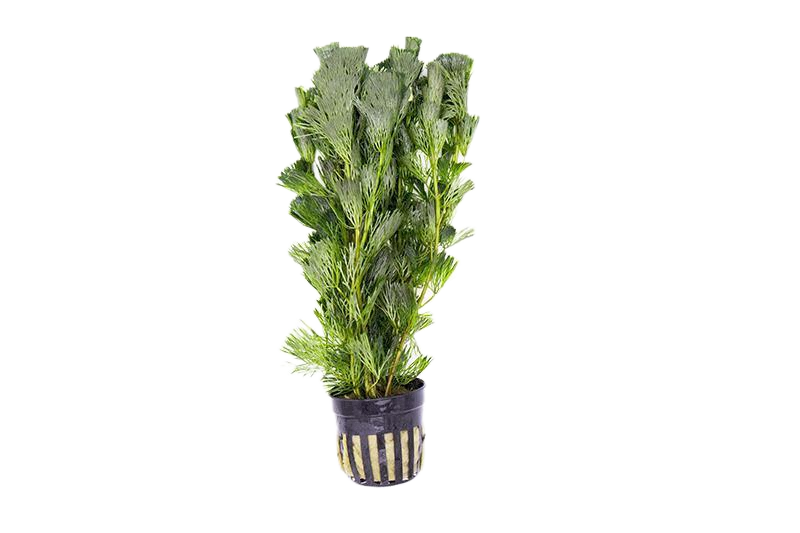
Cabomba Aquatica (Fanwort) is one of the most popular types of Cabomba in the aquarium trade and an easy stem plant suitable for beginners. Planted in dense clusters, it grows into a thick bush of delicate green leaves for background or midground coverage; hardy, prefers nutrient-rich clean water, moderate light, CO2 optional, propagated from cuttings.
Quick facts
Identity
- Also known as
- Giant Fanwort; Yellow Cabomba
- Synonyms
- Cabomba aquatica var. lutea
- Environment
- Freshwater
- Native to
- Guianas, Venezuela, Brazil, Bolivia
- Habitat
- Standing and slow-flowing soft, acidic waters such as ponds, ditches, lakes, and quiet river margins, often over fine sediment in tannin-stained water.
- Sourcing
- Captive-bred
- Conservation
- Not Evaluated
Care
- Care level
- Moderate
- Growth form
- Stem
- Max height
- 4 – 31 in (10 – 79 cm)
- Spread
- 4 in (10 cm)
- Growth rate
- Fast
- Placement
- Background, Midground
Water
- Temperature
- 68 – 82 °F (20 – 28 °C)
- pH
- 6.0 – 7.0
- GH
- 1 – 8 dGH
- dKH
- up to 7 dKH
- PAR
- 30 – 50 PAR
- Flow
- Low-Moderate
- Light
- High
- CO₂
- Beneficial
Planting
- Substrate
- Nutrient-rich preferred
- Feeds from
- Both
- Fertilizer needs
- Medium
- Colors
- Green, Yellow
Feeding & breeding
- Propagation
- Cuttings
Something wrong or missing? Submit a correction
Care guide
Overview
Reaching up to roughly 31 inches under good light, this stem plant forms a tall, bushy column of finely divided, whorled green leaves suited to background or midground planting. It grows quickly from cuttings, needs strong light and soft, acidic water to stay dense from base to tip, and benefits from regular trimming to prevent legginess.
Care
Fanwort needs strong, unobstructed light to keep its feathery whorls dense from top to bottom; under weak lighting the lower fans thin out and drop first. Keep the water soft and on the acidic side, with stable warmth in the low-to-mid 70s F, since cold snaps below the mid-60s slow growth noticeably. Gentle to moderate flow helps keep detritus from settling in the finely divided leaves, which otherwise invites algae and rot. Regular trimming of the tall stems encourages branching from the cut nodes and keeps the plant from overtopping the tank.
Planting & trimming
Plant healthy stem cuttings 1-2 inches deep into a fine, nutrient-rich substrate, spacing individual stems a couple of centimeters apart so light reaches the lower leaves. A substrate depth of at least 2-3 inches gives the adventitious roots room to anchor, since coarse gravel holds the brittle stems poorly. Trim tops regularly with sharp shears, stripping the lower leaves from cut sections before replanting them to keep the display dense rather than leggy.
Fertilizing
Root tabs pushed into a nutrient-rich substrate support the fine adventitious roots at the stem nodes, though this plant also draws a fair amount of nutrition through the water column. A liquid fertilizer supplying iron and trace elements helps maintain leaf density, especially under higher light where uptake demand rises. Pale, thin, or dropped lower leaves usually signal insufficient light or a nutrient shortfall rather than disease.
Propagation
Propagation is by stem cuttings: cut a healthy top section, remove the lowest leaves, and replant it directly into the substrate to root at the nodes. The remaining mother stem typically responds to trimming by branching from the cut node, producing new side shoots that can later be harvested as fresh cuttings.
Problems
The most common failure is bottom-up leaf loss caused by low light or water that is too hard or alkaline for the plant's soft-water preference. Its dense, feathery foliage traps organic debris and fine sediment easily, which can smother lower leaves and trigger filamentous algae if flow and filtration are inadequate. Brittle stems can snap or uproot with rough handling, so replanting should be done carefully and infrequently.
Sources
More Stem plants
Something wrong or missing? Submit a correction
In the community
Popular tanks using Cabomba Aquatica
No public tanks are showcasing Cabomba Aquatica yet.