
Aquatic Plant
Sagittaria Platyphylla
Sagittaria platyphyllaAlismataceaeSagittarias
Price: $6.99 USD
Add from My tanks →1 photos
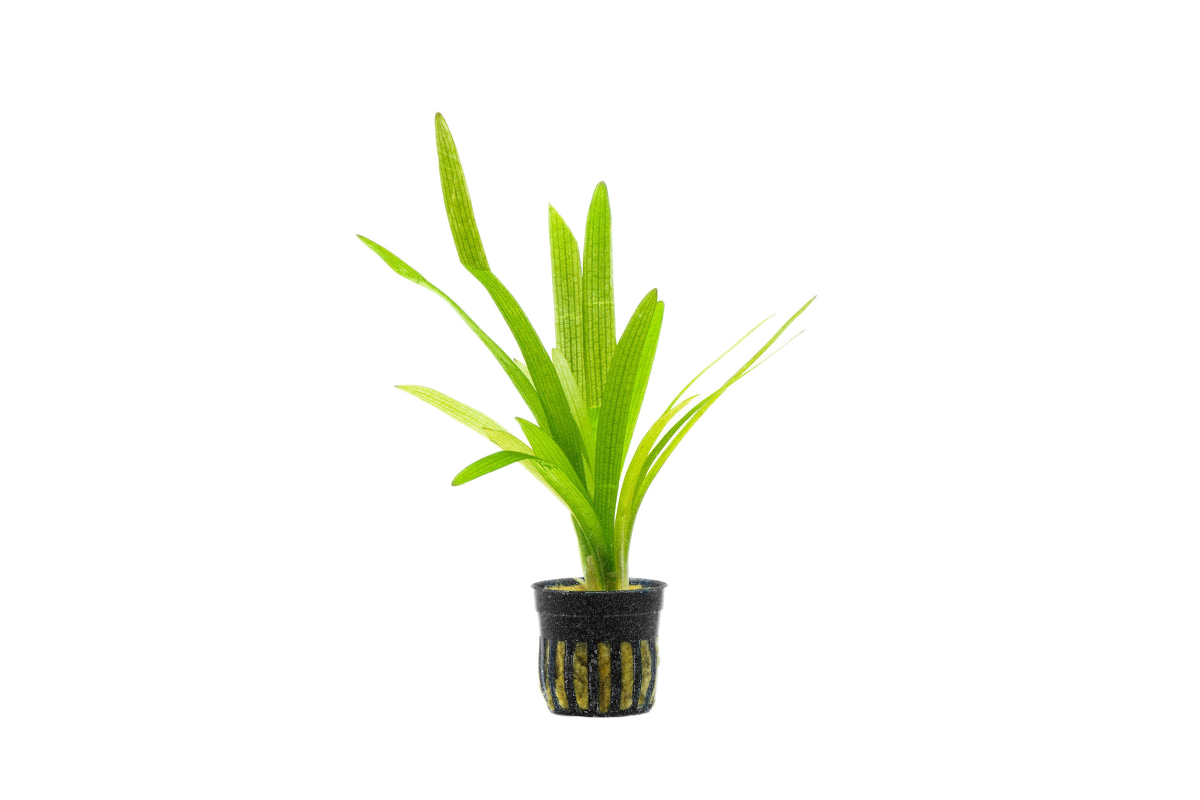
Sagittaria platyphylla (Delta Arrowhead) is a fairly uncommon, undemanding freshwater plant from the southeastern U.S. with ribbon-like submerged leaves and oval emergent leaves, producing small white three-petaled flowers in warm months. Easy and moderate-growing, it needs low to medium light with optional CO2, and propagates via underground runners.
Quick facts
Identity
- Also known as
- Delta arrowhead; Broadleaf arrowhead; Broad leaf sagittaria
- Synonyms
- Sagittaria chilensis; Sagittaria obtusa
- Environment
- Freshwater
- Native to
- Southeastern United States, Central America
- Habitat
- Shallow standing or slow-moving water: ditches, canals, ponds, marshes, streams, and lake margins with muddy or silty substrate
- Sourcing
- Aquacultured
- Conservation
- Not Evaluated
Care
- Care level
- Easy
- Growth form
- Rosette
- Max height
- 4 – 16 in (10 – 41 cm)
- Spread
- 12 in (30 cm)
- Growth rate
- Moderate
- Placement
- Midground, Foreground
Water
- Temperature
- 66 – 79 °F (19 – 26 °C)
- pH
- 5.7 – 8.0
- GH
- 0 – 12 dGH
- Flow
- Low-Moderate
- Light
- Medium
- CO₂
- Beneficial
Planting
- Substrate
- Nutrient-rich preferred
- Feeds from
- Both
- Fertilizer needs
- Medium
- Colors
- Green
Feeding & breeding
- Propagation
- Runners, Rhizome division
Something wrong or missing? Submit a correction
Care guide
Overview
Suited to midground planting in beginner to intermediate freshwater setups, this rosette-forming plant produces broad, ribbon-like leaves that arch outward for a coarser texture than typical carpet species. It tolerates a wide pH and hardness range, spreads gradually by runners once established, and benefits from a nutrient-rich substrate with root feeding.
Care
Delta arrowhead adapts to a wide range of freshwater conditions and is a reasonable choice for beginners setting up a midground planting. It forms a low rosette of broad, ribbon-like leaves that arch outward, giving it a different texture than fine-leaved carpeting plants. Medium lighting keeps growth compact, while dim conditions cause the leaves to stretch and become less attractive. Given a nutrient-rich substrate it will slowly spread by runners and eventually fill in an area without needing much intervention.
Planting & trimming
Plant individual crowns directly into the substrate with the rhizome base buried but the crown left exposed, spacing plants roughly 5-7 cm apart if planting in groups for a fuller look. It tolerates being uprooted and replanted better than many rosette plants, making rearranging straightforward. Trim off outer leaves that yellow or become overly long, and remove excess runners periodically if a denser, more contained clump is desired rather than a spreading colony.
Fertilizing
Root feeding is important for this plant since it draws much of its nutrition through the rhizome and root system in the substrate. Occasional root tabs or a nutrient-rich base layer support steady growth, and iron supplementation helps maintain good leaf color. Liquid fertilizers containing potassium and micronutrients are also taken up through the leaves and are useful in low-tech tanks without a rich substrate. Pale or yellowing new leaves usually point to an iron or nitrogen deficiency.
Propagation
Propagation happens mainly through horizontal underground runners that produce small plantlets, which can be left attached until they develop their own root systems and then separated from the parent. The rhizome can also be divided directly when a plant becomes crowded. Compared to some other Sagittaria species, platyphylla spreads at a more moderate pace, so patience is needed when trying to fill a large area.
Problems
This species is generally hardy and not particularly prone to melt once established, though newly planted specimens may shed a few older leaves while adjusting to submersed life. Poor lighting or a nutrient-poor substrate can lead to weak, elongated growth that is more susceptible to algae fouling. Diatoms or green algae can settle on the broad leaves if flow and light are not well balanced, so periodic leaf cleaning helps keep the rosette looking tidy.
Sources
More Sagittarias
Something wrong or missing? Submit a correction
In the community
Popular tanks using Sagittaria Platyphylla
No public tanks are showcasing Sagittaria Platyphylla yet.