
Aquatic Plant
Echinodorus Rose
Echinodorus 'Rose'AlismataceaeSword plants
Price: $6.99 USD
Add from My tanks →1 photos
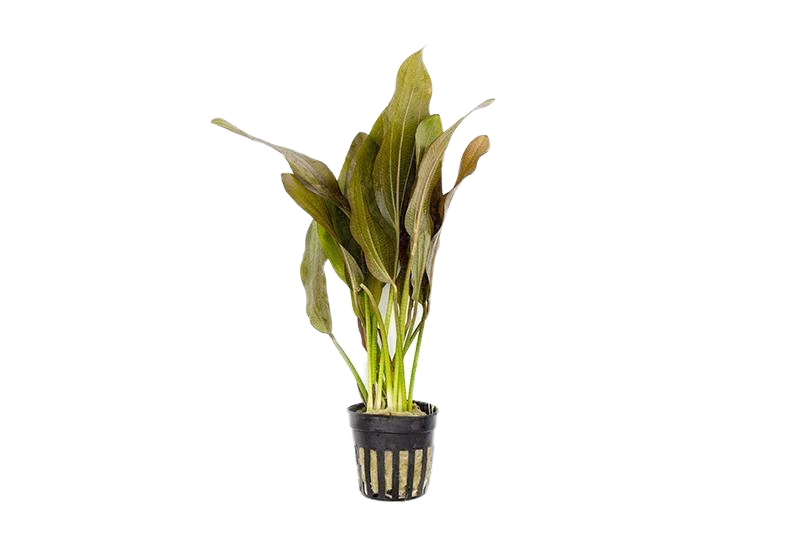
The Sword rose plant is a beautiful mid- or background plant and an excellent choice for beginners. It produces wide, oblong leaves with beautiful striation, wavy texture, and colors from pink to greenish brown; new leaves are pink or bronzy, maturing to bright to dark green. Easy care, no CO2 required, in nutrient-rich substrate.
Quick facts
Identity
- Also known as
- Rose Sword; Pink Amazon Sword
- Synonyms
- Echinodorus schlueteri 'Leopard' x barthii; Echinodorus 'Ozelot Green' (related form)
- Environment
- Freshwater
- Native to
- Captive-bred variety
- Habitat
- No wild habitat; parent species originate from soft-substrate streams, ditches and swamps of South America where they grow submersed in the wet season and emersed as water levels drop
- Sourcing
- Aquacultured
- Conservation
- Not Evaluated
Care
- Care level
- Easy
- Growth form
- Rosette
- Max height
- 6 – 20 in (15 – 51 cm)
- Spread
- 16 in (41 cm)
- Growth rate
- Moderate
- Placement
- Midground, Background
Water
- Temperature
- 72 – 82 °F (22 – 28 °C)
- pH
- 6.5 – 7.5
- GH
- 4 – 18 dGH
- Flow
- Low-Moderate
- Light
- Medium
- CO₂
- Beneficial
Planting
- Substrate
- Nutrient-rich required
- Feeds from
- Roots
- Fertilizer needs
- High
- Colors
- Red, Brown, Green
Feeding & breeding
- Propagation
- Rhizome division, Plantlets, Adventitious plantlets
Something wrong or missing? Submit a correction
Care guide
Overview
Echinodorus Rose is a beginner-friendly sword suited to mid- or background placement in freshwater planted tanks. Wide, oblong leaves show pronounced striation and a wavy texture, emerging pink or bronzy before maturing through greenish brown to dark green. It grows readily without CO2 given a nutrient-rich substrate.
Care
A hardy rosette plant that tolerates a wide range of lighting from low to high, though brighter light with a strong red spectrum brings out the deepest spotting and bronze-red tones on new leaves. It builds a substantial root mass over time and does best when the crown is left sitting right at the substrate surface rather than buried. Growth is steady to fast once established, and older outer leaves should be trimmed away periodically to keep the rosette tidy and to make room for new growth.
Planting & trimming
Plant the roots into a nutrient-rich substrate while keeping the crown exposed at the surface to avoid rot, spacing individual plants generously since the rosette and root system both expand considerably with age. It is typically shipped in its emersed form with plainer green leaves, and the more colorful spotted red foliage only appears after a few weeks of submersed growth. It can also be grown emersed in a paludarium, where mature specimens may send up flowering stalks.
Fertilizing
As a heavy root feeder, this sword depends more on substrate nutrition than on water column dosing, so root tabs pushed near the root zone or a nutrient-rich substrate base are the priority. Iron and other micronutrients supplied through the substrate or a liquid fertilizer intensify the red and brown coloration, particularly on newly emerging leaves. Pale or washed-out new growth usually signals a lack of iron or overall substrate nutrients rather than a lighting problem.
Propagation
Established plants send up long flower stalks that develop small adventitious plantlets along their length; these can be left to grow a few roots while still attached, then cut free and planted separately. Older, crowded specimens can also be propagated by dividing the crown and root mass into separate sections, each retaining enough roots to reestablish on its own.
Problems
Older leaves naturally yellow and decline as the plant redirects energy to new growth, and these should be removed rather than left to decay in the tank. Shipping or replanting stress can cause some leaf melt, but the plant typically recovers and pushes fresh leaves within a few weeks once roots settle in. Poor substrate nutrition shows up as smaller, pale, or less spotted new leaves, while algae can settle on older foliage in high-light, low-flow setups.
Sources
More Sword plants
Something wrong or missing? Submit a correction
In the community
Popular tanks using Echinodorus Rose
No public tanks are showcasing Echinodorus Rose yet.