
Aquatic Plant
Echinodorus Peruensis
Echinodorus peruensisAlismataceaeSword plants
Price: $6.99 USD
Add from My tanks →1 photos
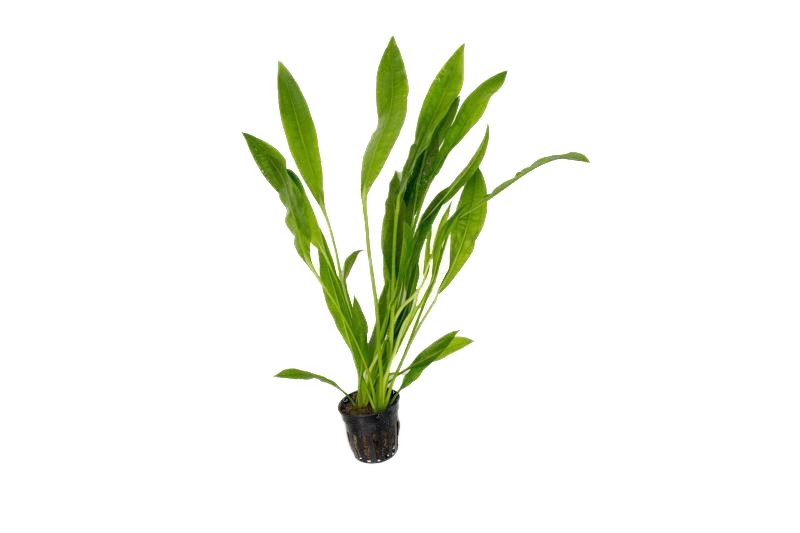
Echinodorus Peruensis is a beautiful, easy-to-care-for sword offering excellent background coverage. Short stems grow in a rosette bearing long, ovoid pointed leaves, dark or bright green with prominent veins; grows submersed or emersed in nutrient-rich substrate, moderate to high lighting, no CO2 required.
Quick facts
Identity
- Also known as
- Peruvian Sword; Dwarf Amazon Sword
- Synonyms
- Echinodorus parviflorus 'peruensis'
- Environment
- Freshwater
- Native to
- Peru, Bolivia, South America
- Habitat
- Shallow freshwater marshes, flooded plains, and shaded riverbanks and canals in the Amazon basin
- Sourcing
- Aquacultured
- Conservation
- Not Evaluated
Care
- Care level
- Easy
- Growth form
- Rosette
- Max height
- 4 – 12 in (10 – 30 cm)
- Spread
- 10 in (25 cm)
- Growth rate
- Moderate
- Placement
- Midground, Background
Water
- Temperature
- 72 – 82 °F (22 – 28 °C)
- pH
- 6.0 – 7.5
- GH
- 3 – 10 dGH
- dKH
- 3 – 10 dKH
- PAR
- 30 – 80 PAR
- Flow
- Low-Moderate
- Light
- Medium
- CO₂
- Beneficial
Planting
- Substrate
- Nutrient-rich preferred
- Feeds from
- Roots
- Fertilizer needs
- Medium
- Colors
- Green
Feeding & breeding
- Propagation
- Adventitious plantlets, Runners
Something wrong or missing? Submit a correction
Care guide
Overview
Reaching roughly 4 to 12 inches with a spread near 10 inches, this rosette stays more compact than other Echinodorus swords while still filling midground to background space. Lance-shaped green leaves with prominent veins rise from a short petiole, best kept dark and dense under medium to high light. It roots heavily, so a nutrient-rich substrate and regular root tabs matter more than water column dosing.
Care
A compact member of the Echinodorus group, this sword forms a dense rosette of lance-shaped leaves with a short petiole, staying smaller than most of its relatives while still reading as a substantial midground to background specimen. It tolerates a range of lighting but shows the best compact habit and darkest leaf tone under medium to high light, and does fine without CO2 injection though supplementation speeds growth. A nutrient-rich substrate is essential since the plant relies heavily on its thick root system for feeding, and sudden shifts in water chemistry should be avoided since they can trigger leaf melt.
Planting & trimming
Free the roots from any wool or rock-wool packaging before planting and bury only the root mass, keeping the crown of the rosette above the substrate surface. Space individual specimens several inches apart since the rosette spreads considerably as it matures, and expect the plant to send up thin leaves toward the surface if grown emersed, producing small white flowers above the waterline. Trim outer leaves regularly to keep the canopy from shading shorter plants nearby.
Fertilizing
Root tabs pushed into the substrate near the base every three to four months supply the iron and trace elements this heavy root feeder needs, and a mineral-rich aquasoil or clay-based substrate gives it a strong start. Liquid fertilizers help address water column deficiencies but do not substitute for root feeding in this species. Pale new growth or thin, washed-out leaves usually point to insufficient iron or a substrate that has become nutrient-depleted.
Propagation
Established plants produce adventitious plantlets on side shoots or runners that can be separated once they have grown a few of their own leaves and developed visible roots, then replanted directly into substrate elsewhere in the tank. Flowering stalks sent up in emersed culture can also produce plantlets along their length. Division of the mother rosette is uncommon compared to propagation via runners.
Problems
Newly planted specimens can shed several leaves as they adjust, a normal transitional melt that resolves once new roots establish, though it becomes a persistent problem if parameters swing widely. Older, damaged, or algae-covered leaves should be removed at the base to redirect energy into fresh growth and to prevent them from shading the rest of the rosette. Iron or potassium deficiency shows up as pale or yellowing new leaves rather than the older foliage.
Sources
More Sword plants
Something wrong or missing? Submit a correction
In the community
Popular tanks using Echinodorus Peruensis
No public tanks are showcasing Echinodorus Peruensis yet.