
Aquatic Plant
Echinodorus Palaefolius
Echinodorus palaefoliusAlismataceaeSword plants
Price: $8.99 USD
Add from My tanks →1 photos
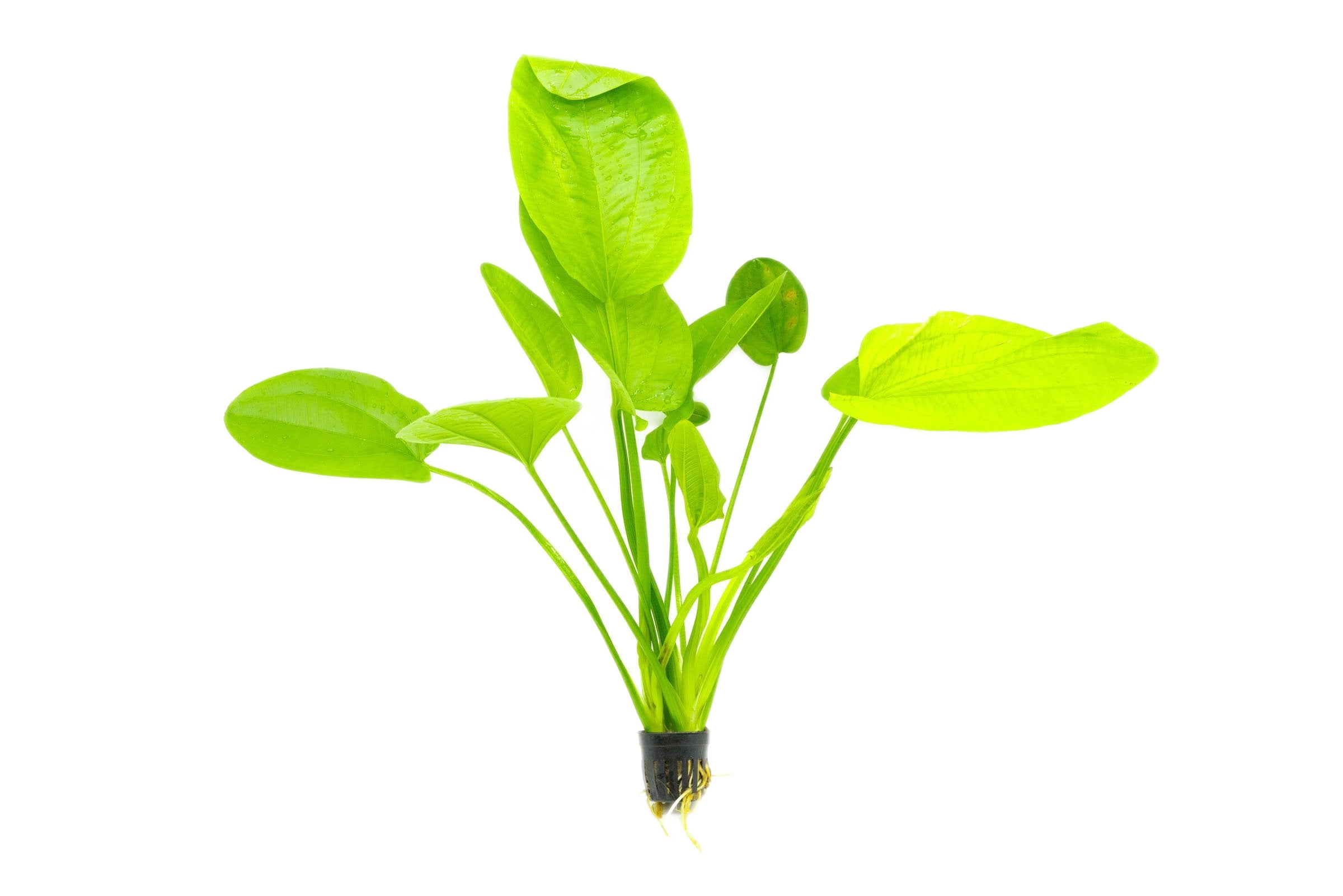
Echinodorus palaefolius is a hardy South American sword plant with rounded leaves that grow narrower and longer when submerged, best in a nutrient-rich substrate as a heavy root feeder. Fast-growing and tolerant of most lighting, it suits larger tanks, benefits from moderate to high light, and can flower white when grown emersed.
Quick facts
Identity
- Also known as
- Broad Leaf Amazon Sword; Palaefolius Sword
- Synonyms
- Echinodorus palifolius; Aquarius palifolius; Echinodorus palaefolius var. latifolius
- Environment
- Freshwater
- Native to
- Brazil, South America
- Habitat
- Marshes, ditches and seasonally flooded lowland ground in eastern Brazil, growing emersed with roots in wet soil but tolerant of temporary flooding
- Sourcing
- Captive-bred
- Conservation
- Not Evaluated
Care
- Care level
- Easy
- Growth form
- Rosette
- Max height
- 4 – 20 in (10 – 51 cm)
- Spread
- 16 in (41 cm)
- Growth rate
- Fast
- Placement
- Background
Water
- Temperature
- 72 – 82 °F (22 – 28 °C)
- pH
- 5.5 – 7.5
- GH
- 2 – 15 dGH
- Flow
- Low-Moderate
- Light
- Medium
- CO₂
- Beneficial
Planting
- Substrate
- Nutrient-rich required
- Feeds from
- Roots
- Fertilizer needs
- High
- Colors
- Green
Feeding & breeding
- Propagation
- Rhizome division, Plantlets
Something wrong or missing? Submit a correction
Care guide
Overview
Eastern Brazilian marshes and seasonally flooded ground are the origin of this rosette-forming sword, whose rounded leaves narrow and lengthen once submerged. A fast-growing, iron-hungry root feeder, it wants a nutrient-rich substrate and regular root tabs, and its eventual size suits it to a large background spot rather than a crowded planting.
Care
A large, fast-growing sword plant suited to spacious tanks or open-topped setups where it can eventually push leaves above the waterline. It is undemanding regarding water chemistry, tolerating a wide pH and hardness range, but performs best with strong light and a nutrient-rich substrate. Given its eventual size, it works better as a solitary background specimen than as one of several plants crowded together.
Planting & trimming
Plant the crown in a deep layer of nutrient-rich substrate with the rhizome exposed and roots well buried, spacing it well away from other plants given its adult spread. In paludaria or open tanks it can be allowed to grow emersed, producing broader, stiffer aerial leaves and eventually a flower stalk. Removing the oldest and longest-stalked leaves periodically encourages shorter, more compact submersed growth.
Fertilizing
As a heavy root feeder, it depends on iron-rich root tabs pushed into the substrate near the root mass rather than on liquid fertilizers alone. Without adequate substrate nutrients, older leaves yellow and growth slows noticeably. Regular replenishment of root tabs every few months keeps the rosette producing new leaves at a steady pace.
Propagation
New plants are most easily produced by dividing the rhizome of a mature specimen once it has developed multiple crowns. When grown emersed, the flower stalk produces small plantlets along its length that can be separated once they show roots and planted independently.
Problems
Yellowing or translucent new leaves usually point to iron or micronutrient deficiency rather than disease, and are corrected with root tabs and stable dosing. Once mature, the plant strongly favors sending leaves above the surface, and if kept in a closed aquarium these emersed-form leaves may rot where they meet the lid or lighting. Trimming the longest petioles before they break the surface keeps the plant compact and submersed for longer.
Sources
More Sword plants
Something wrong or missing? Submit a correction
In the community
Popular tanks using Echinodorus Palaefolius
No public tanks are showcasing Echinodorus Palaefolius yet.