
Coral
ECC Ring of Fire Favites
Favites sp.MerulinidaeBrain corals
Add from My tanks →1 photos
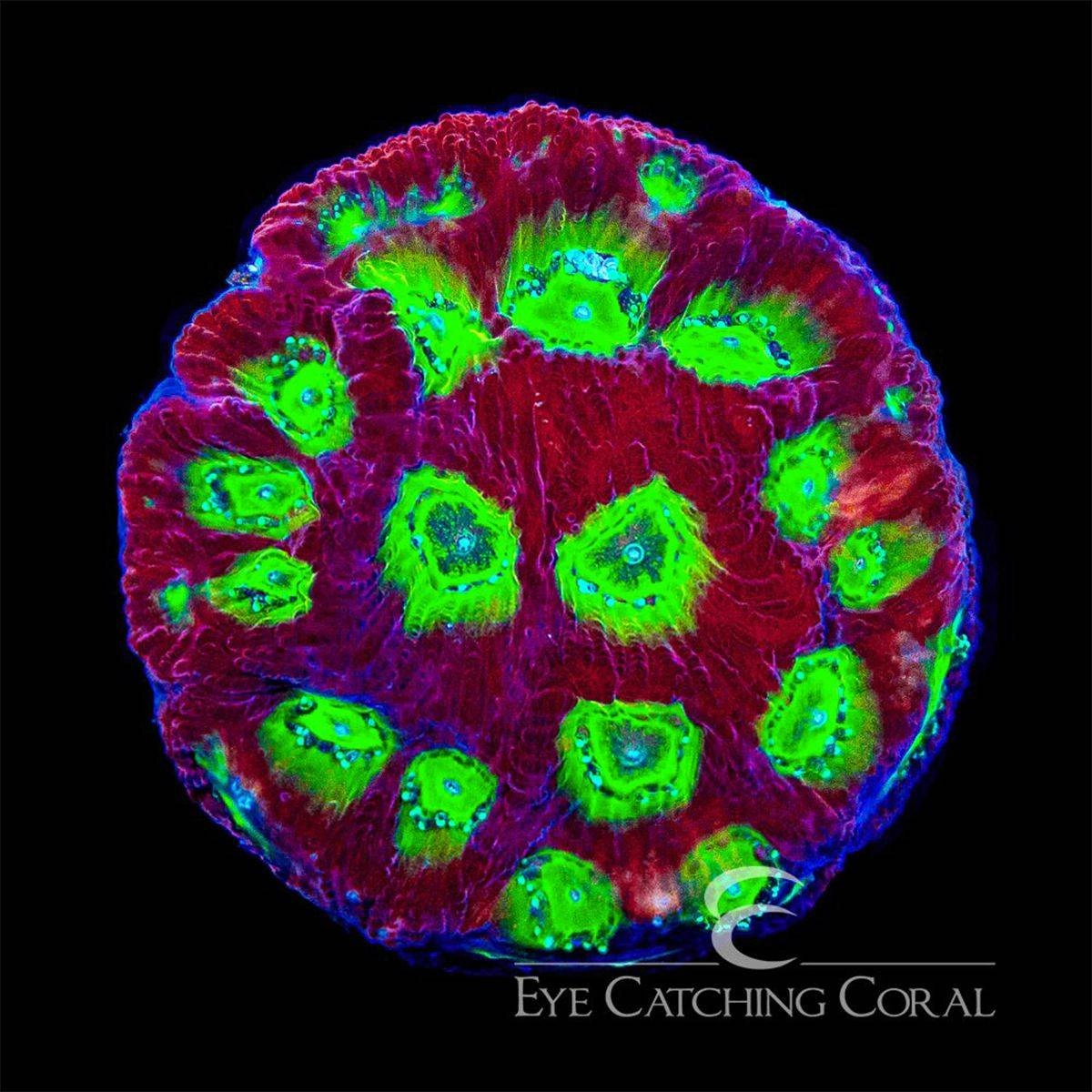
The ECC Ring of Fire Favites is a hardy encrusting LPS coral well suited to a wide range of reef tanks, with a moderate growth rate and manageable care needs that make it a strong choice for seasoned hobbyists and those new to LPS corals alike. It does best in stable conditions with low to medium light (75-250 PAR) and moderate flow, encrusting over rockwork or frag plugs in a uniform pattern to fill open areas of the aquascape.
Quick facts
Handling caution: Can sting via nighttime sweeper tentacles; handle with gloves to avoid skin irritation
Identity
- Also known as
- Favites Brain Coral; Pineapple Coral; Moon Coral
- Synonyms
- Goniastrea sp. (partial); formerly classified under Faviidae, now Merulinidae
- Environment
- Saltwater
- Native to
- Red Sea, Indian Ocean, Indo-Pacific, Western Pacific, Japan
- Habitat
- Reef flats and slopes in the Indo-Pacific, typically on stable substrate in moderate light and flow zones
- Sourcing
- Aquacultured
- Conservation
- Not Evaluated
Care
- Care level
- Easy
- Coral type
- LPS
- Temperament
- Aggressive
- Growth form
- Encrusting
- Adult size
- 1 – 12 in (2.5 – 30 cm)
- Spread
- 12 in (30 cm)
- Growth rate
- Moderate
- Placement
- Low, Middle, Sand bed
Water
- Temperature
- 75 – 80 °F (24 – 27 °C)
- pH
- 8.1 – 8.4
- dKH
- 8 – 9.5 dKH
- Salinity
- 1.024 – 1.026 SG
- PAR
- 75 – 150 PAR
- Flow
- Moderate
- Light
- Medium
Reef care
- Nutrient preference
- Medium
- Alk/Ca uptake
- Medium
- Target feeding
- Beneficial
- Give it room
- 4 in (10 cm)
- Colors
- Green, Red, Orange, Cream, Purple, Multicolor
Feeding & breeding
- Diet
- Photosynthetic
- Foods
- Frozen, Freeze-dried, Coral food, Zooplankton
- Propagation
- Fragging
Something wrong or missing? Submit a correction
Care guide
Overview
Favites sp. is an encrusting LPS coral from the brain coral family, spreading in a uniform mounded pattern over rock or frag plugs. It tolerates low to medium light and moderate flow, making it manageable for both new and experienced LPS keepers. Steady water parameters and spacing from neighboring corals help it encrust without stinging or overgrowth conflicts.
Care
Favites tolerates a broad range of reef conditions and is a reasonable choice for hobbyists moving beyond soft corals into LPS. It does best under low to medium light and gentle, indirect flow that keeps its tissue clean without folding it against the skeleton. Stable alkalinity, calcium, and magnesium support steady skeletal growth, and sudden parameter swings should be avoided since shifted tissue can recede along the shared corallite walls.
Placement & acclimation
Acclimate gradually to light by starting in a lower or shaded position and moving it up over several weeks, since sudden bright exposure can bleach the tissue. Mount frags securely on rockwork or a frag plug with reef-safe epoxy or glue, leaving generous open space around the colony for both growth and sweeper tentacle activity. It can also be placed directly on the sand bed in a stable position where it will grow into a mounded form.
Feeding
Most of its nutrition comes from photosynthetic zooxanthellae, but it extends feeder tentacles at night to capture meaty foods drifting past. Offering small pieces of mysis, chopped seafood, or LPS pellets once or twice a week can improve coloration and growth over time. New colonies should settle in for a couple of weeks before target feeding begins.
Neighbors
This coral is capable of stinging with sweeper tentacles that extend mostly at night, so at least 4 inches of clearance from neighboring corals is recommended. It is not well suited to close-packed frag gardens with acans, zoanthids, or other LPS, since contact can damage both colonies over time. Favia, brain corals, and chalice corals in particular should be kept at a safe distance given their similar growth habits and potential for confusion during placement.
Fragging
Colonies can be fragged by cutting or cracking the skeleton between corallites with a band saw or coral cutters, ideally leaving at least one intact corallite per fragment. Cut edges should be handled carefully and placed in low flow until tissue recovers and covers the exposed skeleton. Fragging is best done on healthy, well-extended colonies to reduce stress and infection risk.
Pests & problems
Bleached or pale patches usually indicate excess light exposure, since this genus prefers subdued lighting compared to many other LPS. Exposed white skeleton near the tissue margin can signal flow that is too strong or direct, causing localized recession. Brown jelly infections and tissue necrosis can occur after physical damage or shipping stress, so newly acquired frags should be monitored closely during acclimation.
Sources
Varieties in the catalog
More Brain corals
Something wrong or missing? Submit a correction
In the community
Popular tanks using ECC Ring of Fire Favites
No public tanks are showcasing ECC Ring of Fire Favites yet.