
Coral
ECC Firewater Platygyra
Platygyra sp.MerulinidaeBrain corals
Add from My tanks →1 photos
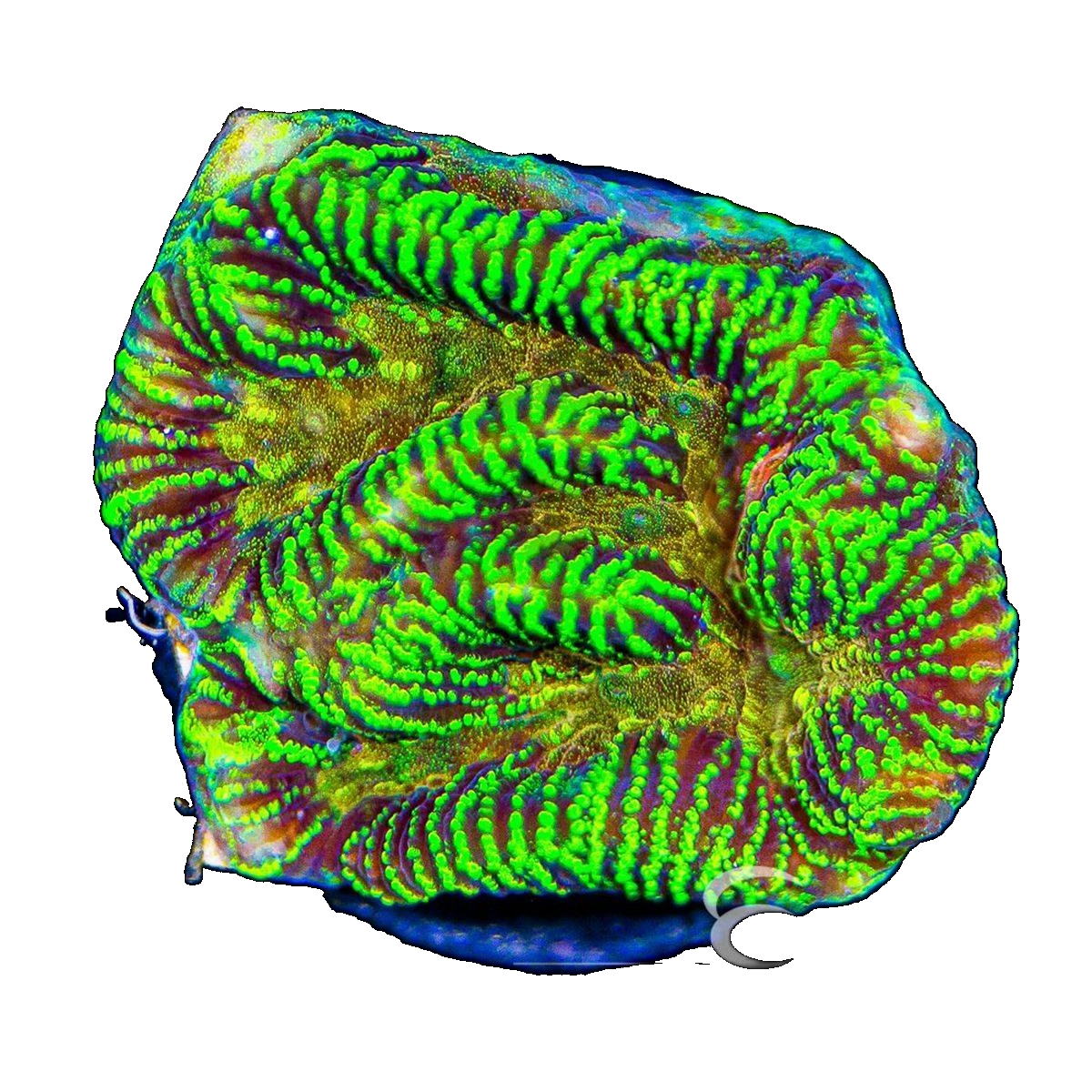
A hardy Platygyra LPS with intense green and yellow highlights; handles a range of lighting conditions and does well in moderate flow, growing slowly into a plate-like structure that is easy to move.
Quick facts
Handling caution: Can produce copious mucus and may sting when handled; use gloves and avoid skin contact
Identity
- Also known as
- Closed brain coral; Maze brain coral
- Environment
- Saltwater
- Native to
- Indo-Pacific
- Habitat
- Shallow to mid-depth reef flats and backwater reef areas with moderate water movement
- Sourcing
- Aquacultured
- Conservation
- Not Evaluated
Care
- Care level
- Moderate
- Coral type
- LPS
- Temperament
- Semi-Aggressive
- Growth form
- Massive
- Adult size
- 1 – 8 in (2.5 – 20 cm)
- Spread
- 12 in (30 cm)
- Growth rate
- Slow
- Placement
- Low, Middle, Sand bed
Water
- Temperature
- 75 – 80 °F (24 – 27 °C)
- pH
- 8.1 – 8.4
- dKH
- 8 – 9.5 dKH
- Salinity
- 1.024 – 1.026 SG
- PAR
- 75 – 150 PAR
- Flow
- Moderate
- Light
- Medium
Reef care
- Nutrient preference
- Medium
- Alk/Ca uptake
- Medium
- Target feeding
- Beneficial
- Give it room
- 4 in (10 cm)
- Colors
- Green, Yellow, Brown, Orange
Feeding & breeding
- Diet
- Photosynthetic
- Foods
- Frozen, Coral food, Zooplankton
- Propagation
- Fragging
Something wrong or missing? Submit a correction
Care guide
Overview
Firewater Platygyra is a closed brain coral selected for green and yellow tones across its maze-like ridges. Like other Platygyra, it tolerates a broad range of lighting and flow, growing slowly into a massive, plate-like colony. Nighttime sweeper tentacles mean nearby corals need adequate spacing, and unattached frags are simple to reposition during acclimation.
Care
Platygyra tolerates a wide swing in lighting and flow, which makes it forgiving for reefers still dialing in a system. Moderate, indirect flow across the colony keeps detritus from settling into the fleshy grooves between skeletal ridges without irritating the polyps. It adapts to a range of PAR values from roughly 75 up to 250, though gradual acclimation is recommended when moving a fragment to brighter light.
Placement & acclimation
Acclimate new fragments to lighting gradually, starting in a lower-light area of the tank before moving toward the intended display spot over several weeks. It can be mounted on rockwork or set directly on the substrate or an aquascape ledge, and because it is not permanently cemented in most aquacultured frags, repositioning later is relatively easy.
Feeding
Most of its energy comes from zooxanthellae, but occasional target feeding with small meaty items such as mysis, chopped seafood, or a prepared coral food can boost growth and coloration. Feeding tentacles and sweeper tentacles typically extend at night, so evening feeding sessions two to three times a week tend to be most effective. Avoid overfeeding, since excess nutrients can dull coloration and encourage nuisance algae.
Neighbors
Give this coral generous clearance from neighbors since it can develop long sweeper tentacles after dark and will sting anything within reach. It pairs well with peaceful reef fish like gobies, wrasses, and tangs, but should be kept away from fast-growing soft corals or other LPS that might encroach on its space. As colonies mature and expand, periodic reassessment of spacing is worthwhile to prevent tissue-to-tissue contact.
Fragging
Colonies are fragged by cutting through the skeleton between polyp valleys with a diamond band saw or bone cutters, then mounting the resulting pieces on plugs or rubble until tissue heals over the cut edges. Frags are typically kept in lower flow with stable parameters during the initial healing period to reduce stress.
Pests & problems
Tissue recession or bleaching usually traces back to unstable alkalinity, calcium, or sudden lighting changes rather than disease. Watch for detritus trapped in the maze-like grooves, which can lead to localized tissue irritation if flow is too weak. Brown jelly infections can occasionally take hold on stressed or physically damaged tissue and should be addressed promptly by isolating and cleaning the affected area.
Sources
More Brain corals
Something wrong or missing? Submit a correction
In the community
Popular tanks using ECC Firewater Platygyra
No public tanks are showcasing ECC Firewater Platygyra yet.