
Coral
ECC Hybrid Hydnophora
Hydnophora sp.MerulinidaeHydnophora corals
Add from My tanks →1 photos
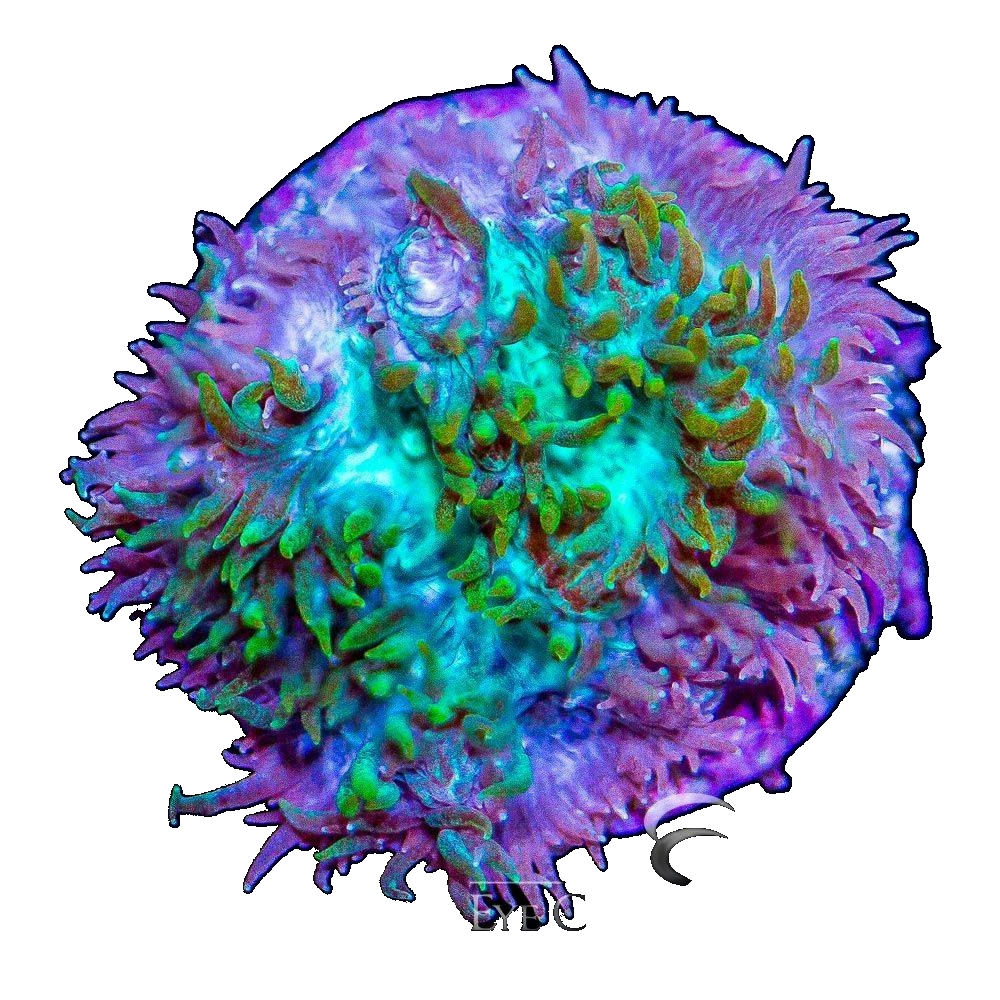
The ECC Hybrid Hydnophora is a tricolor coral with teal, purple, and gold-green tentacles depending on lighting. It forms dense branches with minimal encrusting and is classified as SPS but behaves like LPS; it needs medium light (150-250 PAR) with moderate flow and must be placed away from other corals due to its aggressive stinging behavior.
Quick facts
Handling caution: Sharp, tooth-like skeletal projections and potent sweeper tentacles that can sting handlers and neighboring corals
Identity
- Also known as
- ECC Hydnophora; Hybrid Horn Coral
- Synonyms
- Hydnophora rigida; Hydnophora exesa
- Environment
- Saltwater
- Native to
- Indo-Pacific, Madagascar, Indonesia, Philippines, Fiji, Solomon Islands, Samoa, New Caledonia, Great Barrier Reef
- Habitat
- Reef slopes and lagoons at depths of roughly 3 to 100 feet, often on exposed reef flats with strong light and flow
- Sourcing
- Aquacultured
- Conservation
- Not Evaluated
Care
- Care level
- Moderate
- Coral type
- LPS
- Temperament
- Aggressive
- Growth form
- Branching
- Adult size
- 2 – 12 in (5.1 – 30 cm)
- Spread
- 16 in (41 cm)
- Growth rate
- Fast
- Placement
- Middle, High
Water
- Temperature
- 75 – 80 °F (24 – 27 °C)
- pH
- 8.1 – 8.4
- dKH
- 8 – 11 dKH
- Salinity
- 1.024 – 1.026 SG
- PAR
- 150 – 300 PAR
- Flow
- Moderate-High
- Light
- Medium
Reef care
- Nutrient preference
- Medium
- Alk/Ca uptake
- Medium
- Target feeding
- Beneficial
- Give it room
- 8 in (20 cm)
- Colors
- Green, Teal, Purple, Yellow, Brown, Cream, Multicolor
Feeding & breeding
- Diet
- Photosynthetic
- Foods
- Zooplankton, Coral food, Frozen
- Propagation
- Fragging
Something wrong or missing? Submit a correction
Care guide
Overview
Suited to reef keepers with a spare isolated rock or frag plug rather than a crowded aquascape, this hybrid displays teal, purple, and gold-green tentacle tips that shift with lighting angle. Branches form dense, minimally encrusting colonies under medium PAR and moderate flow. Its aggressive sweeper tentacles demand generous clearance from tankmates.
Care
Hydnophora is a fast-growing coral that sits between LPS and SPS in terms of husbandry demands, tolerating a fairly wide range of established reef tank parameters as long as alkalinity and calcium stay stable. It does best under medium to high light and moderate to strong, turbulent flow that keeps detritus from settling among the branch nodules. The single most important care consideration is spacing, since this genus is among the most aggressive corals commonly kept and will damage anything within reach of its sweeper tentacles.
Placement & acclimation
Mount fragments securely on rock or a frag plug where strong, random flow will reach all sides of the colony. Acclimate to aquarium lighting gradually, starting lower or under a screen and increasing intensity over one to two weeks. Choose an isolated placement point with generous clearance on all sides before final positioning, since relocating an established colony can stress it.
Feeding
Most energy comes from the zooxanthellae housed in its tissue, so strong lighting alone will sustain growth. Sweeper and feeding tentacles extend mainly after dark, so offering finely minced mysis, brine shrimp nauplii, rotifers, or powdered coral foods once or twice a week during lights-out hours can boost coloration and growth rate. Target feeding is optional rather than required.
Neighbors
Keep at least 6 to 10 inches of clear space between Hydnophora and any other sessile invertebrate, since its long sweeper tentacles extend at night and can kill nearby coral tissue. It is generally considered reef safe only with this caution, and fish and mobile invertebrates are not bothered by it. An isolated rock or frag plug away from the main aquascape works well for containing its reach as it grows.
Fragging
Colonies frag readily due to their fast growth, though the dense calcareous skeleton typically requires a bandsaw or bone cutters rather than simple snips. Cut branch sections can be mounted directly onto plugs or rubble, and cutting tools should be handled carefully as the horn-like projections are sharp.
Pests & problems
Rapid swings in alkalinity or temperature are the most common trigger for tissue recession (STN/RTN) in this genus, so stability matters more than hitting exact target numbers. Pale or bleached tissue usually indicates excess light or insufficient nutrients and can often be corrected by dimming lighting or raising nutrient levels slightly. New colonies should be light-acclimated gradually over one to two weeks to avoid stress-related tissue loss.
Sources
More Hydnophora corals
Something wrong or missing? Submit a correction
In the community
Popular tanks using ECC Hybrid Hydnophora
No public tanks are showcasing ECC Hybrid Hydnophora yet.