
Marine Invertebrates
Blood Red Fire Shrimp
Lysmata debeliusLysmatidaeCleaner shrimp
Price: $42.30 USD
Add from My tanks →1 photos
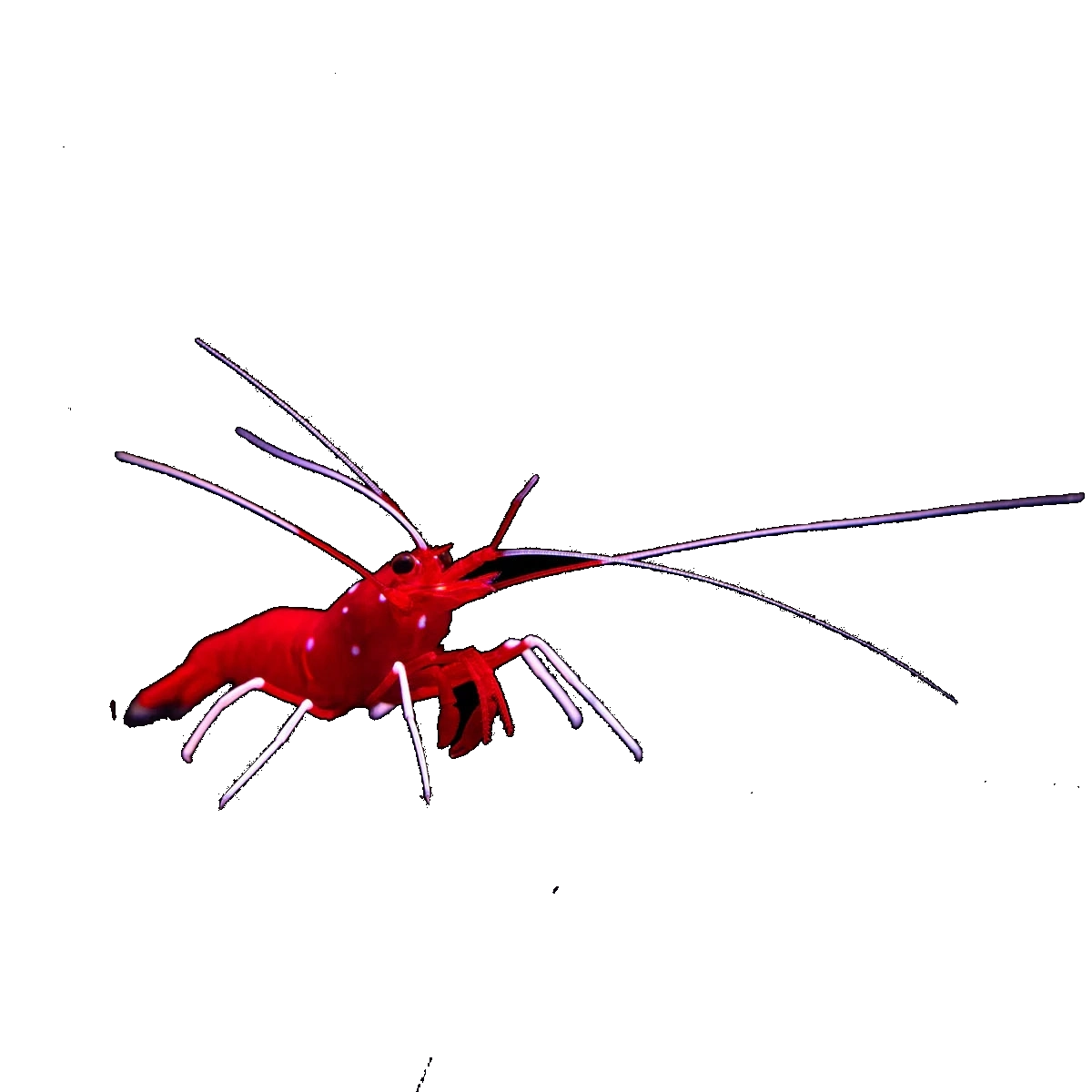
The Blood Red Fire Shrimp (Lysmata debelius), also called the Fire Shrimp or Scarlet Cleaner Shrimp, has striking blood-red coloration with brilliant white spots and long white antennae. It is most active at night, prefers caves and dim lighting, and sets up cleaning stations to remove dead tissue and parasites from fish. It needs iodine for molting and cannot tolerate copper or high nitrates.
Quick facts
Identity
- Also known as
- Fire Shrimp; Blood Shrimp; Scarlet Cleaner Shrimp; Blood Fire Shrimp; Cherry Red Shrimp
- Environment
- Saltwater
- Native to
- Indonesia, Philippines, Sri Lanka, Indo-Pacific
- Habitat
- Rocky reef crevices, caves, and overhangs at depths of roughly 65 to 100 feet, sheltering from direct light during the day
- Sourcing
- Wild-caught
- Conservation
- Not Evaluated
Care
- Care level
- Easy
- Temperament
- Peaceful
- Adult size
- 1 – 2.5 in (2.5 – 6.4 cm)
- Lifespan
- 2 – 3 yrs
- Min tank
- 30 gal (114 L)
- Growth rate
- Moderate
- Placement
- Bottom, Rock & glass
Water
- Temperature
- 75 – 79 °F (24 – 26 °C)
- pH
- 8.1 – 8.4
- dKH
- 8 – 10 dKH
- Salinity
- 1.023 – 1.026 SG
- Flow
- Moderate
Behavior & compatibility
- Social
- Pair
- Aggression to own kind
- Moderate
- Active
- Night
- Reef safe
- Yes
- Invert safe
- With caution
- Shrimp safe
- With caution
- Clean-up role
- Leftover food, Detritus, Pest control
- Population boom risk
- Low
Feeding & breeding
- Diet
- Carnivore
- Foods
- Flakes, Pellets, Frozen, Freeze-dried, Live
- Breeding type
- Broadcast spawner
- Breeding difficulty
- Difficult
- Sexing
- Simultaneous hermaphrodite; any two mature individuals can pair and breed, so external sexing is not applicable
- Target feeding
- Beneficial
Something wrong or missing? Submit a correction
Care guide
Overview
Reaching a mature length of about two and a half inches, this deep red shrimp is patterned with white spots and trails a pair of long white antennae that betray its presence in an otherwise dark crevice. It shelters in caves through daylight, emerging at dusk to run cleaning stations for passing fish. Best suited to a mature reef with stable chemistry and no trace of copper.
Care
The fire shrimp does best in a mature, fully cycled tank with plenty of live rock offering caves and overhangs, since it is shy and spends most daylight hours tucked away with only its long white antennae showing. It becomes more visible after dark or once it settles in and recognizes feeding routines. Stable water quality matters more than exact parameter precision, and copper-based medications must never be used anywhere near it, as even trace amounts are lethal.
Feeding
As a carnivorous scavenger, it accepts most meaty aquarium foods including frozen mysis, flake, pellet, and freeze-dried preparations, and will also pick at leftover fish food and detritus around the rockwork. Regular water changes help replenish iodine, which the shrimp needs for successful molting. It will also actively clean fish that present themselves, picking off dead skin, scales, and external parasites.
Tank mates
Generally peaceful toward fish and most reef inhabitants, often forming a cleaning relationship with tankmates that solicit its attention. A single mated pair usually coexists well, but unrelated conspecifics may be chased off unless the aquarium is large with abundant hiding spots. A minority of individuals have been reported picking at LPS or SPS polyps at night, so newly added specimens are worth monitoring in coral-dense systems.
Breeding
Being simultaneous hermaphrodites, any two adults can pair and reproduce without needing distinct sexes. After mating, the female carries a saddle of eggs under her abdomen for roughly two weeks before releasing free-swimming larvae. The larvae pass through several planktonic stages over a couple of months and are rarely raised successfully in home aquariums, so most specimens in the trade are wild-caught or produced by specialized breeders.
Health
Fire shrimp are notably sensitive to ammonia, nitrite, and elevated nitrate, so they should only go into an established tank with stable water chemistry. Incomplete molts can occur if iodine or trace element levels run low, so periodic dosing or regular water changes are recommended. Slow, careful acclimation is important since sudden parameter swings can cause fatal shock.
Sources
More Cleaner shrimp
Something wrong or missing? Submit a correction
In the community
Popular tanks using Blood Red Fire Shrimp
No public tanks are showcasing Blood Red Fire Shrimp yet.