
LPS Corals
Black Torch 6-8 Heads
Euphyllia glabrescensEuphyllidaeTorch corals
Price: $125.49 USD
Add from My tanks →1 photos
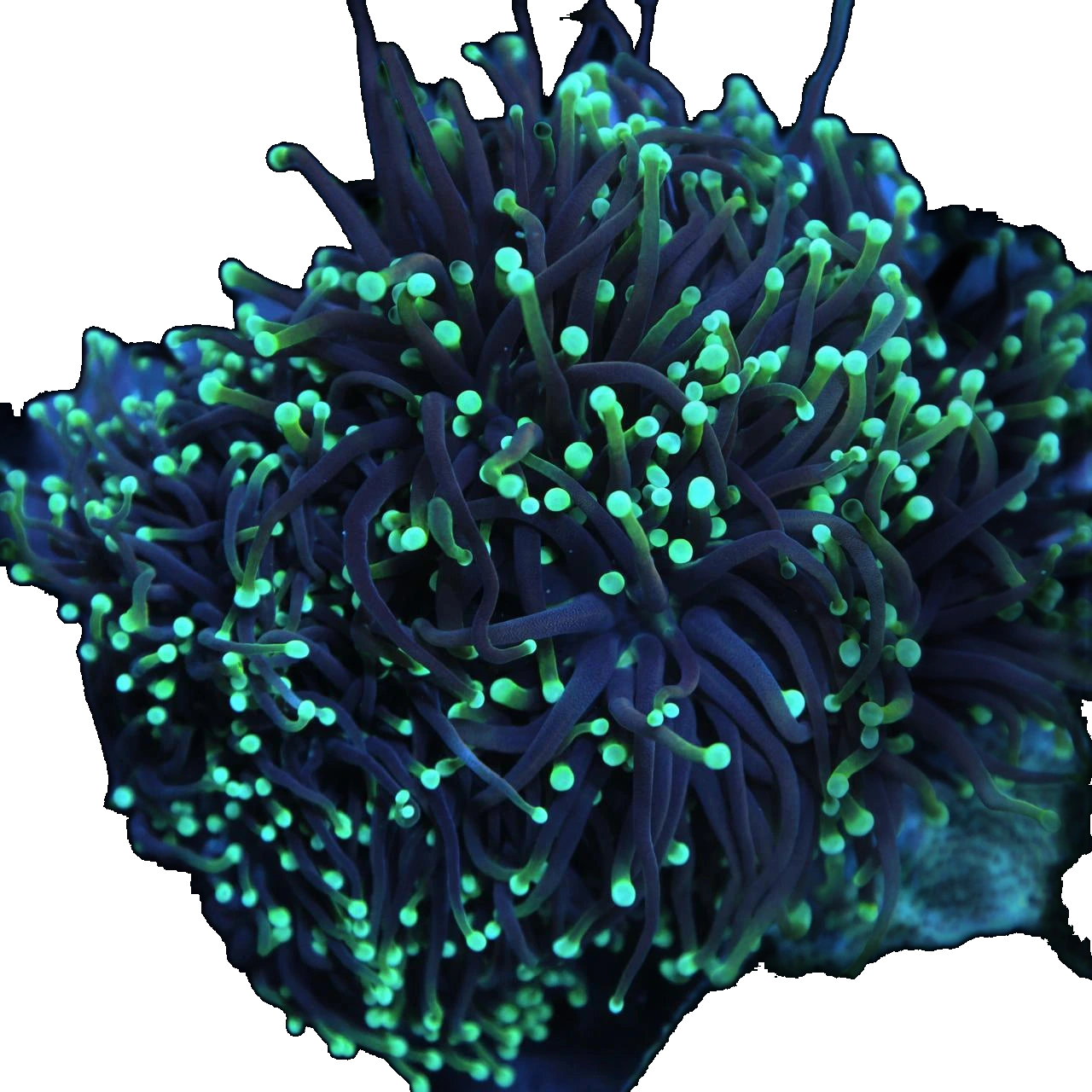
The Euphyllia Torch Coral is a large polyp stony (LPS) coral, also called the Trumpet or Pom-Pom Coral, with long flowing polyps ending in single rounded tips, often brown or green with yellow tips that glow under actinic lighting. It is moderately difficult to maintain, needing moderate lighting, moderate water movement, excellent water quality, calcium and trace elements, weekly micro-plankton or brine shrimp feedings, and plenty of space since its night-time sweeper tentacles sting neighboring corals.
Quick facts
Handling caution: Long sweeper tentacles deliver a potent sting; can cause skin irritation on contact with humans
Identity
- Also known as
- Trumpet Coral; Pom-Pom Coral; Euphyllia Torch
- Synonyms
- Euphyllia glabrescens fimbriata
- Environment
- Saltwater
- Native to
- Indo-Pacific, Red Sea, Australia, Indonesia, Micronesia
- Habitat
- Reef slopes and lagoons in the Indo-Pacific, typically on sandy or rubble substrate in areas with moderate light and water movement
- Sourcing
- Both
- Conservation
- Not Evaluated
Care
- Care level
- Moderate
- Coral type
- LPS
- Temperament
- Aggressive
- Growth form
- Branching
- Adult size
- 1 – 4 in (2.5 – 10 cm)
- Spread
- 12 in (30 cm)
- Growth rate
- Moderate
- Placement
- Low, Middle
Water
- Temperature
- 75 – 80 °F (24 – 27 °C)
- pH
- 8.0 – 8.4
- dKH
- 8 – 9.5 dKH
- Salinity
- 1.024 – 1.026 SG
- PAR
- 80 – 150 PAR
- Flow
- Low-Moderate
- Light
- Medium
Reef care
- Nutrient preference
- Medium
- Alk/Ca uptake
- Medium
- Target feeding
- Beneficial
- Give it room
- 6 in (15 cm)
- Colors
- Green, Yellow, Orange, Purple, Multicolor
Feeding & breeding
- Diet
- Photosynthetic
- Foods
- Frozen, Zooplankton, Coral food, Target-fed
- Propagation
- Fragging
Something wrong or missing? Submit a correction
Care guide
Overview
Long flowing polyps end in single rounded tips, typically brown or green bodies with yellow-tipped tentacles that fluoresce under actinic light across this 6-8 head colony. Moderate lighting, moderate flow, and stable calcium and trace elements support steady growth, with weekly meaty feedings encouraged. Sweeper tentacles reach out at night, so surrounding corals need room to avoid contact.
Care
Torch coral does best under moderate lighting, roughly 80 to 150 PAR, since intense light can cause bleaching or tissue retraction, especially in newly acquired colonies. Flow should be gentle and indirect, enough to make the tentacles sway without pinning them flat against the skeleton. Mount it securely on rockwork rather than loose rubble, and keep parameters stable since sudden swings in alkalinity or temperature are a common cause of decline.
Placement & acclimation
Acclimate gradually to aquarium lighting by starting in a lower-light position or using a shade screen for the first one to two weeks. Mount on a stable rock ledge or frag plug where tentacles will not rub against rock or sand, and drip acclimate over thirty to forty-five minutes before introduction. Leave generous open space around the placement site to accommodate both its sting radius and future branching growth.
Feeding
Most of its energy comes from photosynthetic zooxanthellae, but growth and coloration improve with occasional target feeding. Offer small meaty foods such as mysis, chopped clam, or enriched brine shrimp once or twice a week with the flow paused, then restore circulation after ten to fifteen minutes. Overfeeding or feeding whole shrimp can foul water quality and stress the tissue, so keep portions small.
Neighbors
Give this coral at least six to ten inches of clearance from any neighbor since its sweeper tentacles extend well beyond the base and sting aggressively, particularly at night. It can be kept in proximity to other torch heads with reasonable success, though occasional aggression between colonies still occurs. Avoid placing it near slow-growing or sessile corals that cannot be moved if contact becomes a problem.
Fragging
Colonies grow by branching, with individual heads periodically splitting into two, so mature specimens can be fragged by cutting the skeleton between heads with a coral saw or bone shears. Allow cut fragments to heal in low flow and stable conditions before mounting them separately. Handle with gloves during fragging since the sting can cause skin irritation.
Pests & problems
Brown jelly infection and flatworm infestations are the most common problems, often triggered by physical damage or poor water flow around the base. Bleaching can result from excess light or very low nutrient levels, while polyp recession is frequently linked to unstable alkalinity or strong direct current. New arrivals should be dipped and quarantined, and any affected heads should be fragged away promptly to stop infection from spreading.
Sources
Varieties in the catalog
Something wrong or missing? Submit a correction
In the community
Popular tanks using Black Torch 6-8 Heads
No public tanks are showcasing Black Torch 6-8 Heads yet.