
Marine Invertebrates
Banded Coral Shrimp
Stenopus hispidusStenopodidaeBoxer shrimp
Price: $28.20 USD
Add from My tanks →1 photos
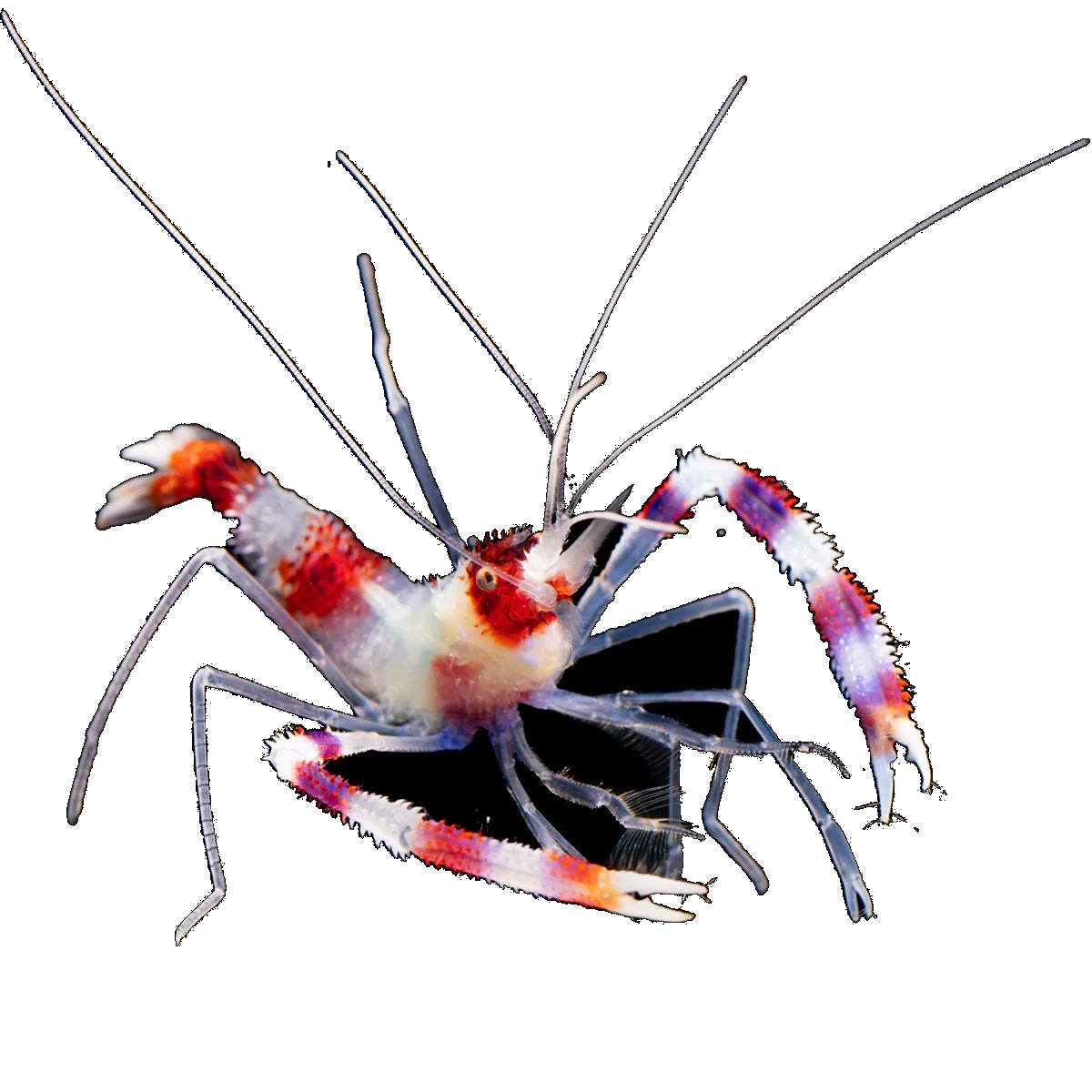
The Banded Coral Shrimp (Stenopus hispidus) has striking red and white bands, long pinchers often held erect like a boxer, extra long white antennae, and a prickly body texture, actively scampering in search of food. House individually or as a true mated pair as it is aggressive toward other banded coral shrimp and smaller shrimp, provide room so its antennae don't touch corals or anemones, acclimate slowly, maintain proper iodine for molting, intolerant of high nitrates and copper; it accepts most flaked and frozen foods.
Quick facts
Handling caution: Large pincers can pinch firmly if handled carelessly
Identity
- Also known as
- Banded Boxer Shrimp; Barber Pole Shrimp; Candy Cane Shrimp
- Synonyms
- Palaemon hispidus
- Environment
- Saltwater
- Native to
- Indo-Pacific, Caribbean Sea, Red Sea, circumtropical
- Habitat
- Coral reefs and rocky reef crevices in shallow tropical and subtropical waters, usually found hanging upside down in caves or under ledges with only antennae protruding
- Sourcing
- Wild-caught
- Conservation
- Not Evaluated
Care
- Care level
- Easy
- Temperament
- Semi-Aggressive
- Adult size
- 1.5 – 3 in (3.8 – 7.6 cm)
- Lifespan
- 3 – 5 yrs
- Min tank
- 30 gal (114 L)
- Growth rate
- Moderate
- Placement
- Bottom
Water
- Temperature
- 72 – 78 °F (22 – 26 °C)
- pH
- 8.1 – 8.4
- dKH
- 8 – 12 dKH
- Salinity
- 1.023 – 1.025 SG
- Flow
- Moderate
Behavior & compatibility
- Social
- Pair
- Aggression to own kind
- High
- Active
- Night
- Reef safe
- With caution
- Invert safe
- With caution
- Shrimp safe
- No
- Clean-up role
- Leftover food, Carrion, Detritus
- Population boom risk
- Low
Feeding & breeding
- Diet
- Carnivore
- Foods
- Pellets, Frozen, Freeze-dried, Flakes
- Breeding type
- Broadcast spawner
- Breeding difficulty
- Difficult
- Sexing
- Females are typically larger and rounder-bodied than males, especially noticeable in mated pairs; males are smaller and more slender
- Target feeding
- Beneficial
Something wrong or missing? Submit a correction
Care guide
Overview
Reaching about three inches at most, this shrimp shows alternating red and white bands across its prickly-textured body, with oversized white antennae and pincers held forward like raised fists. It hides in reef crevices by day and forages at night, best kept singly or as a true pair since it fights its own kind and smaller shrimp. Stable parameters and copper-free water are essential around molting.
Care
This species does best in a mature reef tank with plenty of rockwork offering tight crevices and overhangs to retreat into during the day, becoming more active around dusk and at night. Stable water parameters matter more than chasing exact numbers, and sudden swings in salinity, pH, or temperature should be avoided, particularly around molting when the exoskeleton is soft and the animal is vulnerable. Moderate flow with good oxygenation suits it well, but strong current directed at its preferred hiding spot should be avoided. Only one individual should be kept per tank unless a confirmed male-female pair is established, since conspecifics fight aggressively.
Feeding
A scavenger by nature, this shrimp readily accepts sinking pellets, frozen meaty foods, and finely chopped seafood, along with any uneaten flake food that reaches the substrate. Feeding at night or dusk, when it naturally emerges to forage, tends to produce the best results. It is not a picky eater and will scavenge leftover food from the tank floor and rockwork rather than relying on target feeding.
Tank mates
Territorial toward its own kind, this shrimp will fight other coral banded shrimp unless housed as an established mated pair, and it can also harass or kill smaller ornamental shrimp such as peppermint or cleaner shrimp. It generally leaves fish, corals, and larger invertebrates alone, though it may walk over coral and anemone tissue while foraging, so enough space should be given that its long antennae do not brush against neighboring polyps. Avoid housing it with aggressive predators like triggers, lionfish, or large wrasses that may prey on it, especially soon after a molt.
Breeding
Coral banded shrimp form long-term monogamous pairs and will readily produce eggs when a true male-female pair is kept together, with the female carrying visible eggs under her abdomen. Successful rearing in the home aquarium is uncommon because the free-swimming larvae are extremely small and typically get pulled into filtration or removed by protein skimmers before completing their planktonic stage. Specialized larval rearing setups are needed for any real chance of raising offspring to juvenile stage.
Health
Most health problems trace back to unstable salinity or temperature, elevated nitrate, or exposure to copper-based medications, all of which this species tolerates poorly. During and shortly after molting it is soft-bodied and prone to hiding for a day or two, so failed molts, lethargy, or missing limbs should be watched for as signs of stress. Copper treatments must never be used in any tank housing this or other invertebrates.
Sources
More Boxer shrimp
Something wrong or missing? Submit a correction
In the community
Popular tanks using Banded Coral Shrimp
No public tanks are showcasing Banded Coral Shrimp yet.