
Marine Fish
Two Spot Bristletooth Tang
Ctenochaetus binotatusAcanthuridaeTangs
Price: $42.30 USD
Add from My tanks →1 photos
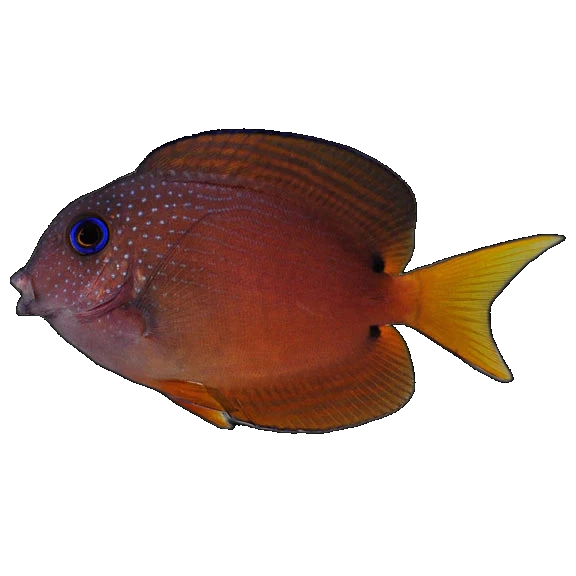
The Two Spot Bristletooth Tang (Ctenochaetus binotatus) has a brown-to-orange body decorated with fine blue lines and two distinct black spots at the bases of the dorsal and anal fins. Its bristle-like teeth scrape algae and biofilm from rocks, making it an excellent grazer, and it needs a minimum 265-liter tank with plenty of live rock, moderate care, and an herbivorous diet.
Quick facts
Handling caution: Sharp caudal peduncle scalpel spine can cause lacerations when handled
Identity
- Also known as
- Twospot Surgeonfish; Twospot Tang; Two-spot Bristletooth
- Synonyms
- Ctenochaetus cyanocheilus (misapplied in some older trade references)
- Environment
- Saltwater
- Native to
- Indo-Pacific: East Africa, Red Sea, Mascarene Islands, Indonesia, Australia, Central and West Pacific, southern Japan
- Habitat
- Outer reef slopes and deep lagoons with mixed coral rubble, from about 15 to 300 feet, grazing detritus and microalgae off rock and rubble.
- Sourcing
- Wild-caught
- Conservation
- Not Evaluated
Care
- Care level
- Moderate
- Temperament
- Semi-Aggressive
- Adult size
- 3 – 8.5 in (7.6 – 22 cm)
- Lifespan
- 10 – 20 yrs
- Min tank
- 75 gal (284 L)
- Growth rate
- Moderate
- Placement
- Rock & glass
Water
- Temperature
- 72 – 82 °F (22 – 28 °C)
- pH
- 8.1 – 8.4
- dKH
- 8 – 12 dKH
- Salinity
- 1.020 – 1.025 SG
- Flow
- Moderate-High
Behavior & compatibility
- Social
- Solitary
- Aggression to own kind
- High
- Active
- Daytime
- Reef safe
- Yes
- Shrimp safe
- Yes
Feeding & breeding
- Diet
- Herbivore
- Foods
- Flakes, Pellets, Frozen, Algae, Vegetables, Freeze-dried
- Breeding type
- Broadcast spawner
- Breeding difficulty
- Not bred in captivity
- Sexing
- No reliable external sexual dimorphism; visual sexing is essentially impossible in this species.
Something wrong or missing? Submit a correction
Care guide
Overview
A brown-to-orange body traced with fine blue lines identifies this fish, along with the twin black spots marking the dorsal and anal fin bases that give it its common name. It grazes constantly across live rock and glass, needing mature, algae-rich surfaces to stay healthy. Best housed alone among tangs, it suits a spacious reef system with strong flow and a secure lid.
Care
A well matured system with abundant algae-covered live rock is essential, since this tang spends most of its time grazing biofilm and diatoms off rock and glass surfaces. It does best with strong, well-oxygenated water flow and plenty of open swimming space, as it is a fairly active swimmer despite being smaller and calmer than many other surgeonfish. A tight-fitting lid is recommended, since like most tangs it can startle and jump. Ich and other parasitic outbreaks are more common if the fish is stressed by cramped quarters or poor water quality.
Feeding
Most of its nutrition should come from grazing on natural algae and biofilm in the tank, supplemented with dried nori, spirulina flakes, and algae-based pellets offered several times a week. Occasional frozen mysis or brine shrimp can round out the diet, but vegetable matter should remain the bulk of what it eats. Feeding it too little algae-based food can weaken its immune response and increase aggression toward other tangs.
Tank mates
Generally peaceful toward non-tang species such as clownfish, gobies, blennies, and smaller angelfish, but it can be territorial and aggressive toward other tangs, especially other Ctenochaetus. Best kept as the only bristletooth in the tank unless the aquarium is very large and all tangs are introduced simultaneously. It rarely bothers corals or sessile invertebrates, making it a solid reef tank candidate as long as it has enough algae to graze.
Breeding
Like other surgeonfish, it is a broadcast spawner that releases eggs and sperm into open water, a behavior essentially impossible to replicate in home aquariums. Pairing and sexing are not practical for hobbyists, and there are no verified captive breeding accounts for this species. All specimens in the trade are wild-caught.
Health
Newly imported specimens are prone to marine ich and other parasitic infections, particularly if stressed during shipping or held in tanks lacking sufficient grazing surface. A slow acclimation and a quarantine period are advisable before introducing it to a display tank. Maintaining stable water chemistry and consistent access to algae helps prevent the emaciation sometimes seen in tangs deprived of a proper herbivorous diet.
Sources
Something wrong or missing? Submit a correction
In the community
Popular tanks using Two Spot Bristletooth Tang
No public tanks are showcasing Two Spot Bristletooth Tang yet.