
Marine Invertebrates
Sexy Anemone Shrimp
Thor amboinensisThoridaeAnemone shrimp
Price: $35.25 USD
Add from My tanks →1 photos
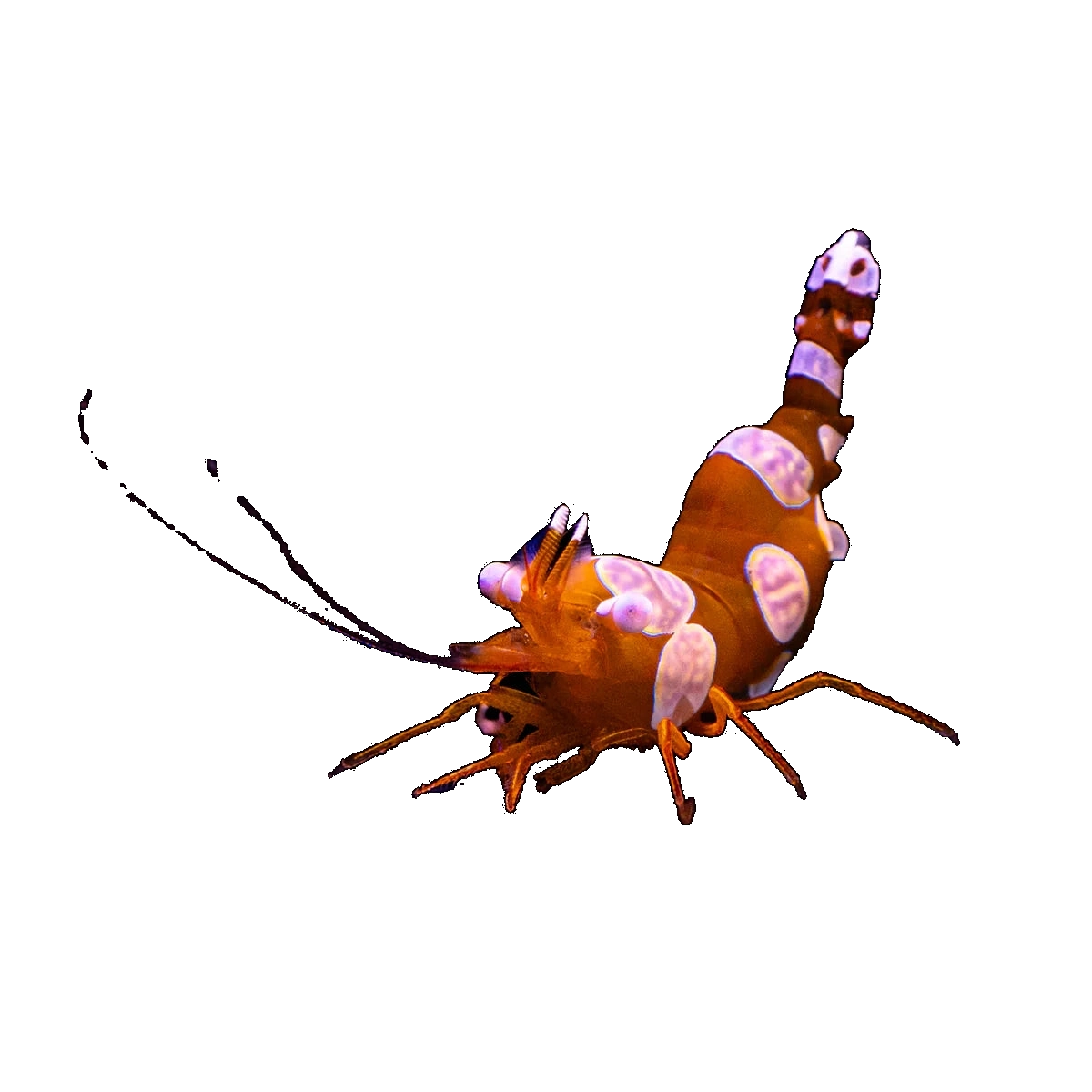
The Sexy Anemone Shrimp (Thor amboinensis) is named for swaying its abdomen back and forth with exotic flair while walking; it has a reddish brown body dotted with brilliant white spots and lives amongst anemone tentacles in Indo-Pacific reefs. Keep in small groups, feed a varied diet of plankton and flaked, frozen, and meaty foods, avoid predatory fish; it molts about once a month, grows to about 1.5 inches, needs slow acclimation and sufficient iodine for proper molting, and cannot tolerate high nitrates or copper.
Quick facts
Identity
- Also known as
- Sexy Shrimp; Anemone Shrimp; Squat Shrimp; Squat Anemone Shrimp; High-tailed Shrimp; Humpback Shrimp; Dancing Shrimp; Pikmin Shrimp
- Environment
- Saltwater
- Native to
- Indo-Pacific, Red Sea, Caribbean Sea, Gulf of Mexico
- Habitat
- Shallow coral reefs and lagoons, 0.5-20 m depth, living among the tentacles of sea anemones, mushroom corals, or large-polyp stony corals with gentle to moderate water movement.
- Sourcing
- Wild-caught
- Conservation
- Not Evaluated
Care
- Care level
- Easy
- Temperament
- Peaceful
- Adult size
- 0.5 – 1 in (1.3 – 2.5 cm)
- Lifespan
- 1 – 2 yrs
- Min tank
- 10 gal (38 L)
- Placement
- Rock & glass
Water
- Temperature
- 72 – 81 °F (22 – 27 °C)
- pH
- 8.1 – 8.4
- dKH
- 8 – 12 dKH
- Salinity
- 1.023 – 1.026 SG
- Flow
- Low-Moderate
Behavior & compatibility
- Social
- Group · groups of 3+
- Aggression to own kind
- Low
- Active
- Daytime
- Reef safe
- Yes
- Invert safe
- Yes
- Shrimp safe
- Yes
- Clean-up role
- Detritus, Leftover food
- Population boom risk
- Low
Feeding & breeding
- Diet
- Omnivore
- Foods
- Frozen, Freeze-dried, Zooplankton, Coral food
- Breeding type
- Broadcast spawner
- Breeding difficulty
- Difficult
- Sexing
- No obvious external differences between sexes; some evidence of protandrous hermaphroditism where males may change to females with age. Females are typically slightly larger and carry eggs beneath the abdomen when berried.
- Target feeding
- Beneficial
Something wrong or missing? Submit a correction
Care guide
Overview
Sways its arched abdomen side to side while perched among anemone tentacles or coral polyps, a rocking motion that gives this shrimp its name. The reddish-brown body is dotted with bright white spots, and it stays tiny, best kept in a group of three or more within a mature, copper-free nano reef.
Care
This tiny shrimp does best in a mature nano reef with an established host such as a bubble tip anemone, Stichodactyla, Euphyllia, or a Zoanthus colony, though it will also survive without one by hiding among rockwork. Water quality should be stable, with low nitrates and no measurable copper, since this species is highly copper-sensitive. Keep several individuals together, as they are social and communicate through the characteristic swaying, tail-arched dance that gives them their common name.
Feeding
In the wild these shrimp graze on anemone or coral mucus and trapped plankton, but in captivity they readily scavenge leftover meaty foods such as mysis, brine shrimp, and cyclopeeze that drift past their host. Target feeding with small frozen or powdered coral foods helps ensure they get enough to eat in a tank with more competitive feeders. No dedicated feeding regimen is strictly necessary if a host anemone or coral is present, since they will pick at its mucus and captured food particles.
Tank mates
Best paired with peaceful reef fish like gobies, small clownfish, and blennies; avoid wrasses, hawkfish, dottybacks, pufferfish, and other predatory or crustacean-eating fish that will pick them off quickly. They coexist well with corals and will often take up residence on Euphyllia or mushroom corals if no anemone is offered. Larger, aggressive crabs or hermits sharing the same rockwork can also pose a threat to such a small, soft-bodied shrimp.
Breeding
Females carry fertilized eggs under the abdomen until they hatch into free-swimming zoea larvae, which pass through several planktonic stages before settling near a host anemone. Rearing the larvae in the display tank is very difficult since they are easily lost to filtration or predation, and successful captive rearing typically requires a separate larval-rearing vessel with rotifers or similar first foods. Some hobbyists have reported unplanned successful breeding in mature systems with plentiful microfauna, though deliberate captive breeding remains rare.
Health
Molting occurs roughly monthly and depends on adequate iodine availability in the water, so dosing or water changes that maintain trace iodine levels support healthy molts. Sudden swings in salinity or the presence of even trace copper (from medications or old equipment) can be fatal to this species. A shrimp that stops molting or shows a stuck exoskeleton may be suffering from an iodine or trace element deficiency.
Sources
Something wrong or missing? Submit a correction
In the community
Popular tanks using Sexy Anemone Shrimp
No public tanks are showcasing Sexy Anemone Shrimp yet.